Ontario dental practices should target procedure-plus-location keywords, not generic head terms. ‘Dental implants North York’ converts; ‘dentist’ does not. This guide gives Dentist Spark’s complete keyword list for Ontario dental clinics — organised by intent, service, and search volume — so you can build a dental SEO strategy that books patients, not just ranks pages.
Key Takeaways
Key Takeaways
✓ Toronto has over 3,500 registered dental practices competing for the same local search results — generic keywords like ‘toronto dentist’ are dominated by high-authority directories, not individual clinics.
✓ Procedure-plus-location keywords convert at 3–5x the rate of generic terms — ‘dental implants North York’ outperforms ‘dentist near me’ for patient acquisition.
✓ The Google Maps Pack receives the majority of clicks for local dental searches — a dental clinic not appearing there misses the highest-traffic position available without paid spend.
✓ CDCP-specific search terms — ‘Canadian Dental Care Plan dentist near me,’ ‘CDCP accepted dentist Ontario’ — are undercompetitive and growing rapidly as 2.7 million Canadians now hold active coverage.
✓ A structured dental SEO strategy targeting the right keywords compounds over 12–24 months — practices that invested two years ago now dominate the search results Ontario patients see first.

The Short Version
Ontario dental clinics waste SEO budgets targeting high-volume keywords they cannot realistically rank for. ‘Toronto dentist’ is searched 8,100 times monthly — and dominated by Healthline, RateMDs, and dental directories with decade-old domain authority. A dental clinic in North York will never outrank those domains on that term alone. The dental SEO keywords that actually produce new patients are procedure-specific, neighbourhood-specific, and intent-matched to patients who are close to booking.
The right dental SEO strategy for Ontario practices targets three keyword tiers simultaneously: high-intent emergency and urgent care terms including emergency dentistry, procedure-plus-location combinations, and long-tail informational queries that build authority and capture patients in the research phase. Good oral health content that answers patient questions — free services available under CDCP, private insurance direct billing, treatment plan expectations — serves as the authority foundation that makes all three tiers more effective. All three tiers feed the same outcome: more patients reaching your booking form.
This is not a complete tutorial on search engine optimization. For how these keywords connect to Google Business Profile, dental website structure, and content strategy, read our guide to dental SEO services for Ontario practices — which covers the full process from keyword research through to performance data reporting.
The Detail: Ontario Dental SEO Keywords by Intent and Volume
The following keyword tiers represent the Ontario dental search landscape as of 2025, based on Google Search Console data, Ahrefs keyword research, and search terms analysis across Toronto dental markets. Monthly volumes are Canadian estimates; actual search terms vary by neighbourhood, season, and CDCP rollout phase.
| Keyword | Monthly Volume (CA Est.) | Keyword Intent | Competition | Priority Tier |
| dentist near me | 22,000+ | High — ready to book | Very high — directories dominate | Tier 2 — GBP, not page |
| toronto dentist | 8,100 | High — comparing options | Very high — directories + aggregators | Tier 2 — GBP, not page |
| dental emergency toronto | 1,600 | Ultra-high — in pain now | Medium — winnable for clinics | Tier 1 — Emergency page |
| emergency dentist north york | 480 | Ultra-high — immediate | Low — highly targetable | Tier 1 — Emergency page |
| dental implants toronto | 1,300 | High — evaluating options | High — can rank with authority | Tier 1 — Service page |
| dental implants north york | 320 | High — location-specific | Low — winnable | Tier 1 — Service page |
| teeth whitening toronto | 880 | Medium — cosmetic intent | Medium | Tier 1 — Service page |
| invisalign toronto | 1,900 | High — procedure decided | High | Tier 1 — Service page |
| root canal toronto | 590 | High — in pain, needs care | Medium | Tier 1 — Service page |
| wisdom teeth removal toronto | 720 | High — pre-scheduled need | Medium | Tier 1 — Service page |
| affordable dental care ontario | 390 | High — cost-motivated | Low — undercompetitive | Tier 1 — CDCP page |
| canadian dental care plan dentist near me | 260 | High — insurance-motivated | Very low — new term | Tier 1 — CDCP page |
| cdcp accepted dentist toronto | 140 | High — plan-specific | Very low — high opportunity | Tier 1 — CDCP page |
| free dental care ontario | 480 | High — eligibility-motivated | Low | Tier 1 — CDCP page |
| family dentist north york | 390 | Medium — relationship-building | Low — targetable | Tier 1 — Local page |
| cosmetic dentist toronto | 720 | High — elective, high value | High | Tier 2 — Content + GBP |
| how much does a root canal cost in ontario | 210 | Informational — pre-decision | Low | Tier 2 — Blog/FAQ |
| dental implants cost ontario | 480 | Informational — evaluating | Low | Tier 2 — Blog/FAQ |
| do i qualify for cdcp canada | 320 | Informational — eligibility | Very low | Tier 3 — Content |
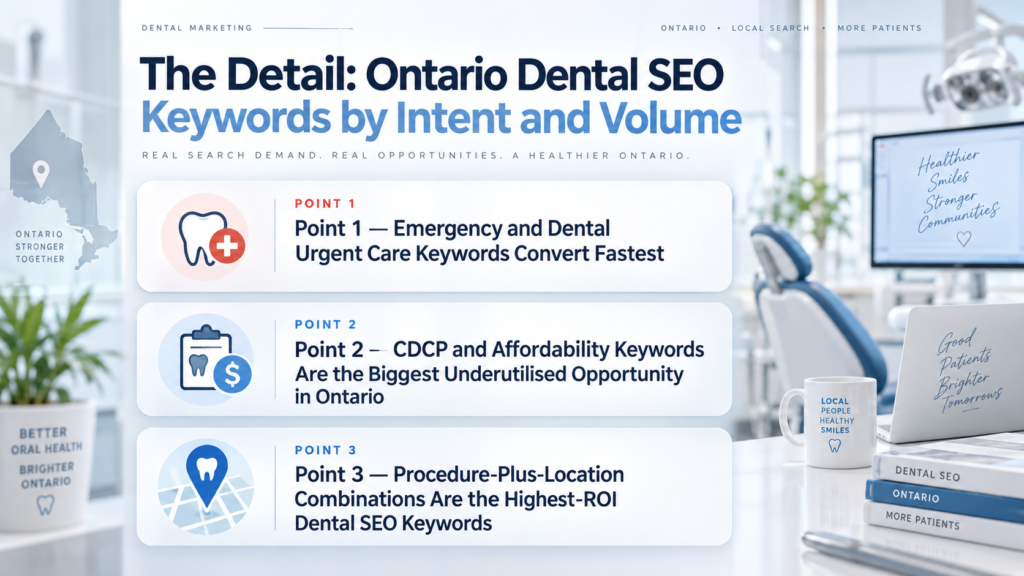
Point 1 — Emergency and Dental Urgent Care Keywords Convert Fastest
Emergency dental keywords — ‘dental emergency toronto,’ ’emergency dentist north york,’ ‘urgent dental care near me,’ ‘tooth decay pain same day appointment’ — convert at the highest rate of any dental search term category. A patient with dental pain does not comparison shop. They call the first practice that appears credible and available. Emergency dental searches have an ultra-high conversion rate because the patient’s need is immediate — ranking at position 3 or 4 still generates same-day appointment bookings.
For dental practices in North York, Etobicoke, Scarborough, and surrounding Toronto municipalities, neighbourhood-level emergency keywords are winnable — unlike city-wide terms. ‘Emergency dentist North York’ has approximately 480 monthly searches in Canada and low keyword competition from other dental clinics (as opposed to directories). A dental clinic with a properly optimised emergency service page, Google Business Profile, and consistent local citations can rank in the top three positions for this term within four to six months of a focused dental SEO effort.
Emergency keyword pages must include: the dental emergency keyword in the H1 and first paragraph, a click-to-call phone number above the fold, ‘same day appointments’ language, office hours for urgent care, and a clear statement of which dental emergencies you treat — dental pain, broken tooth, root canal treatments, extractions, dental abscesses, and lost crowns. Schema markup for the dental office, including emergency availability, further strengthens visibility in search results for urgent searches.
Point 2 — CDCP and Affordability Keywords Are the Biggest Underutilised Opportunity in Ontario
The Canadian Dental Care Plan now covers all eligible Canadians with household income under $90,000 who lack private dental insurance. As of 2025, more than 2.7 million Canadians hold active CDCP coverage. Despite this volume, most Ontario dental clinic websites have no dedicated CDCP page, no keyword-optimised content targeting CDCP search terms, and no mention of CDCP acceptance on their service pages. This is a significant keyword gap.
Achieving top priority status for CDCP-related searches is a significant opportunity. CDCP-specific search terms — ‘Canadian Dental Care Plan dentist near me,’ ‘CDCP accepted dental clinic Ontario,’ ‘free dental care ontario,’ ‘affordable dental care north york’ — carry high patient intent and very low keyword competition. A dental clinic that invests in CDCP content today will rank higher for these terms within months, while competitors who ignore them will struggle to reach a higher page position later when competition intensifies.
A dental clinic that publishes a comprehensive CDCP information page covering eligibility requirements, covered dental services including dental cleanings, tooth fillings, root canal treatments, extractions, and partial dentures, and how to use CDCP coverage at their dental office can rank on the first page of search results for multiple CDCP search terms within 60 to 90 days.
Pair CDCP keyword pages with internal linking to your dental services pages for specific covered treatments — teeth cleaning, dental cleanings, root canals, tooth fillings, partial dentures, and full or partial dentures. This structure signals topical authority for affordability-related dental search terms and captures patients across both the awareness and decision phases of their CDCP-informed patient journey.
The Exception — When Affordability Keywords Attract the Wrong Patient
Dental practices with a primarily private-pay model and no intention to accept CDCP should not build keyword content around CDCP or free dental care terms. Attracting CDCP-eligible patients who cannot be served creates a poor patient experience, increases appointment no-show rates, and generates negative reviews that suppress Google Business Profile rankings. If your dental clinic does not accept CDCP, exclude these terms from your dental SEO keyword strategy entirely.
Why It Happens
Many dental SEO agencies apply generic keyword lists to all dental clients without assessing which patient types the practice actually serves. CDCP keyword content added to a private-pay dental clinic’s website creates a keyword-to-patient mismatch that harms long-term reputation management and website traffic quality.
How to Spot It Early
If your website attracts CDCP enquiries but your practice does not accept the plan, update your service pages and CDCP content immediately to clarify coverage status.
Point 3 — Procedure-Plus-Location Combinations Are the Highest-ROI Dental SEO Keywords
The highest-volume, highest-intent dental searches in Ontario are procedure-plus-location combinations — ‘dental implants toronto,’ ‘invisalign north york,’ ‘cosmetic dentistry scarborough,’ ‘teeth whitening etobicoke.’ These terms convert at 3–5 times the rate of generic searches because the patient has already decided on the procedure. They are searching for a dental clinic in a specific location that performs that specific dental service.
Each dental service offered by your practice — dental implants, cosmetic dentistry, teeth whitening, root canal treatments, wisdom teeth removal, oral surgery, dental surgery, periodontal treatments for gum disease and bone loss, full or partial dentures, partial dentures, dental bridges — should have its own dedicated service page optimised for the procedure-plus-location keyword combination most relevant to your clinic’s location. A dental clinic in North York should target ‘dental implants north york,’ not just ‘dental implants toronto.’
Dedicated service pages improve search engine rankings for specific dental treatments. Dental website design and development plays a critical role here — a properly structured dental website with individual service pages, correct internal linking, optimised meta descriptions, and schema markup for each dental service is the technical foundation that makes keyword rankings achievable.
How This Plays Out in Ontario — Local Search Specifics
Toronto is the most competitive dental market in Canada. Over 3,500 registered dental practices compete for the same local search results in the Greater Toronto Area. That density means neighbourhood-level dental SEO — targeting north york, Etobicoke, Scarborough, Markham, Vaughan, and Downtown Toronto specifically — consistently outperforms city-wide keyword strategies for individual dental clinics.
Google Maps Pack visibility is the primary objective for most Ontario dental clinics. For searches like ‘toronto dentist,’ ‘dental emergency near me,’ and ‘new patients dentist north york,’ the Maps Pack receives the majority of clicks — organic website results receive the remainder. A dental clinic that ranks well in organic search but is absent from the Maps Pack is missing the higher-traffic position. Both require dental SEO effort but different tactics: the Maps Pack rewards Google Business Profile optimisation, consistent citations, and patient reviews; organic results reward dental website content, technical SEO, and backlinks from other sites.
Ontario-specific dental search behaviour also reflects the province’s public programs. Toronto Public Health operates low-cost dental programs for eligible patients. CDCP coverage is administered federally but varies by the Ontario Dental Association fee guide for covered treatments. Dental practices in Ontario that address these public programs in their content — explaining eligibility, covered dental services, and what patients should bring to their first visit — rank for a category of search terms that most dental websites ignore entirely.
For dental practices operating across multiple Ontario locations — North York and Scarborough, or downtown Toronto and Etobicoke — managing keyword strategy across locations introduces additional complexity. Ranking a multi-location dental practice requires location-specific pages, separate Google Business Profiles, and citation management across all locations to avoid keyword cannibalisation between your own dental clinic websites.
The dental industry in Ontario is also affected by answer engine optimisation — AI-generated search results that pull from authoritative dental content. A dental SEO strategy focused only on traditional keyword rankings will increasingly miss patients who receive their answer from an AI overview rather than clicking through to a dental website. Building content that earns featured snippet positions and answers specific dental questions — oral health queries, dental pain triage, CDCP eligibility, root canal treatments, and dental emergency triage — is part of a modern dental SEO approach.
What AEO means for dental practices and how to optimise for AI-generated search results is covered in our dedicated guide on answer engine optimisation for Ontario dental clinics.

Search Engines, YMYL, and Oral Health Content Standards
Dental websites must comply with Google’s YMYL (Your Money or Your Life) guidelines — search engine quality standards that apply to content affecting a person’s health, overall health, and financial wellbeing. This means dental SEO professionals must ensure that every service page, blog post, and FAQ on a dental clinic website is accurate, authoritative, and aligned with RCDSO professional advertising guidelines. Search engines reward this alignment with higher page rankings; they penalise thin or misleading oral health content with ranking suppression.
Technical SEO audits cover Core Web Vitals, page speed, crawlability, HTTPS security, duplicate content, and structured data. These are top priority for dental clinics launching new dental websites or migrating existing ones — crawlability issues and duplicate content are among the most common reasons dental websites fail to rank higher despite good keyword targeting and quality content.
What People Get Wrong About Dental SEO Keywords in Ontario
The most common dental SEO mistake Ontario dental clinics make is targeting the same five keywords as every other dental practice: ‘toronto dentist,’ ‘dentist near me,’ ‘dental clinic toronto,’ ‘family dentist toronto,’ ’emergency dentist toronto.’ These terms are legitimate — patients do search for them — but they are dominated by directory websites, dental aggregators, and long-established dental groups with substantial domain authority accumulated over years. A new dental clinic or one with no existing dental SEO foundation will not rank on page one for ‘toronto dentist’ regardless of how well its page is optimised. The search engine has already allocated those positions.
The second most common mistake is treating keyword strategy as a one-time decision. Keyword rankings shift as competitors invest in dental SEO, as Google updates its search algorithms, and as patient search behaviour evolves — particularly as CDCP search terms gain volume and as voice search queries from mobile devices change the structure of the search terms patients use. A dental SEO strategy that is not updated against performance data every quarter is a strategy that compounds its irrelevance, not its results.
The third mistake is treating dental website optimisation and keyword strategy as separate from dental services themselves. A dental clinic that does not list specific dental services — root canal treatments, tooth fillings, dental implants, cosmetic procedures, oral surgery, wisdom teeth removal, dental surgery, periodontal treatments for gum disease and bone loss — as dedicated pages on their website cannot rank for the keyword combinations that drive the highest-value new patient enquiries. Keyword strategy without the correct dental website structure to support it produces keyword rankings with no website traffic and no patient inquiries.
Whether Google Ads or dental SEO is the better investment for a small dental practice depends on your timeline, budget, and market position. For practices that need new patients immediately, Google Ads produces results within days. For practices investing in long-term patient acquisition, dental SEO compounds over 12–24 months into a sustainable, lower-cost-per-patient channel that paid search cannot replicate.
Local Patients and Nearby Patients — Why Neighbourhood Targeting Outperforms City-Wide Keywords
Local patients and nearby patients search differently than city-wide audiences. A patient in Willowdale is more likely to type ‘dentist willowdale’ or ‘dental clinic near york mills’ than ‘toronto dentist’ — because they want care close to home, not just anywhere in Toronto. Targeting these hyperlocal search terms produces toronto patients who actually show up for their first visit, rather than patients who chose your clinic as a fallback option because it appeared in city-wide search results they weren’t filtering carefully.
Web design choices also affect local patient acquisition. A dental website with no location-specific landing pages, no neighbourhood content, and no internal linking between service pages and local SEO pages sends no geographic signal to search engines. The result: the dental clinic ranks for neither city-wide nor neighbourhood terms, and nearby patients find a competitor whose dental website was structured to serve local intent.
How Dentist Spark Approaches Dental SEO for Ontario Practices
Dentist Spark’s keyword strategy for Ontario dental clinics begins with a full audit of existing keyword rankings, website traffic, and search terms currently driving patient inquiries — before any new keyword list is built. Most dental clinics discover they rank for more search terms than they realise, and that several of those terms are close to page one positions that require targeted dental SEO effort rather than an entirely new strategy. Our dental SEO services are built around this audit-first approach.
We segment every Ontario dental clinic’s keyword strategy into three priority tiers: Tier 1 keywords that target immediate patient bookings (emergency dental, CDCP, and procedure-plus-location terms); Tier 2 keywords that support Google Business Profile and Maps Pack visibility; and Tier 3 informational keywords that build topical authority and capture patients in the research phase. Each tier receives a different content and technical SEO approach — and all three are tracked against performance data monthly.
Technical SEO audits covering Core Web Vitals, page speed, crawlability, HTTPS security, duplicate content, and structured data are conducted at the start of each dental SEO engagement. Dental websites must comply with Google’s YMYL (Your Money or Your Life) guidelines — search engine quality standards that apply to health-related content — which means content accuracy, authorship signals, and E-E-A-T (Experience, Expertise, Authoritativeness, Trustworthiness) are not optional for a dental clinic that wants to rank in competitive Ontario markets.
Local SEO strategies for north york dental clinics and across Ontario include Google Business Profile optimisation, consistent citation building across the Ontario Dental Association directory, local dental directories, and health-focused platforms, and reputation management — building a consistent stream of patient reviews that improves both keyword rankings and patient trust signals. Backlinks from credible dental websites, health publications, and local Ontario sources are a top Google ranking factor that most dental SEO efforts underinvest in.

Frequently Asked Questions
What dental SEO keywords should dental practices target first to attract new patients in search results?
Ontario dentists should target dental emergency keywords and procedure-plus-location combinations first — these convert at the highest rate and face less competition than generic terms. ‘Emergency dentist north york,’ ‘dental implants toronto,’ and ‘root canal [neighbourhood]’ are winnable for individual dental clinics. Generic head terms like ‘toronto dentist’ are dominated by directories and should be pursued through Google Business Profile optimisation rather than dental website page rankings.
How does local SEO work for a dental clinic serving oral health patients in north york and Ontario?
Local SEO for Ontario dental practices requires three concurrent efforts: optimising the Google Business Profile with accurate dental services, hours, and photos; building consistent NAP citations across local directories including the Ontario Dental Association; and developing location-specific dental service pages with neighbourhood keywords. The Google Maps Pack — which receives the majority of local search clicks for dental searches — is driven primarily by GBP signals and patient reviews, not website rankings alone.
How long does search engine optimization take to rank for dental emergency and local search terms in Ontario?
Procedure-specific and neighbourhood dental keywords typically produce first-page search results within four to six months of targeted dental SEO effort for dental clinics with existing domain authority. New dental websites require six to twelve months for competitive terms. CDCP and affordability keywords — currently undercompetitive — can rank significantly faster. A dental SEO strategy that compounds over 12–24 months consistently outperforms paid search on cost per new patient for established Ontario dental practices.
Are free dental care and CDCP keywords worth targeting in Ontario?
The Canadian Dental Care Plan now covers over 2.7 million eligible Canadians with household income under $90,000 who lack private dental insurance. CDCP search terms including ‘free dental care ontario,’ ‘CDCP accepted dentist north york,’ and ‘affordable dental care toronto’ carry high patient intent and very low keyword competition. For dental clinics that accept the plan, these are among the highest-ROI keywords in Ontario dental SEO — underserved by most dental websites and growing in search volume as CDCP awareness increases.
The Dental SEO Keyword Checklist for Ontario Clinics
Dental SEO Efforts That Compound Over Time
Use this checklist to assess whether your dental SEO keyword strategy covers all three tiers of Ontario dental search intent.
• Tier 1 — Immediate bookings Emergency dental keywords, CDCP and free dental care terms, procedure-plus-location combinations for each dental service you offer
• Tier 2 — Maps Pack and GBP ‘Dentist near me,’ ‘toronto dentist,’ ‘dental clinic [neighbourhood]’ — targeted through Google Business Profile optimisation, not dental website pages
• Tier 3 — Authority and research Informational keywords about oral health, dental pain triage, CDCP eligibility, root canal treatments, dental implants cost — supporting dental SEO efforts and building E-E-A-T signals
• Technical foundation Core Web Vitals, meta descriptions, internal linking, duplicate content audit, schema markup — the dental website structure that makes keyword rankings achievable
• Performance data tracking Keyword rankings, website traffic, patient inquiries, and search terms reports reviewed monthly against dental SEO goals
About Dentist Spark
Dentist Spark is a dental marketing agency based in North York, Ontario, working exclusively with dental clinics across the Greater Toronto Area and Ontario. We have provided dental SEO services for Ontario dental practices since our founding, building keyword strategies, dental website content, and Google Business Profile optimisations that rank in competitive Ontario dental markets. Every dental SEO engagement starts with a full keyword audit tied to actual patient inquiry data — not generic keyword lists built for other markets. We operate without long term contracts — our results produce the retention.
Dental Practices We Work With Across Ontario
We work with general dental clinics, emergency dentistry providers, cosmetic dentistry specialists, and multi-location dental practices across Ontario. Whether your dental SEO priority is new patients for routine checkups, dental implants consultations, or CDCP-eligible dental services, our keyword strategy is built around your specific patient mix and market.
Service Area
Dentist Spark serves dental clinics in North York, downtown Toronto, Etobicoke, Scarborough, Mississauga, Markham, Vaughan, Richmond Hill, Newmarket, and across Ontario. Our dental SEO strategies are built for the Ontario market specifically — covering RCDSO compliance, CDCP patient acquisition, Ontario Dental Association fee guide alignment, and Toronto Public Health dental program integration where applicable. We understand what Ontario patients search for, when they search, and what converts them into booked dental appointments.
Next Step
If you are ready to build a dental SEO keyword strategy that targets the Ontario search terms your potential patients are actually using — dental SEO services from Dentist Spark start with a free keyword audit for your specific market and service mix. We will show you which keywords you can realistically rank for, which are generating your current website traffic, and which represent the fastest path to new patient bookings for your dental clinic in Ontario.
Dentist Spark | Dental SEO Keywords | Ontario | DentistSpark.com