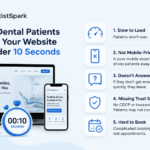
A dental website turns visits into booked appointments when it removes every barrier between a patient’s decision and their confirmed booking. Dentist Spark builds dental websites for Ontario clinics that answer patient questions, display trust signals, and route every visitor to a frictionless booking page — because a website that informs without converting is not doing its job.
Key Takeaways
Key Takeaways
✓ Clear calls to action increase conversion rates by 67% — every dental website page needs a visible, action-oriented CTA above the fold.
✓ Over 60% of healthcare searches happen on mobile devices — a dental website that is not mobile friendly loses most of its potential patients before they read a word.
✓ 76% of mobile searchers visit a business within 24 hours of searching — a dental website must convert in the moment, not after a follow up.
✓ Booking forms with no more than 5 fields convert at significantly higher rates — every additional form field reduces completion rates measurably.
✓ 80% of visitors will not scroll below the fold — the dental website’s most important conversion elements must appear before any scrolling is required.
What a Dental Website Needs to Turn Visits Into Booked Appointments, Defined
A dental website that converts visitors into booked appointments is one where every page element serves a defined role in guiding each person from arrival to a confirmed booking. It is not a brochure. It is a patient acquisition system — one that answers questions, builds trust, reduces friction, and captures commitment at the exact moment a potential patient is ready to act. Dentist Spark’s dental website design service is built around this conversion framework. For Ontario dental clinics accepting new patients, this distinction determines whether a dental website generates consistent scheduled appointments or simply generates traffic with no measurable return.
How It Works — The Conversion Mechanism
A dental website converts a visitor into a booked appointment through a sequence of micro-decisions. Each page element either advances the visitor toward booking or creates friction that stops the sequence. The goal of dental website design for conversion is to remove every point of friction and reinforce every decision point.
Step by Step — How a Dental Website Booking Happens
The conversion sequence follows a consistent pattern for most dental website visitors — whether they are future patients searching for a family dentist, patients with urgent dental pain, or patients researching a specific treatment.
Stage 1 — The Patient Arrives and Makes an Instant Assessment
A website visitor lands on the dental website and makes an immediate decision: is this relevant to my situation? This assessment takes under three seconds and is based entirely on visual design, headline clarity, and the presence of recognisable trust signals — Google rating, years in practice, accepting new patients confirmation. A dental website that fails this assessment loses the visitor immediately, regardless of how good the content below the fold is.
Stage 2 — The Patient Evaluates Trust and Answers Concerns
Service pages that answer common questions about health care costs, payment options, and what to expect reduce hesitation at this stage. Trust signals — patient reviews, professional credentials, RCDSO membership, before-and-after photos where compliant — move the visitor from consideration to intent. This stage takes 60–90 seconds on a well-structured dental website.
Stage 3 — The Patient Reaches the Booking Page and Commits
The booking page must have: the fewest possible form fields (five or fewer), a visible phone number for patients who prefer to call, confirmation of availability (same-day or next-day appointments shown where true), and immediate confirmation after submission. Any friction at this stage — a broken form, a long wait time, an unclear next step — loses the appointment.
The Main Conversion Elements — What Each Does and Why It Matters
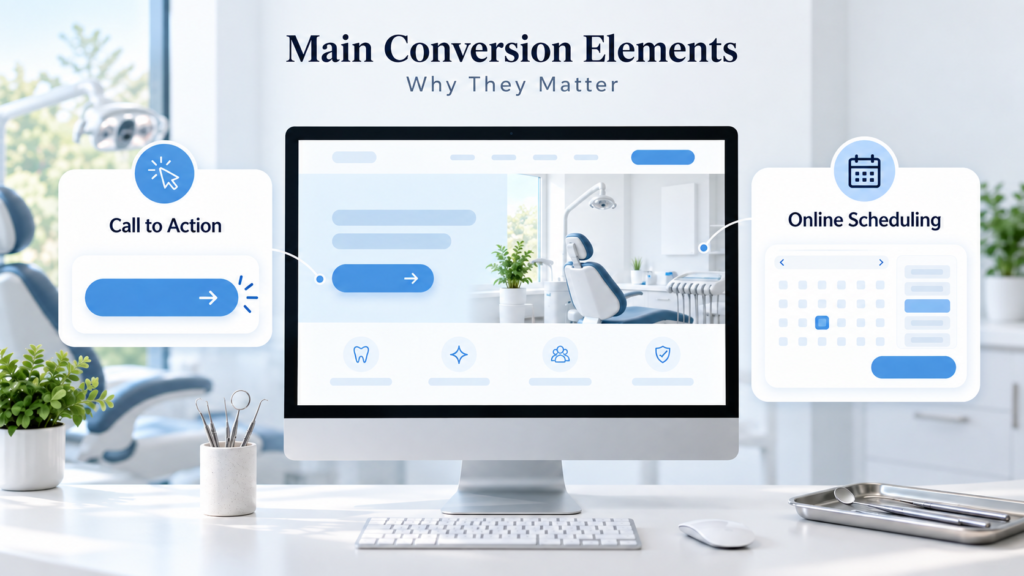
Every dental website has the same core conversion elements. What differs is whether each element is implemented correctly. The two most impactful are the call to action and online scheduling integration.
Type 1 — The Call to Action
The call to action converts awareness into commitment. It must use action-oriented language — ‘Book Your Appointment,’ ‘Call Us Now’ — and appear above the fold on every page. A CTA below the fold will not be found by the 80% of visitors who do not scroll.
Best Suited To
Every page of a dental website. Service pages for health care, family health services, and urgent appointments all require a CTA. The booking page itself needs one at top and bottom.
Limitation to Know
A static contact form behind a ‘Book Now’ CTA destroys trust immediately.
Type 2 — Online Scheduling Integration
Online scheduling converts dental website visits into confirmed appointments without phone contact. A patient who decides to book at 10pm does so immediately — no voicemail, no follow up uncertainty, no delay until the clinic opens. It captures commitment at the exact moment it exists.
Best Suited To
Dental clinics accepting new patients with high after-hours search volume. Routine checkups, dental hygiene visits, and scheduled appointments for family health services all suit self-serve booking.
Limitation to Know
Requires integration with practice management software to prevent double-booking.
What a Converting Dental Website Is Not
A converting dental website is not the same as a professional-looking dental website. Many Ontario clinics have visually polished sites structurally broken for conversion — no online scheduling, CTAs buried below service descriptions, booking pages with too many form fields. Visual polish does not produce booked appointments. Conversion structure does.
It is not the same as an informational website. A dental website that educates future patients about treatment options and health care without a booking action is producing informed patients for a competitor. Information and conversion must happen simultaneously.
And it is not the same as a dental website that ranked well three years ago. Dental website redesign considerations include conversion structure, not just visual refresh — a dental website that has aged out of mobile-friendly design standards, has no online scheduling, and lacks current trust signals is losing the new patients it would otherwise have converted, regardless of its historical search ranking.
Who It Suits in Ontario — Dental Clinics Ready to Convert Website Traffic
Dental website marketing that attracts new patients is only half the equation. A dental clinic in Ontario spending money on Google Ads, local SEO, or social media to drive website visitors is wasting a proportion of that investment if the dental website is not built to convert those visitors. The problem is common: the dental clinic invests in getting traffic, but the website loses the patients that traffic delivers.
A converting dental website suits any Ontario dental clinic accepting new patients whose website visitors are not booking. It suits healthcare providers in North York and the Greater Toronto Area — where over 3,500 dental practices compete for the same local patients — because the dental website that converts best wins the patient.
Features every dental website should include covers the full checklist of conversion elements, trust signals, technical requirements, and content standards that a dental website in Ontario needs to perform consistently — across desktop, mobile, and patient types ranging from family health to emergency care.
Dentist Spark can assist your practice and builds dental website design for Ontario dental clinics built around this conversion architecture from the ground up. Every dental website we build has: mobile-friendly design tested on real devices before launch, online scheduling integrated with the clinic’s practice management system, CTAs positioned above the fold on every page, service pages that answer the most common patient questions, and Google rating display that complies with RCDSO advertising guidelines.
Dental website design and development for Ontario practices covers the full range of design decisions that affect conversion — from site architecture and internal linking to contact form field count and mobile experience testing.
Frequently Asked Questions
These are the questions Ontario dental clinic owners and practice managers most commonly ask before improving their website conversion rate.
What does a dental website need to get more bookings from website visitors?
A dental website needs a clear call to action above the fold on every page, online scheduling that captures appointments 24/7, a mobile-friendly design that works on the devices 60%+ of patients use, service pages that answer the most common patient questions, and social proof — Google rating and review count — displayed before patients have to search for it. Booking forms must have five fields or fewer.
How do I make my dental website mobile friendly?
A mobile-friendly dental website uses responsive design so layout adapts to screen size automatically, fonts are legible without zooming, buttons and form fields are large enough to tap accurately, click-to-call is one tap from any page, and the online scheduling widget functions correctly on small screens. Test the full booking journey on an actual mobile device — not just a desktop browser’s mobile preview — before considering it complete.
What service pages and health care information should a dental website booking page include?
Patients who must call during business hours to book often do not follow up. An online scheduling widget removes that barrier entirely, converting website visitors into confirmed scheduled appointments without front-desk involvement. Automated reminders sent after booking further reduce no-show rates.
How long does it take to see results from a dental website redesign?
Most dental clinics see measurable improvement in conversion rate — more booked appointments from existing traffic — within 60 to 90 days of a website redesign focused on conversion elements. Page speed improvements and CTA placement changes show results fastest. Content improvements and trust signal additions take longer as returning visitors build familiarity. Google Ads and SEO traffic quality also affects the timeline — higher-intent traffic converts sooner regardless of website quality.
About Dentist Spark
Dentist Spark is a dental marketing agency based in North York, Ontario, working exclusively with dental clinics across the Greater Toronto Area and Ontario. We build and optimise dental website design for Ontario dental practices — from new patient conversion architecture and mobile-friendly redesigns to online scheduling integration and service page development. Our dental websites are built to RCDSO compliance standards, PHIPA-compliant tracking configurations, and conversion structures that produce measurable increases in booked appointments.
Service Area
Dentist Spark serves dental clinics in North York, downtown Toronto, Etobicoke, Scarborough, Mississauga, Markham, Vaughan, Richmond Hill, and across Ontario. Whether your practice serves family health patients, drop-in dental clinics, urgent dental care, or patients registered with a or referral patients, our dental websites deliver a great experience — no waiting, no friction — and a clear path to confirmed appointments. As your partner in patient acquisition, we focus on converting visitors.
Next Step
If your dental website is receiving visitors who are not booking appointments, dental website design from Dentist Spark starts with a free conversion audit — we identify exactly which elements are causing visitors to leave without booking and show you what a converting dental website looks like for your specific clinic and patient mix in Ontario.