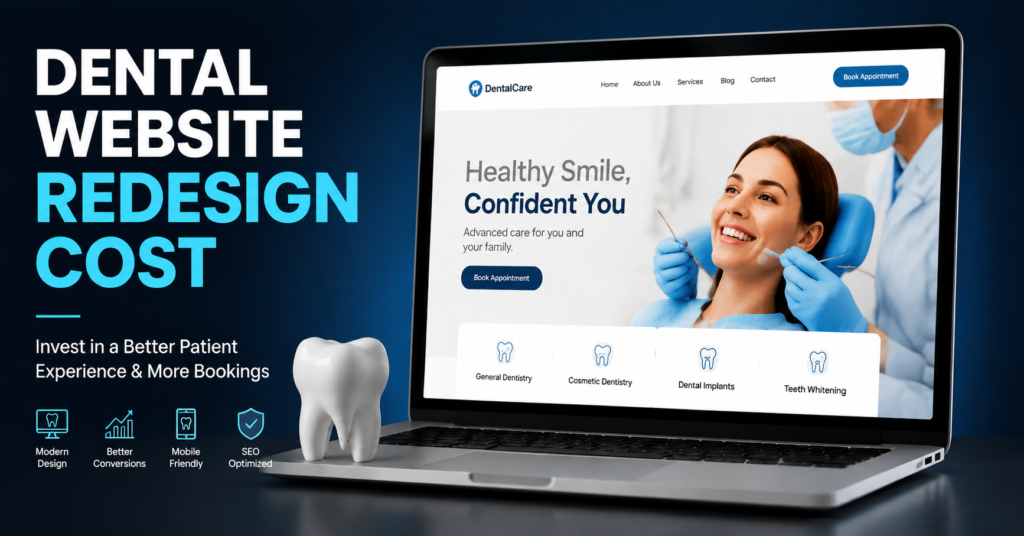
A dental website redesign in 2026 costs between $3,000 and $20,000 for most Canadian dental practices, with the final investment depending on customisation level, number of service pages, content writing, and whether dental SEO is included. Most established dental clinics invest between $4,000 and $8,000 for a professional redesign that attracts new patients, converts website visitors into booked appointments, and supports long-term search engine performance.
This guide breaks down what each budget level delivers, what drives costs up or down, and what every dental website redesign should include — so your practice makes an informed investment.
When a Dental Practice Website Needs a Redesign
An outdated website costs your dental practice more than it saves. More than 70% of local health searches occur on smartphones, yet many dental clinic websites were built before mobile-first design was standard. If your dental website doesn’t load quickly, display correctly on mobile devices, or include clear paths for patients to book appointments, prospective patients leave — and book with a competitor who made it easier.
97% of patients prefer visiting a dental website over calling before making an appointment. That means your dental website is typically the first substantive interaction a potential patient has with your practice. An outdated website that fails to build patient confidence or clearly communicate your practice’s philosophy and services will underperform regardless of how strong your clinical reputation is.
Most dental practices should plan a full redesign every four to five years, or sooner if analytics show declining website traffic, falling search rankings, or a drop in new patient bookings. The best dental websites are not static — they evolve with patient expectations, latest dental industry trends, and search engine requirements.
88% of mobile users visit or contact a local business within a day of searching on their smartphone. For dental practices, that makes mobile performance a direct patient acquisition factor — not a design preference. (Source: Google Consumer Insights)
Dental Clinic Website design Cost Breakdown by Tier
The following investment ranges reflect 2026 market rates for dental web design across Canada and North America, based on published data from Flamingo Agency (February 2026), Rosemont Media (May 2026), and Top Dental Websites (May 2026).
| Tier | Investment Range | Best For | Typical Inclusions |
| Basic | $2,000 – $4,000 | New practice, minimal competition | Template design, core pages, contact form, basic mobile optimisation |
| Professional | $4,000 – $8,000 | Established solo or group practice | Custom layout, service pages, SEO setup, online booking, professional photos |
| Custom | $8,000 – $20,000 | Multi-location or specialist clinic | Fully custom design, advanced SEO, dedicated service pages, full content writing |
| Enterprise | $20,000+ | Large group or DSO | Custom architecture, integrations, AI tools, full marketing ecosystem build |
Basic: $2,000 – $4,000
Template-based dental websites at this level provide a clean online presence but rarely rank competitively in local search results. They typically include a homepage, about page, contact form, and a handful of general service pages — without the dedicated service pages, content depth, or SEO structure that attract new patients through organic search. Appropriate for a brand-new dental office that needs an immediate digital presence while longer-term investment is planned. (Source: Flamingo Agency, February 2026)
Professional: $4,000 – $8,000
The most common investment range for established Canadian dental practices. A professional dental website redesign at this level delivers a custom layout, dedicated service pages for treatments like dental implants and cosmetic dentistry, mobile-first design, online appointment booking integration, basic dental SEO setup, and professional photos. This is the tier where a dental website begins to actively convert visitors into new patient bookings rather than simply providing information. (Source: Flamingo Agency, February 2026)
Custom: $8,000 – $20,000
Appropriate for multi-location dental practices, cosmetic specialists, or dental clinics in highly competitive urban markets. A custom dental website at this level includes fully bespoke design, advanced dental SEO integration, a complete content writing package, patient testimonials sections, smile galleries, and the technical architecture to support long-term patient growth. Professional copywriting alone at this level adds $4,000 to $12,000 to the project, reflecting the depth of dental website content required to rank for competitive local search terms. (Source: Top Dental Websites, May 2026)
Enterprise: $20,000+
Multi-location dental groups and large practices with complex integrations — patient management systems, multiple booking platforms, multi-language requirements — invest at this level. Enterprise dental website design services typically include a full digital presence strategy alongside the build itself.
What Drives Dental Website Redesign Costs Up or Down
Number and Depth of Service Pages
Each dedicated service page requires design, content writing, and SEO optimisation. A dental practice website with individual pages for dental implants, teeth whitening, general dentistry, cosmetic dentistry, pediatric dentist services, emergency dentist care, and each additional treatment costs significantly more than a five-page brochure site — but performs significantly better in local search results. Creating dedicated service pages is one of the most effective ways to improve SEO and help prospective patients understand what your practice offers before their first visit. A great dental website design solves all of this, while also making your marketing cheaper, because higher conversion rates reduce cost-per-lead.
Content Writing and Professional Photos
Professional copywriting for a dental website ranges from $500 to $2,500 depending on scope, with specialist healthcare copywriters charging $400 to $1,200 per optimised page. (Source: 12AM Agency, 2025) Websites with original professional photos of the dental team and clinic environment build significantly more patient trust than stock photography — and they perform better in search results. High-quality images and videos build patient confidence and reduce the anxiety that prevents dental appointment bookings.
Online Booking and System Integrations
Online booking integration is one of the highest-ROI features on any dental website. Websites with online booking capture the 30 to 40% of appointment bookings that happen outside business hours, and they significantly increase patient engagement by removing friction from the booking process. Basic booking integrations cost $0 to $500 to set up; more advanced integrations with practice management systems cost more but deliver proportionally stronger patient bookings returns.
SEO and Technical Performance
A dental website without search engine optimisation built into its architecture is, as one industry source describes it, ‘just a digital brochure.’ (Source: Dentists Marketing Company, February 2026) Local SEO optimisation — page speed, mobile responsiveness, SSL security, schema markup, and keyword-optimised content — should be integrated into the redesign process, not added as an afterthought. Practices that launch a new dental website without SEO foundations often find that their search rankings drop post-launch and take months to recover.
Ongoing Dental Website Costs After Launch
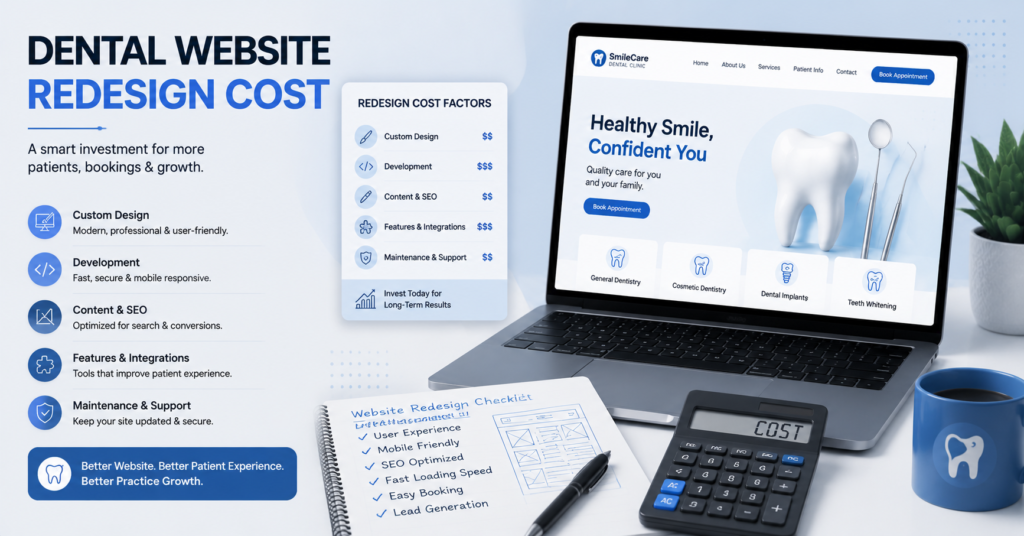
The redesign investment is a one-time cost, but dental website maintenance is an ongoing operating expense. Typical annual ongoing costs include domain registration and hosting ($200 to $600 per year), SSL certificate renewal, website maintenance for security updates and bug fixes, and dental SEO services if ongoing search visibility work is included.
One important question to ask any dental web design provider before signing: if you cancel, what happens to your website files, content, and domain? Some dental marketing platforms retain ownership of the website design and content, meaning practices that leave must start from scratch. A reputable dental web design partner ensures you own all files, content, and your domain outright.
Page speed affects both user experience and search engine rankings. Fast loading speeds are critical for reducing bounce rates — and for dental clinic websites where a prospective patient’s first impression happens in under three seconds, performance is a patient acquisition factor, not a technical afterthought.
What Every Dental Website Redesign Should Include
Regardless of budget tier, a great dental website redesign must deliver a specific set of outcomes for a dental practice. These are the non-negotiables that separate a dental website that generates patient growth from one that simply exists online.
• Mobile-first design — built for smartphone performance first, scaled to desktop; more than half of all dental searches happen on mobile
• Dedicated service pages — individual pages for each treatment that educate patients, support SEO, and guide the patient journey toward booking
• Clear calls to action — prominent book appointments buttons, phone numbers, and online booking links on every page; websites with clear calls-to-action increase patient bookings measurably
• Patient testimonials — integrated throughout the site rather than confined to one page; patient testimonials enhance credibility and reduce appointment anxiety
• Professional photos — real images of the dental team, dental office, and patient results; modern dental websites with original photos build patient trust before a first visit
• SSL security — HTTPS is essential for patient data protection and for search engine rankings; secure sites rank higher and convert visitors more effectively
• Analytics setup — Google Analytics or equivalent installed at launch so you can measure website performance, traffic sources, and patient conversion rates from day one
• Local SEO foundations — page titles, meta descriptions, schema markup, and location-specific content that help your dental practice appear in local search results for the searches your potential patients are running
Why Dentist Spark for Dental Website Design Services
Dentist Spark builds custom dental websites for Canadian dental practices that are designed to convert visitors into patients — not just to look professional. Every dental website redesign we deliver is mobile-first, built with dental SEO integrated from the foundation, and structured around the patient journey from first search to booked dental appointment.
We offer a free consultation for dental practices considering a redesign — an honest assessment of your current dental website, what’s holding it back, and what a new dental website built for patient growth would look like for your specific practice and local market.
Considering a Dental Website Redesign?
Book a free consultation with Dentist Spark. We’ll review your current dental website, identify what’s preventing it from converting prospective patients, and show you what a modern dental website designed for your practice and your market would look like.
→ Book Your Free Consultation at DentistSpark
Frequently Asked Questions
How much does a dental website redesign cost in Canada in 2026?
A dental website redesign in Canada costs between $3,000 and $20,000 for most dental practices in 2026. Most established clinics invest $4,000 to $8,000 for a professional redesign that includes custom dental web design, dedicated service pages, mobile-first layout, online booking, and basic dental SEO. Custom dental websites for multi-location practices or cosmetic specialists run $8,000 to $20,000. (Sources: Flamingo Agency 2026; Rosemont Media 2026)
What should a dental practice website redesign include?
A dental practice website redesign should include mobile-first design, dedicated service pages for each treatment, professional photos of the dental office and team, patient testimonials, clear calls to action for booking appointments, SSL security, local SEO foundations, and analytics setup. These are the elements that determine whether your new dental website actively converts website visitors into patient bookings rather than simply providing information.
How often should a dental clinic redesign its website?
Most dental clinics should plan a full website redesign every four to five years, or sooner if analytics show declining traffic, dropping search rankings, or falling new patient bookings. A dental clinic website that is more than five years old is likely missing mobile-first design, modern SEO structure, and the online booking functionality that prospective patients now expect before committing to a first visit.
What is a custom dental website and is it worth the investment?
A custom dental website is built specifically for your practice — not adapted from a generic template. It reflects your practice’s personality, services, and patient community in a design that can’t be confused with a competitor’s site. For established dental practices in competitive markets, a custom dental website delivers stronger long-term patient growth and search performance than a templated alternative, and it becomes a durable digital asset that supports dental marketing for years.
How does dental web design affect patient bookings?
Dental web design directly affects patient bookings through page speed, mobile performance, clarity of calls to action, and the trust signals a site communicates on first impression. Websites with clear calls to action and online booking integration increase patient engagement significantly. 97% of patients prefer visiting a dental website over calling before booking — which means your website’s ability to convert visitors into booked appointments is one of the most direct levers of practice growth available.
What dental marketing should be included in a website redesign?
A dental website redesign should integrate dental marketing foundations from the start — not as an add-on. This includes local SEO structure, keyword-optimised service page content, Google Analytics setup, schema markup, and Google Business Profile alignment. Dental marketing built into a new dental website from day one produces faster search rankings improvement and stronger patient conversion rates than SEO and marketing applied to an already-built site.
How do I convert website visitors into dental patients?
Converting website visitors into dental patients requires three things working together: a clear patient journey from landing page to booking, prominent and frictionless calls to action on every page, and content that educates patients and builds confidence before their first visit. Educational content reduces patient anxiety, patient testimonials provide social proof, and online booking removes the friction that causes prospective patients to leave without making contact. A well-structured dental website redesign addresses all three simultaneously.
Conclusion
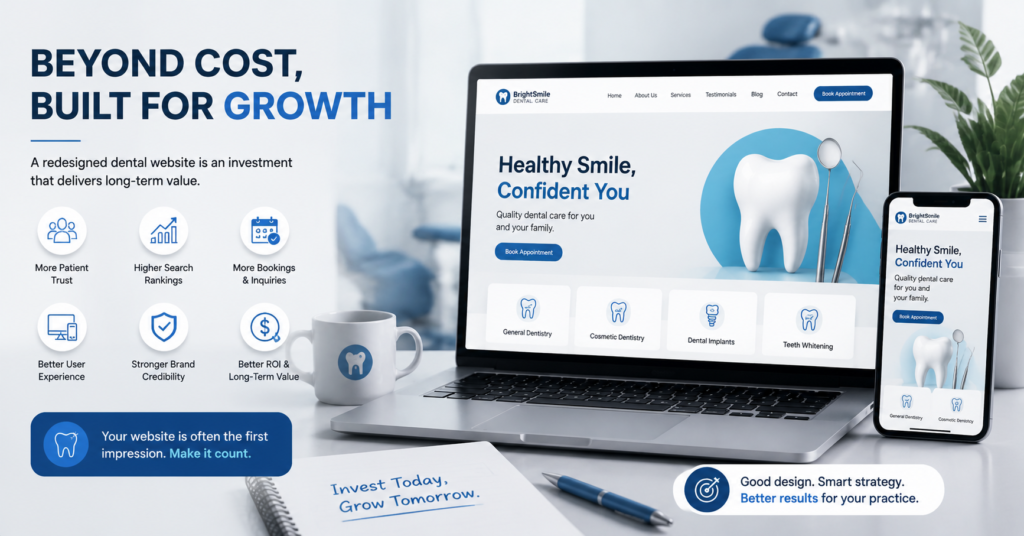
A dental website redesign is one of the highest-return investments a dental practice can make in its digital presence — but only when the investment is calibrated correctly to the practice’s market, growth objectives, and patient acquisition goals. Basic template sites serve new practices with minimal competition. Professional custom dental websites serve established clinics that want consistent new patient bookings. Custom and enterprise builds serve specialist clinics and multi-location groups competing in demanding markets.
The right question isn’t ‘how do I spend the least?’ It’s ‘what does my dental website need to do — and what investment level makes that achievable?’ A free consultation with Dentist Spark is the most direct way to answer both.