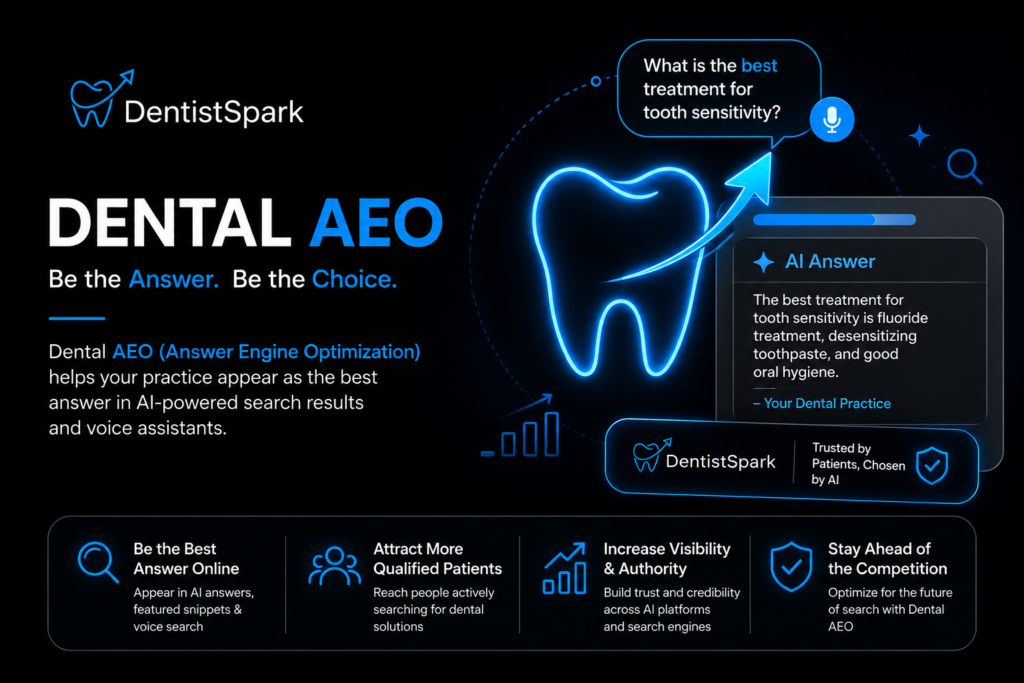
If a patient in your city asks an AI chatbot ‘Who is the best dentist near me accepting new patients?’ — is your practice the answer? That’s exactly what AEO, or Answer Engine Optimisation, is about. It’s the strategy that determines whether your dental clinic appears in AI-generated answers, not just traditional search results.
AEO for dental practices means structuring your online content so that AI search engines, voice assistants, and generative AI tools can find, understand, and confidently recommend your clinic. It sits alongside traditional SEO, but it requires a different approach — one that focuses on clear, direct answers rather than keyword density alone.
The Best AI Search Engines Dental Practices Should Know About
Google AI (Search with AI Overviews) remains the highest priority for Canadian dental practices. It surfaces AI-generated summaries at the top of search results, drawing directly from your website content, Google Business Profile, and structured data.
ChatGPT accesses the web in real time and is increasingly used for healthcare queries. Practices with clear, authoritative service content are more likely to be cited in its responses.
Claude (Anthropic) is a fast-growing AI platform known for producing thoughtful, nuanced answers to complex questions. Patients using Claude to research dental treatments will encounter responses shaped by high-quality, well-organised content — exactly the kind dental practices should already be publishing.
Perplexity functions as a research-focused AI search engine that cites its sources directly. It rewards well-structured, factual content from credible websites — making it highly responsive to strong on-page expertise signals.
Bing AI (Microsoft Copilot) powers AI-assisted search across Microsoft’s ecosystem, including Windows, Edge, and enterprise tools. It serves a significant portion of Canadian desktop users and is consistently overlooked by dental marketers.
You.com and emerging AI platforms are smaller in market share today but growing steadily. Content optimised for the major platforms above tends to perform well here too, since they share the same core principles of accuracy, authority, and relevance.
Key AI Features to Look for When Evaluating AI Tools for Your Dental Practice
Not all AI tools are built the same. Some offer a free plan with limited functionality, while others unlock advanced features like deep research, custom models, and priority support under premium plans. For most dental practices, the key is finding a tool that fits your existing tech stack without requiring a full operational overhaul.
The most useful AI platforms for dental marketing allow you to upload internal data — think patient FAQs, service descriptions, and marketing copy — so the AI generates tailored, on-brand responses rather than generic content. Some advanced tools can even connect to your CRM data to personalise outreach at high volumes without losing your brand voice.
For small businesses like independent dental clinics, a wide selection of templates and pre-built resources can significantly reduce setup time. Look for platforms that support human agents in the workflow — especially for sensitive patient communications where an AI-generated draft should always be reviewed before sending.
AEO vs. SEO: Why Dental Practices Need to Understand the Difference
Traditional SEO is about ranking high in search results on Google or Bing. You optimise your website, build links, and aim to appear on page one. It still matters — a lot. But search behaviour is changing fast.
More patients are now using AI search engines and AI chatbots like ChatGPT, Google AI Overviews, Perplexity, and Bing AI to find healthcare providers. Instead of clicking through ten links, they ask a question in natural language and expect a direct, accurate response. If your practice information isn’t structured to appear in those AI answers, you’re invisible to a growing segment of your local market.
AEO (Answer Engine Optimisation) focuses specifically on earning placement in AI-generated responses. Think of it as optimising for the answer, not just the algorithm.
A patient searching ‘best family dentist in Mississauga accepting new patients’ on an AI platform expects one or two clear recommendations — not a list of ten blue links. AEO positions your practice to be that recommendation.
How AI Search Engines Work — and Why It Matters for Your Clinic
AI search engines don’t crawl pages the same way traditional search engines do. They pull from training data, structured data, indexed web content, and increasingly, real-time search results to generate tailored responses to user intent.
When a patient asks an AI tool about dental services in their city, the AI is looking for content that clearly answers the question, uses natural language, is authoritative, and can be verified across multiple sources. This is why E-E-A-T — Experience, Expertise, Authoritativeness, and Trustworthiness — is so central to AEO.
Google AI, for example, draws on indexed content and its own knowledge graph to build AI Overviews. Perplexity and ChatGPT access the web in real time and synthesise answers from high-quality sources. Your clinic needs to show up credibly across all of them.
What AI Platforms Look for When Recommending a Dentist
• Clear, structured content that directly answers common patient questions
• Consistent business data across Google Business Profile, your website, and directories
• Positive reviews with specific, keyword-rich language patients use naturally
• Schema markup (structured data) that signals your services, location, and hours
• High-quality backlinks from trusted Canadian health and local business sources
AI-Powered Search Is Already Changing How Patients Find Dentists
Voice search via virtual assistants, AI mode features in Google Search, and the rise of AI chatbots have fundamentally shifted search behaviour. Patients no longer always type queries — they speak them, or they ask follow-up questions in a conversational thread.
‘Do you take insurance?’ ‘Are you open on Saturdays?’ ‘How much does a cleaning cost?’ These are the kinds of follow-up questions patients ask in AI tools after an initial search. Practices that answer these questions clearly on their websites — and in their Google Business Profiles — are far more likely to generate accurate AI responses that convert to booked appointments.
AI platforms reward depth and specificity. A thin ‘About Us’ page won’t cut it. Your content needs to reflect the full range of services, patient types, and geographic areas you serve.
One dental clinic in Ottawa added a structured FAQ section answering 22 common patient questions. Within four months, they saw a 34% increase in organic traffic and began appearing regularly in Google AI Overviews for local dental searches.
AEO Best Practices: How to Optimise Your Dental Website for AI Answers
You don’t need an entirely new website. What you need is smarter content architecture and a few practical adjustments that make it easier for AI tools to extract, trust, and surface your information.
1. Write Content That Directly Answers Patient Questions
Every service page should open with a clear, direct answer to the most common question about that service. For example, a root canal page shouldn’t begin with a lengthy preamble — it should immediately explain what a root canal is, why a patient might need one, and what to expect at your clinic.
This approach aligns perfectly with how AI-generated answers are constructed. AI tools extract the clearest, most direct response from available content. Make sure that’s yours.
2. Implement Structured Data (Schema Markup)
Schema markup is code added to your website that tells search engines and AI platforms exactly what your content means. For dental practices, this includes DentistSchema, LocalBusinessSchema, FAQSchema, and ReviewSchema.
Structured data gives AI search engines additional context they can’t always infer from plain text. It explicitly communicates your services, location, hours, and patient ratings — the exact business data AI platforms use to generate confident, accurate responses.
3. Build and Optimise Your Google Business Profile
Your Google Business Profile remains one of the most powerful tools for local AEO. Google AI draws directly from GBP data when answering local queries. Ensure every field is complete: services, hours, photos, accepted insurance, and especially patient reviews.
Encourage patients to leave reviews that describe their experience in natural language. ‘Dr. Chen was great with my anxious six-year-old’ is far more valuable for AEO than ‘Good dentist.’ AI tools parse review sentiment and specificity as trust signals.
4. Create a Comprehensive FAQ Section
FAQs are one of the highest-value content formats for AEO. They mirror the natural language questions patients ask virtual assistants and AI chatbots, and they give AI tools clean, extractable answers to surface in responses.
Cover everything from ‘What should I expect at my first appointment?’ to ‘Do you offer payment plans for dental work?’ Mark up your FAQs with FAQSchema to increase the likelihood of appearing in AI answers and traditional search features like featured snippets.
5. Ensure Consistent NAP Data Across All Platforms
NAP — Name, Address, Phone Number — consistency across your website, Google Business Profile, Yelp, RateMDs, and Canadian dental directories is foundational for both local SEO and AEO. Conflicting information creates uncertainty for AI platforms and reduces the likelihood they’ll confidently recommend your practice.
Run a regular audit of your business data. Even a minor inconsistency — like ‘Suite 200’ on one listing and ‘#200’ on another — can affect how AI tools interpret and surface your information.
AI-Generated Content and Your Dental Brand Voice
There’s a growing temptation to use free AI tools to mass-produce dental content. A few tips before going down that path: AI-generated content without expert review often lacks the specificity, clinical accuracy, and brand voice that builds genuine patient trust.
AI tools can be powerful for drafting outlines, generating first drafts, or identifying content gaps. But the final content on your dental website should reflect real clinical expertise — ideally reviewed or contributed to by a dentist. This is what Google’s quality guidelines mean by Experience and Expertise, and it’s exactly what differentiates authoritative content from generic filler.
At Dentist Spark, we combine strategic AEO frameworks with human dental marketing expertise. Our content reflects how Canadian dental patients actually search and what they genuinely need to know before booking.
Local AEO: Getting Your Dental Practice Recommended in Your City
Geographic context is everything in dental marketing. A patient in Burlington, Ontario isn’t looking for a great dentist in Canada — they’re looking for the best option within a ten-minute drive. AI platforms understand this and heavily weight local signals when generating responses.
For effective local AEO, your content needs to mention your city, neighbourhood, and nearby landmarks naturally throughout your website — not in a stuffed, awkward way, but as genuine geographic context. Include location-specific landing pages if you serve multiple areas.
Canadian patients also look for province-specific signals: whether you accept provincial dental plans, how your fees compare to the Ontario Dental Association suggested fee guide, or whether you’re a member of the Royal College of Dental Surgeons. Mentioning these signals establishes local authority and builds the trust that AI tools need to recommend you confidently.
Measuring AEO Success for Your Dental Practice
Unlike traditional SEO, where ranking positions are easy to track, AEO results require a broader measurement lens. You’re looking for growth in branded search volume, increases in direct appointment requests, higher click-through rates from AI-generated snippets, and improved performance in Google Search Console for question-based queries.
Track which questions your website is ranking for. Monitor your Google Business Profile insights for search term data. Note whether your clinic name starts appearing in ChatGPT or Perplexity responses when you test local dental queries. These are the signals that your AEO strategy is working.
Dentist Spark clients who implement structured AEO strategies typically see measurable improvements in new patient inquiries within 90 to 120 days — without increasing their ad spend.
Conclusion
AEO isn’t a replacement for traditional SEO or paid advertising — it’s an evolution of how dental practices need to think about online visibility. As more patients use AI search engines, voice assistants, and AI chatbots to find healthcare providers, the practices that structure their online presence for AI-readable, patient-focused answers will have a significant competitive advantage.
The fundamentals aren’t complicated: clear content, structured data, consistent business information, strong reviews, and geographic specificity. What’s challenging is executing all of it consistently while running a busy clinic. That’s where a dedicated dental marketing partner makes a tangible difference.
Dentist Spark helps Canadian dental practices build AEO strategies that generate real patient bookings — not just rankings. If your clinic isn’t showing up in AI answers, that’s revenue your competitors are capturing.

Frequently Asked Questions
What is AEO and how is it different from SEO for dentists?
SEO (Search Engine Optimisation) focuses on ranking your dental website in traditional search results on Google or Bing. AEO (Answer Engine Optimisation) goes further — it optimises your content so that AI search engines, voice assistants, and AI chatbots like ChatGPT and Perplexity include your practice in their generated answers. Both matter, but AEO is increasingly important as patients shift toward conversational, AI-powered search.
How do I get my dental practice to show up in Google AI Overviews?
Google AI Overviews pull from well-structured, authoritative content that directly answers user questions. To improve your chances, implement FAQ schema markup, optimise your Google Business Profile, use structured data (LocalBusiness and DentistSchema), and ensure your website content answers the specific questions your patients are asking. E-E-A-T signals — real clinical expertise, patient reviews, and consistent business data — are especially influential.
Does my dental website need to be redesigned for AEO?
Not necessarily. In most cases, AEO improvements involve adding structured FAQ sections, implementing schema markup, improving content specificity, and ensuring your business data is consistent across platforms. A full redesign is rarely the first step. Start with a content and technical audit to identify the gaps between what your site currently offers and what AI platforms need to recommend you.
How long does it take to see results from AEO for a dental practice?
Most dental practices begin seeing measurable improvements in organic traffic and AI visibility within 90 to 120 days of implementing a structured AEO strategy. However, this depends on your current online presence, competition in your local market, and how comprehensively the strategy is executed. AEO compounds over time — the more authoritative your content becomes, the more consistently AI platforms recommend you.
Can I do AEO myself, or do I need a dental marketing agency?
Some elements of AEO — like improving your Google Business Profile or adding FAQ content to your website — can be done independently. However, technical components like schema markup implementation, structured data auditing, and integrating AEO with your broader local SEO strategy are complex and easy to get wrong. Working with a dental marketing agency that understands both the technical requirements and the Canadian dental landscape significantly accelerates results and reduces costly mistakes.
Ready to Make Your Dental Practice the Answer Patients Find?
Most dental clinics across Canada are invisible in AI search right now. That’s your window. Dentist Spark builds AEO and local SEO strategies specifically for Canadian dental practices — combining structured data, content authority, and patient acquisition expertise into one cohesive system.
Book your free dental marketing audit today. We’ll show you exactly where your practice stands in AI search, what’s holding you back, and what it takes to start generating more patient bookings within 90 days.
About Dentist Spark
Dentist Spark is a Canadian dental marketing agency specialising in local SEO, AEO, Google Ads, and patient acquisition for dentists, orthodontists, and multi-location dental practices. We help clinics grow predictably — with strategies built for the Canadian market.