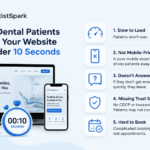
To identify which dental marketing channel books patients, connect every source — SEO, Google Ads, social media, and referrals — to tracked booking events in GA4. Dentist Spark helps Ontario dental clinics attribute revenue to the right channel so you invest in what fills your chair, not just what drives clicks. This guide is for practice owners running multiple dental marketing channels who want to make budget decisions based on actual booked appointments.
Key Takeaways
Key Takeaways
✓ Dental practices that track GA4 key events reduce wasted ad spend by 20–40% by cutting channels that generate clicks but no bookings.
✓ Google Ads delivers an average 8:1 return — but only when conversion tracking connects to actual booked appointments, not just form views.
✓ Local SEO claims 42% of Map Pack clicks for dentist near me searches — the highest-traffic position available to a toronto dentist without paid spend.
✓ Call tracking assigns a unique number to each dental marketing channel, revealing which source generated each phone call and new patient appointment.
✓ Dental care plan CDCP acceptance displayed on every channel measurably increases new patient conversion — eligible patients actively search for practices that accept it.
Before You Start
This guide is for dental clinic owners and practice managers in Ontario — particularly those running more than one dental marketing channel simultaneously and unsure which is producing actual bookings. It requires access to GA4, your Google Ads account, and your booking system or front-desk call logs.
If your dental office has no GA4 setup, no call tracking, and relies on asking patients ‘how did you hear about us,’ this is not a DIY project. The attribution gap is too wide for a manual fix. You need a dental marketing partner to build the measurement infrastructure first. When done correctly, attribution turns your marketing spend from a cost centre into a calculable patient acquisition system with a known cost per new patient booking.
What You Need
• GA4 property linked to your dental website — with key events configured for appointment form completions and call clicks
• Google Ads account — linked to GA4 with conversion actions importing dental appointment key events
• Call tracking software — assigns a unique phone number to each marketing source
• Google Business Profile — with call tracking enabled for Map Pack and Google Search calls
• UTM parameters — applied consistently to every link in every dental marketing email, social post, and paid ad
• Booking system data — monthly count of new patients by referral source
• Google Search Console — to confirm which organic search terms drive visits to your dental services pages
Safety and Prerequisites
Do not make budget cuts based on a single month of data. Attribution models take 60–90 days to stabilise after setup. A dental marketing channel that appears underperforming in month one is often the channel patients used for research before converting through a different source in month two.
PHIPA and PIPEDA apply to any tracking that captures patient behaviour on your dental website. Ensure GA4 does not store personally identifiable information. Use server-side tracking or consent mode where applicable, and confirm your privacy policy reflects how visitor data is collected.

What Each Dental Marketing Channel Books Best
Before measuring attribution, understand what each channel is actually suited to market. Matching the right dental service to the right channel reduces wasted spend before tracking even begins.
| Channel | Best Dental Services | Typical Patient Intent |
| Google Ads | Dental emergency, dental implants, same day appointments, broken tooth, tooth pain | High — ready to book immediately |
| Local SEO / Map Pack | Toronto dentist near me, routine checkups, new patients, accepting new patients, dental cleanings | Medium-high — comparing 2-3 options |
| Social media | Cosmetic dentistry, teeth whitening, invisalign braces, porcelain veneers, healthier smile | Low-medium — awareness, not booking-ready |
| Email marketing | Recall reminders, dental hygiene visits, routine checkups, treatment plan follow-ups, preventive care | High — existing patients only |
| Referral / word-of-mouth | Comprehensive dental care, oral surgery, wisdom tooth removal, root canal, dental surgery | High — trust already established |
| CDCP landing page | Teeth cleaning, dental cleanings, tooth fillings, wisdom tooth extractions, dental care plan cdcp eligible services | High — motivated by affordability |
Cosmetic dental procedures — cosmetic dentistry, teeth whitening, invisalign braces, porcelain veneers — require social proof and visual content before patients commit to a consultation. Social media marketing is where these services build the trust that eventually converts through a direct Google search. A dental clinic that attributes all cosmetic dentistry bookings to the last-click channel (typically direct or branded search) misses that social media was the channel that started the patient journey.
How social media marketing for dentists helps attract more patients explains why cosmetic dentistry and elective dental treatments require a longer consideration phase — and why attribution models that look only at last click undervalue social media’s role in patient acquisition.
High-Intent Dental Services That Should Run Google Ads
Dental emergency searches — dental pain, broken tooth, urgent care, same day appointments — convert immediately because the patient’s need is urgent. Dental implants to replace missing teeth, oral surgery, wisdom teeth removal, wisdom tooth extractions, and root canal treatment all carry high cost-per-click but generate high patient lifetime value. For a toronto dentist or north york dental clinic, these services justify Google Ads budgets because the return per patient exceeds the attribution cost significantly.
Root canal treatment typically costs $700–$1,500. Dental implants to replace missing teeth run $2,500–$5,000 per implant. A single booked dental implant case pays for weeks of Google Ads spend. Attribution tracking makes this return measurable — so you can defend the budget with numbers rather than estimates.
Services Best Suited to Local SEO, Organic Search, and Routine Checkups
Where Cosmetic Dentistry Fits in the Channel Mix
Dental website marketing that attracts new patients focuses on dental services with consistent long-tail search demand: routine checkups, dental cleanings, dental hygiene visits, teeth cleaning, preventive care, family dentist searches, comprehensive dental care, and accepting new patients in a specific neighbourhood. These terms have lower cost-per-click in paid search and strong organic conversion rates when service pages are built correctly.
Oral health content — explaining gum disease, periodontal disease, tooth decay, bone loss, bad breath, oral cancer screening, dental hygiene, and the role of the dental hygienist and dental team in preventive dental work — also supports local SEO by establishing your dental clinic as an educational authority in your community. General dentistry content that answers patient questions before they book builds the trust that converts research-phase visitors into new patients at a later visit.
CDCP and Insurance — a Dedicated Channel Worth Tracking Separately
The Canadian Dental Care Plan (CDCP) covers eligible dental treatments for Canadians with household income under $90,000 who lack private dental insurance. As of 2025, the CDCP covers exams, dental cleanings, tooth fillings, wisdom tooth extractions, and some oral surgery services. CDCP coverage must be renewed annually.
Dental clinics that communicate CDCP acceptance clearly — on their dental website, Google Business Profile, and social media — attract a growing segment of new patients specifically searching for affordable dental care. Tracking CDTP enquiries as a separate key event in GA4, with a dedicated landing page and unique call tracking number, reveals exactly how much new patient volume this channel generates. Practices in north york and downtown toronto that serve a broad income range often find CDCP patients represent 20–35% of new patient volume within six months of clearly communicating their dental care plan CDCP acceptance.
Dental SEO marketing to get more patients covers how organic search attribution works for dental clinics that serve both private insurance patients and CDCP-eligible patients — and why separating these two audiences in your GA4 setup produces more actionable marketing data.
Private dental insurance, direct billing, and flexible payment plans for treatments like dental implants, oral surgery, dental bridges, full or partial dentures, partial dentures, and restorative services all affect patient conversion differently. Displaying insurance providers accepted, direct billing availability, and payment plans on every dental service page reduces financial exit intent — which attribution data will confirm as higher conversion rates from organic traffic.
Step-by-Step: How to Track Which Dental Marketing Channel Books Patients
Channel × Tracking Method × What It Misses
| Channel | Tracking Method | What It Misses |
| Google Ads | GA4 key events + call tracking | Patients who call without clicking the ad |
| Local SEO / Map Pack | Google Business Profile insights + call tracking | Patients who visit directly after a search |
| Social media | UTM links + GA4 source/medium | Offline word-of-mouth driven by social posts |
| Referral / CDCP enquiries | Dedicated landing page + unique phone number | Patients who called the main dental office line |
| Email marketing | UTM parameters on all links | Patients who read the email but booked by phone |
| Direct / walk-in | Front-desk log + GA4 direct traffic | Cannot be attributed further without patient survey |
Step 1 — Configure GA4 Key Events for Every Booking Action
In GA4, navigate to Admin → Events → Create Event for each patient booking action: appointment form submission, click-to-call, online booking confirmation, and live chat initiation. Mark each as a Key Event. Then open Google Ads, navigate to Goals → Conversions → Import from Google Analytics, and import each key event as a conversion action.
Result to look for: within 48 hours of setup, your Google Ads conversion column should show data for at least one imported key event. If it shows zero conversions despite active traffic, the GA4 link is broken or the key event is not firing. Use GA4 DebugView and Google Tag Assistant to confirm event triggers on your dental website’s booking confirmation page.
If It Does Not Work First Time
Check that the GA4 Measurement ID is correctly placed on every page of your dental website — not just the homepage. Use Google Tag Manager to audit tag firing. Confirm the Google Ads account and GA4 property are linked under Admin → Google Ads Links in GA4. Test by submitting the appointment form yourself and confirming the key event appears in GA4 DebugView within 30 seconds.
Most Common Cause
The GA4 tag is placed only on the homepage, not on the booking confirmation or thank-you page where the key event fires. Every page of your dental website must carry the GA4 tag — including service pages for dental emergency, dental implants, oral surgery, root canal treatment, and wisdom teeth removal.
Stop Here If You See This
If GA4 shows zero sessions from any source for more than 72 hours after setup, the Measurement ID is incorrect or the tag is not firing. Do not proceed until sessions appear in the GA4 Realtime report.
Step 2 — Apply UTM Parameters to Every Dental Marketing Link
UTM parameters are tags appended to URLs that tell GA4 which channel, campaign, and source drove each visit. Every link you publish — in Google Ads, social media posts, email newsletters, CDCP acceptance announcements, and referral program invitations for dental treatments — must carry a UTM string. Without them, GA4 groups untagged traffic into the direct bucket, making channel attribution impossible.
Use Google’s Campaign URL Builder to generate consistent UTM strings. Standard structure: utm_source (google, facebook, email), utm_medium (cpc, organic, social, email), utm_campaign (campaign name, e.g. dental-implants-north-york-cdcp). Apply the same naming convention across all dental marketing channels. Result: within one week, GA4’s Traffic Acquisition report shows distinct rows for each UTM source tagged.
If It Does Not Work First Time
Check for URL encoding issues — spaces in UTM values break attribution. Confirm links are not stripped of UTM parameters by your email platform or link shortener. Test each link in GA4 DebugView before publishing to patients. A broken UTM on a CDCP information page, for example, hides an entire new patient segment from your attribution report.
Most Common Cause
UTM parameters are inconsistently capitalised across campaigns. ‘Google’ and ‘google’ appear as two separate sources in GA4. Use lowercase throughout, enforced by a shared UTM naming guide across your entire dental marketing team.
Stop Here If You See This
If all UTM traffic appears as direct in GA4, the website is stripping URL parameters on redirect. Fix the redirect configuration on your dental website before proceeding with any attribution analysis.
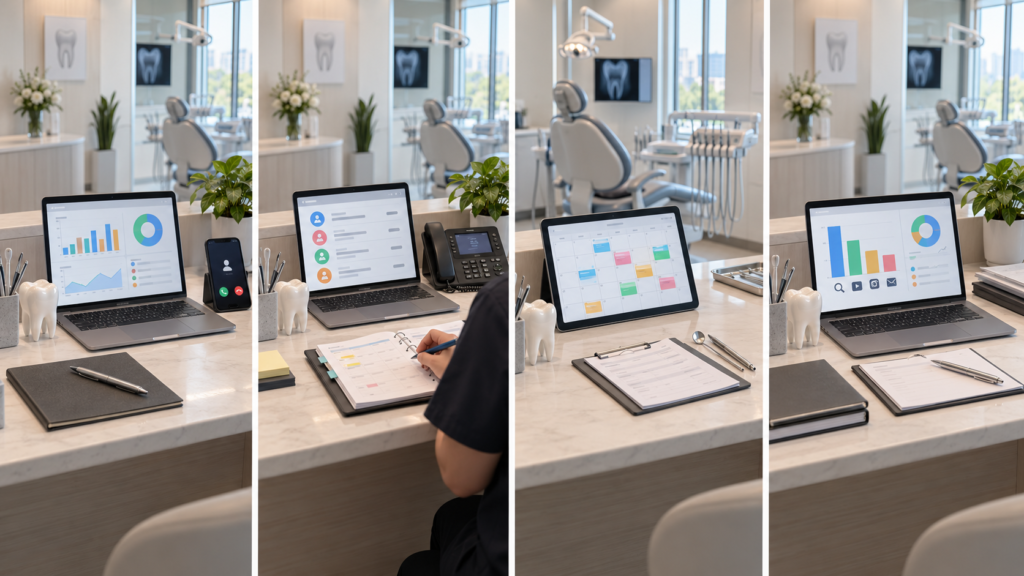
Step 3 — Set Up Call Tracking for Each Channel
Call tracking assigns a unique local phone number to each dental marketing source. When a patient calls the number shown on your Google Ads landing page, on your social media profile, or on a CDCP information page, the call is attributed to that source. Without call tracking, the majority of dental appointment bookings are invisible — patients searching for a toronto dentist, a dental emergency, or same day appointments in north york typically call rather than submit a form. Call tracking is not optional for a dental clinic with more than two active marketing channels.
Assign a unique tracking number to: Google Ads (use Google’s auto-inserted call extension), local SEO and Map Pack listings (a forwarding number that routes to your main dental office line), your social media bio, CDCP or insurance-focused landing pages, and direct mail or print campaigns if active. All tracking numbers route to the same dental office main line — patients experience no disruption.
Result: within two weeks, your call tracking dashboard shows calls attributed to each source. Cross-reference against front-desk booking logs to confirm attributed sources match. Pay particular attention to dental emergency calls — these often represent the highest patient lifetime value and the highest call-rather-than-form conversion rate of any dental service.
Step 4 — Read the Attribution Report and Make One Decision
What Good Performance Looks Like
After 90 days of clean data collection, open GA4’s Traffic Acquisition report filtered by key events. Sort by conversion volume. For each paid channel, calculate cost per booked dental appointment: total ad spend divided by appointments confirmed in the booking system. For organic channels, calculate cost as the proportion of your total dental marketing services investment.
Compare against patient lifetime value. A new patient in north york is worth approximately $700–$1,500 in their first year of routine dental care alone — more for comprehensive dental care, dental implants, cosmetic dentistry, or oral surgery treatment plans. A channel generating new patients at $120 per booking and a patient lifetime value of $1,200 is a 10:1 return. A channel generating patients at $400 per booking needs scrutiny.
A well-performing dental marketing channel shows improving cost per booked appointment over three consecutive months, increasing new patient volume, and a conversion rate above the industry benchmark. A channel to cut shows flat or rising cost per booking and declining appointment volume despite consistent or increasing spend.
A patient’s overall health journey often begins with a single dental appointment and evolves into comprehensive dental care over years. Each new patient your marketing generates has compounding lifetime value — which is why cost per booking is the right attribution metric. Make one budget decision per 90-day cycle. Identify the channel with the highest cost per booked appointment and lowest volume. Reduce its budget by 20–30%. Reinvest into the highest-performing channel. Verify at the next 90-day cycle that total booking volume held or improved while overall cost per appointment declined.
When DIY Stops Being Sensible
Attribution tracking across three or more active channels — SEO, Google Ads, social media, email, referral programs, and CDCP simultaneously — is not reliably manageable without dedicated expertise. Configuration errors compound: UTM inconsistencies, GA4 key events that misfire on mobile, call tracking numbers that aren’t properly ported, and conversion double-counting all inflate a channel’s apparent performance. At three or more channels, the cost of misattribution exceeds the cost of professional dental marketing services within six months. If your dental clinic is in that position, dental marketing services built specifically for Ontario practices are a more reliable investment than continued manual attribution.
The honest cut-off: if your monthly dental marketing spend exceeds $3,000 across all channels and you cannot currently state which channel booked your last 10 new patients, you have an attribution gap costing you more than professional management would. Read how to make a dental marketing plan for the full strategic framework before allocating any budget changes.
What a North York Dental Marketing Professional Does Differently
Dentist Spark’s attribution process for North York dental clinics begins with a full GA4 audit — confirming every key event fires correctly on every device before a single dollar of budget is allocated. Call tracking is configured at the channel level from day one, with unique numbers for Google Ads, the Map Pack listing, CDCP landing pages, and each major dental service page.
We build a monthly attribution dashboard showing cost per booked appointment — not cost per click or cost per lead — for every active dental marketing channel. This dashboard pulls from GA4, Google Ads, and your front-desk booking log simultaneously, so the report reflects actual booked dental appointments rather than digital interactions that may or may not have led to bookings.
For dental clinics serving north york, downtown toronto, and surrounding Ontario municipalities, we also track CDCP conversion rates separately. As of 2025, CDCP-eligible patients represent a growing share of new patient volume for Ontario dental practices with household incomes under $90,000 who lack private dental insurance. Tracking CDCP enquiries accurately requires a dedicated measurement layer that most general digital marketing agencies do not build. Our expert dentists marketing team handles this from initial setup through monthly reporting.

Frequently Asked Questions
How do I know which dental marketing channel is getting me new patients?
Connect every channel to GA4 with key events tracking each booking action — form completions, call clicks, and online bookings. Apply UTM parameters to every link you publish. Add unique call tracking numbers per source. After 90 days of clean data, GA4’s Traffic Acquisition report shows bookings by channel with enough volume for budget decisions. Without all three layers, attribution for a dental clinic is guesswork.
Is Google Ads or local SEO better for a toronto dentist accepting new patients?
Google Ads delivers immediate new patients for a toronto dentist — results within days. Local SEO compounds over months and reduces cost per patient long-term. For accepting new patients quickly, Google Ads wins short-term. For sustainable new patient volume in north york or downtown toronto, both channels are needed simultaneously. Attribution data tells you the optimal spend split for your specific dental clinic, market, and dental services mix.
How do I track dental emergency, root canal, wisdom teeth, and dental implants bookings separately?
Create a dedicated landing page for dental emergency and same day appointments with its own call tracking number and a separate GA4 key event. Separate Google Ads campaigns for dental emergency, root canal treatment, and oral surgery route to this page only. This separates emergency attribution from routine checkup and dental hygiene booking data — revealing whether your dental emergency marketing spend generates patients or just calls that don’t convert to booked appointments.
How does the Canadian Dental Care Plan affect which dental marketing channel works best?
The CDCP covers eligible dental treatments for Canadians with household income under $90,000 lacking private dental insurance. Dental clinics that publish clear CDCP acceptance on their dental website and Google Business Profile see higher organic conversion rates — because CDCP-eligible patients search specifically for accepting new patients who take the plan. Track CDCP enquiries as a separate GA4 key event to reveal how much of your new patient volume this growing channel generates.
What dental marketing channels work for invisalign braces, cosmetic dentistry, oral surgery, and insurance providers in downtown toronto?
Invisalign braces — typically a 6–8 month treatment — and cosmetic dentistry procedures including porcelain veneers, teeth whitening, and cosmetic dental procedures require a longer patient consideration phase. Social media builds awareness and showcases visual results. Google Ads captures patients who have already decided and are searching for a cosmetic dentist. Local SEO converts patients comparing insurance providers and treatment options in their specific area. All three channels work together — attribution reveals which one closes the booking.
How to Read Your First Attribution Report
After 90 days, your GA4 Traffic Acquisition report filtered by key events shows new patient bookings per channel. Sort descending by conversions. Cost depends on the channel — Google Ads incurs direct spend, while local SEO is part of your monthly dental marketing services investment. For free dental care and CDCP channel enquiries, the effective cost per patient is often significantly lower than paid search. Modern dentistry practices that measure this rigorously consistently reallocate budget toward their highest-performing channel within three reporting cycles. That single comparison is enough to make your first budget reallocation decision.
About Dentist Spark
Dentist Spark is a dental marketing agency based in North York, Ontario, working exclusively with dental clinics across the Greater Toronto Area and Ontario. Every campaign we manage is measured against one metric: cost per new patient booked — not impressions, not clicks. Our dental marketing services include full GA4 attribution setup, call tracking configuration, Google Ads management, local SEO, and monthly performance reporting tied to your booking system. We help dental clinics market comprehensive dental care, dental implants, cosmetic dentistry, oral surgery, routine checkups, and CDCP-eligible dental services compliantly across Ontario.
Service Area
Dentist Spark serves dental clinics in North York, downtown Toronto, Etobicoke, Scarborough, Mississauga, Markham, Vaughan, Richmond Hill, and across Ontario. We market the full range of dental services — from routine checkups and preventive care to dental implants, oral surgery, tmj disorder treatment, and cosmetic dentistry. All dental marketing services are built around Ontario’s regulatory environment — RCDSO compliance, PHIPA-compliant tracking, and Canadian Dental Care Plan patient acquisition strategies specific to the Canadian dental market. Modern technology, compassionate care, and expert dentists — these are the qualities we help your dental clinic communicate to new patients across every channel.
Next Step
If your dental clinic is ready to know exactly which marketing channel is booking your patients — from dental emergency calls to dental implant consultations to routine checkups and CDCP-eligible cleanings — dental marketing services from Dentist Spark start with a free attribution audit. We’ll identify your biggest measurement gap and show you what a clean 90-day attribution report looks like for a dental clinic your size in your market. No commitment required.
Dentist Spark | Dental Marketing Attribution | Ontario | DentistSpark.com