Google Ads location targeting sounds straightforward: pick a radius around your clinic, set a budget, run the ads. For most industries, that approach works reasonably well. For Toronto dental clinics, it is one of the most expensive mistakes you can make.
Toronto’s geography, transit network, and commuter patterns create targeting traps that do not exist in smaller markets. Clinics running broad city targeting or a simple radius-based setup pay for clicks from people who will never book — people who work near the clinic but live elsewhere, commuters passing through, and searchers in adjacent postal codes that fall within the radius but are practically unreachable by car.
This post explains what a properly structured Google Ads location targeting setup looks like for a Toronto dental practice, why the commuter problem is specific to Toronto and not just a general local PPC issue, and how to build campaigns that reach the patients who will actually show up. If you want an expert to manage this for you, see our dental Google Ads management service.
This is for dental clinic owners and marketing teams running Google Ads for Toronto dental practices. It matters because wasted ad spend in Toronto’s dental market is high — the cost per click for dental keywords is competitive, and paying for clicks from low-intent users compounds quickly into a budget problem that makes the entire channel look ineffective when the real issue is targeting.
Key Takeaways:
- The biggest Google Ads location targeting mistake in Toronto dental Google Ads is failing to exclude commuter corridors and employment hubs — people physically near the clinic who will never book.
- A downtown Toronto clinic and a North York clinic require completely different campaign structures, not the same setup with a different address.
- “Presence only” targeting is non-negotiable — “presence or interest” will show your ads to people researching Toronto dentists from across the country.
- Campaigns should be segmented by procedure value and urgency, not just geography.
- Conversion tracking must be set to track booked appointments, not just clicks or calls.
Why Toronto’s Dental Market Breaks Standard Location Targeting
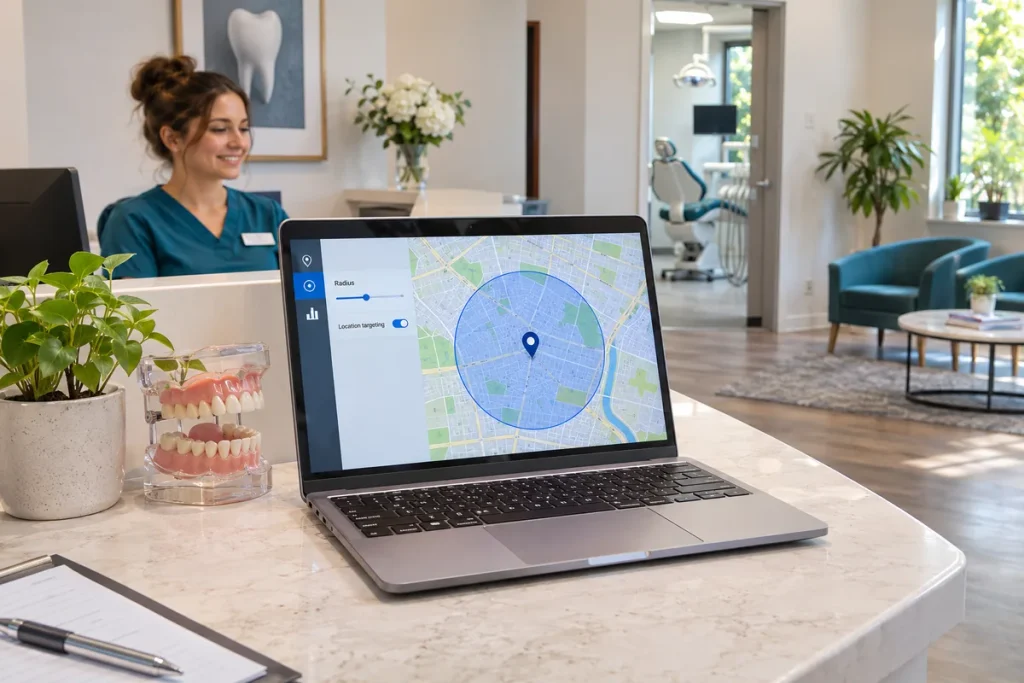
The standard advice for Google Ads location targeting is to target a 5–10 km radius around your clinic location. In most Canadian cities, that is a reasonable starting point. In Toronto, it creates a hidden budget leak that most clinics never identify.
Toronto’s transit network — the TTC, GO Transit, and the UP Express — moves large volumes of people through geographic areas they have no intention of staying in. With broad Google Ads location targeting, a person searching “emergency dentist” on their phone while commuting through North York may trigger your ad, click it, and never book because they live in Brampton and have a dentist there. You paid for that click.
Employment density compounds this. The downtown core, the Financial District, and clusters like the hospital district around University Avenue and College Street pull tens of thousands of workers daily who live in Scarborough, Etobicoke, Mississauga, and beyond. If your clinic is near any of these employment hubs and your Google Ads location targeting is set to a simple radius, your ads are reaching a large population that works near you but would never choose you as their primary dentist.
This is not a general local PPC problem — it is a Toronto-specific structural issue driven by the city’s density, transit corridors, and the separation between where people work and where they live.
The “Presence or Interest” Problem
Google Ads offers two Google Ads location targeting modes: Presence (show ads only to people physically in or regularly in the targeted area) and Presence or Interest (show ads to people in the area or who have shown interest in it).
For dental clinics, “Presence or Interest” can lead to wasted ad spend. It may show your Mississauga dental implant ad to someone in Calgary who recently searched for Mississauga restaurants. That click is unlikely to generate a local appointment. Every Toronto dental clinic should consider using Presence only to focus on people physically located in or regularly present in its service area. This is one of the most important settings to review when optimizing Google Ads location targeting for local dental campaigns.
How to Structure Location Targeting for a Toronto Dental Clinic
Downtown Toronto vs. North York: Different Blueprints
A well-structured Google Ads account for a Toronto dental clinic rejects the “one campaign, 5 km radius” setup. Effective Google Ads location targeting requires separating intent, geography, and procedure value into individual campaigns because patient behaviour differs significantly depending on where they live and work.
Downtown Toronto clinic (Financial District, King West, Yonge and Bloor area)
Downtown clinics face the highest commuter density in the city. Effective Google Ads location targeting needs to account for the fact that many people physically near the clinic during business hours will not book because they are not residents — they are workers who commute in and have established dentists in their home neighbourhoods.
A downtown clinic should:
- Target a tighter radius (2–4 km) than a suburban clinic, because downtown density means that radius still covers a large patient pool
- Segment one campaign specifically for the residential population nearby — Corktown, Distillery District, St. Lawrence, King West residential — using postal code targeting for those neighbourhoods
- Run a separate campaign targeting high-urgency searches (emergency dentist, tooth pain, broken tooth) with broader radius, because patients in acute pain will travel further and urgency overrides the usual proximity preference
- Exclude named transit-hub postal codes (M5J covers the Union Station area; M4W and M4Y cover the Bloor-Yonge interchange) from the residential campaign, while keeping them in the emergency campaign
Midtown Toronto and North York clinics (Yonge and Eglinton, Yonge and Sheppard, Hwy 401 corridor)
Clinics in the Yonge and Eglinton area (midtown Toronto) and further north along the Yonge corridor sit in a zone of mixed residential and commercial density. The Yonge-Sheppard corridor and areas near Hwy 401 have both residents and significant daytime worker populations that commute in from other areas. Effective Google Ads location targeting helps clinics reach relevant local patients while accounting for these commuting patterns.
A North York clinic should:
- Use a 4–6 km radius as a baseline for Google Ads location targeting, then refine with postal code exclusions for areas that fall within the radius but are unlikely to convert (adjacent postal codes with high commercial-only density).
- Target residential postal codes in North York explicitly — Willowdale, Bayview Village, Don Mills, Newtonbrook — rather than relying on the radius to capture them.
- Segment a separate campaign for high-value procedures (dental implants, dental surgery, oral surgery, missing teeth) with willingness to extend the targeting radius, because patients seeking these services are more likely to travel and have higher lifetime value.
- For the Hwy 401 corridor, reduce bids or run a separate campaign with restricted hours to limit exposure during peak commute windows — ad schedules apply to an entire campaign, so isolating these postal codes into their own campaign is the cleanest way to control dayparting independently.
Segment by Procedure, Not Just Geography
A single campaign covering all services — routine dental care, dental implants, teeth cleaning, and emergency dentistry — is a structural problem for two reasons: it makes budget allocation imprecise, and it conflates very different search intents in a way that hurts ad relevance. Effective Google Ads location targeting helps dental clinics organize campaigns by service, geographic area, and patient intent.
The correct segmentation splits campaigns by procedure category and urgency level:
High-urgency campaign: emergency dentist, tooth pain, broken tooth, urgent care dental. This campaign can run with a wider radius because patients in acute pain will travel. It should run 24 hours a day and have budget available outside standard business hours for people searching at night or on weekends.
High-value procedure campaign: dental implants, dental surgery, missing teeth, oral surgery, bone loss. These patients are typically earlier in a decision process and comparing multiple providers. The campaign can target a wider area and use different keywords than the emergency campaign. These patients have higher lifetime value, which justifies a higher cost per click.
Routine and general care campaign: teeth cleaning, general dentistry, routine dental care, dental hygienist, dental checkup. This is the highest-volume category but typically the most price-sensitive and location-sensitive. Tight radius targeting, residential postal code focus, and clear calls-to-action around booking and insurance acceptance.
Specific treatment campaigns: teeth whitening, root canal, veneers, dentures, dental fillings. These are search-intent-specific campaigns that target people actively looking for a specific treatment and can be tied to dedicated landing pages for each service.
Performance Max Campaigns and Location Targeting
Google’s Performance Max campaign type optimizes ads across all Google channels — Search, Display, YouTube, Gmail, Maps, and Discover — using a single campaign. Google markets this as a simplified approach that uses machine learning to find the best placements automatically. However, Google Ads location targeting remains an important factor in ensuring ads reach relevant local audiences and minimizing wasted ad spend.
Google’s Performance Max campaign type optimizes ads across all Google channels — Search, Display, YouTube, Gmail, Maps, and Discover — using a single campaign. Google markets this as a simplified approach that uses machine learning to find the best placements automatically. Google Ads location targeting is also an important part of this campaign setup.
If using Performance Max, dental clinics should:
- Set Google Ads location targeting to Presence only within the campaign settings.
- Use location exclusions to block postal codes and regions outside the realistic patient catchment area.
- Monitor the Location performance report closely in the first weeks after launch to identify where impressions are actually being served and improve Google Ads location targeting.
- Run Performance Max alongside, not instead of, standard Search campaigns for high-intent keywords — search campaigns give you more control over keyword targeting and location handling.
For most Toronto dental clinics, standard Search campaigns with well-structured ad groups and tight Google Ads location targeting outperform Performance Max in the early months. Performance Max can be valuable once there is enough conversion data for the algorithm to optimize against, but it is not the right starting point for a clinic with limited historical data.

Reading Your Location Performance Report
Google Ads provides a Location performance report that shows how ads are performing by geographic area — by region, city, postal code, or the custom areas you have set up. For Toronto dental clinics, this report is one of the highest-value optimization tools available for Google Ads location targeting because it reveals exactly where your budget is going and which areas are converting.
After running campaigns for four to six weeks, the Location report typically shows:
- Which postal codes are generating the most conversions relative to spend
- Which areas have high click volumes but low or zero conversions (these are candidates for exclusion or bid reduction)
- Whether suburban areas that fall within the radius are converting at rates worth the spend
- Time-of-day patterns by area — downtown postal codes may convert better on weekdays while residential North York postal codes may convert better on evenings and weekends
Acting on this data is what separates a campaign that improves over time from one that runs flat. Toronto’s density means the variation in Google Ads location targeting performance between adjacent postal codes can be significant. A postal code one block from your clinic may underperform a postal code three kilometres away simply because of the commuter vs. resident ratio in each zone.
Review the Location report monthly for the first three months to improve Google Ads location targeting. Add exclusions for areas with more than 50 clicks and zero conversions. Increase bids for postal codes with strong conversion rates. This calibration process — reviewing, adjusting, waiting, reviewing again — is how a Toronto dental Google Ads account improves from a basic setup into one that reliably produces patient bookings.
Setting Up Conversion Tracking Correctly
Location targeting improvements are only measurable if conversion tracking is set up correctly. Many Toronto dental clinics track clicks as conversions — this tells you nothing about whether the click became a patient.
Conversion tracking for a dental clinic should capture:
- Phone calls from ads: calls that last more than a defined threshold (60 seconds is a reasonable starting point) are more likely to be appointment bookings than misdials or general inquiries
- Form submissions: online booking requests and contact form completions from the landing page
- Online booking completions: if the clinic uses an online scheduling system, tracking completed bookings directly is the most accurate conversion signal available
Google Analytics can be connected to the Google Ads account to pass these conversion events back and allow Google’s algorithm to optimize toward the signals that actually drive patients. Without this, the algorithm optimizes for clicks — and in Toronto’s commuter-heavy environment, clicks are not a reliable proxy for appointments. This data also helps improve Google Ads location targeting based on actual patient conversions.
Tracking booked appointments rather than clicks provides better data for optimizing the campaign and allocating budget across the different campaign segments. Over time, this data tells you which postal codes, which times of day, and which keywords produce the highest ratio of bookings to clicks — which is the information needed to tighten Google Ads location targeting further.
Budget Allocation for Toronto Dental Google Ads
Budget allocation across the campaign segments depends on the clinic’s service mix and competitive landscape:
- Emergency and high-urgency campaigns should have budget available at all hours, including evenings and weekends, since dental emergencies do not follow business hours
- High-value procedure campaigns (implants, surgery) warrant higher per-click budgets because the patient lifetime value is higher — a dental implant patient is worth significantly more than a routine cleaning patient
- Routine care campaigns can run on tighter radius targeting, since these patients are strongly location-sensitive
Daily budgets can be adjusted at any time in the Google Ads account. It is worth reviewing budget pacing weekly for the first month of a new campaign, since daily spend can vary significantly and an overspend early in the month can exhaust the budget before the month ends.
The Canadian Dental Care Plan and Location Targeting
The Canadian Dental Care Plan (CDCP) has changed how some patients search for dental care. Patients eligible under the plan are actively looking for providers who accept it, and “dentist accepting CDCP” searches have grown significantly since the plan’s rollout.
For Toronto dental clinics that accept CDCP patients, this represents a Google Ads location targeting opportunity: a campaign or ad group specifically structured around CDCP-related searches, with location targeting focused on the postal codes where CDCP eligibility is higher, can capture patients who are ready to book but filtering first on whether the clinic participates in the plan.
This is a narrow but high-intent segment well worth including in any Toronto dental Google Ads account that participates in the plan.

Frequently Asked Questions
What is Google Ads location targeting for dental clinics?
Google Ads location targeting controls which geographic area sees your ads. For dental clinics, it means your ads show to people searching for dental services in a defined area around your clinic — typically a radius, a set of postal codes, or a combination. The goal is to reach patients who are realistically likely to book, not just anyone in a broad area.
Why does Toronto require different location targeting than other Canadian cities?
Toronto’s combination of transit density, high commuter volumes, and the separation between where people work and where they live creates a targeting problem unique to the GTA. Patients near your clinic during business hours are frequently commuters from other parts of the city or region who will not book a local dentist. Standard radius targeting captures these users and charges you for clicks that will not convert.
What targeting mode should a Toronto dental clinic use in Google Ads?
Presence only. This Google Ads location targeting setting shows ads to people physically located in or regularly present in your targeted area. The alternative — Presence or Interest — also shows ads to people who have shown interest in the area but may be located anywhere, which is not useful for a dental practice trying to attract local patients.
How should a Toronto dental clinic structure its Google Ads campaigns?
Separate campaigns by urgency and procedure value: one for emergency and high-urgency searches, one for high-value procedures like dental implants and oral surgery, and one for routine general dentistry. Each campaign should have its own targeting radius and postal code inclusions or exclusions appropriate to the patient behaviour for that service type.
What should conversion tracking measure for a dental practice?
Phone calls from ads (above a minimum duration threshold), online booking form completions, and completed online appointment bookings if available. Tracking clicks alone does not distinguish between a patient who booked and one who called to ask about parking. Conversion data tied to actual appointments is what allows the Google Ads account to optimize toward genuine patient acquisition.
What determines how much a Toronto dental clinic should spend on Google Ads?
Budget depends on the clinic’s service mix, geographic targets, and competitive pressure in those postal codes. A campaign covering emergency, high-value, and routine segments will need more daily budget than a single-service campaign. Reviewing pacing weekly in the first month and adjusting Google Ads location targeting based on what the Location report shows is more reliable than starting with a fixed figure.
How does the Canadian Dental Care Plan affect Google Ads targeting for Toronto dentists?
Clinics that accept CDCP patients can build a targeted ad group around CDCP-related search terms, with Google Ads location targeting focused on postal codes where CDCP eligibility is higher. These are high-booking-intent searches from patients specifically seeking a participating provider.
About Dentist Spark
Dentist Spark is a dental marketing agency based in North York, ON, working exclusively with Canadian dental practices. We manage Google Ads campaigns, local SEO, and Google Business Profile optimization for dental clinics across Toronto and the GTA.
If you want a review of your current Google Ads location targeting or want to build a campaign structure that matches Toronto’s specific geography, learn more about our dental Google Ads management or contact Dentist Spark.
Website: dentistspark.com Email: info@dentistspark.com Phone: +1 866-753-1112