Dental practices rank in the Google Map Pack by completing their Google Business Profile, building consistent local citations, and earning a steady stream of patient reviews. Dentist Spark helps Ontario dental clinics achieve and maintain Map Pack positions across North York and the Greater Toronto Area. This guide covers every ranking factor, the exact steps, and when to stop doing it yourself.
Key Takeaways
Key Takeaways
✓ 46% of all Google searches have local intent — for dental searches, this figure is higher because most patients search for a dentist near their home or workplace, not a national brand.
✓ The Google Local Pack shows only 3 business listings above organic search results — a dental clinic not in the top 3 is invisible to the majority of patients searching on mobile devices.
✓ 50% of local search users visit a business within 24 hours of searching — for dental practices, this means Map Pack visibility directly translates to same-day appointment enquiries.
✓ 60% of smartphone users contact businesses directly from local search results — a dental clinic without a complete Google Business Profile loses these contacts entirely.
✓ Consistent NAP (name, address, phone number) information across all digital listings is the single most important citation signal for local search ranking — one mismatch suppresses the entire profile.
Before You Start
This guide is for dental practice owners, practice managers, and in-house marketing coordinators across Ontario who want to improve or establish their dental clinic’s position in the Google Local Pack. It requires a claimed and verified Google Business Profile, access to your dental website’s CMS, and the ability to update your clinic’s information across online directories. If your Google Business Profile is unclaimed or suspended, resolve that before any other step — all other optimisation is wasted on an unverified listing.
The Google Map Pack — also called the Google Local Pack, local 3-pack, or local finder — is the block of three local business listings that appears above organic search results for queries with local intent. For a dental clinic in Ontario, this is the highest-traffic position in local search, ahead of every organic search result and equal in visibility to paid ads for searches like ‘dentist near me,’ ’emergency dentist North York,’ and ‘dental clinic toronto.’ Getting into this position is the single highest-ROI activity in local SEO for dentists.
What You Need
• Claimed and verified Google Business Profile — with owner-level access, not just manager access
• Google Search Console — to monitor which search queries are driving visits to your dental website
• A citation audit tool — BrightLocal, Whitespark, or Moz Local to identify NAP inconsistencies across directories
• Access to your dental website CMS — to add or update location pages, meta tags, and schema markup
• A review request system — SMS platform or email automation to send review links to patients after appointments
• A spreadsheet of all existing directory listings — to track NAP consistency across Google, Yelp, RateMDs, Yellow Pages, Ontario Dental Association, and local health directories
• Google Analytics or GA4 — to track which local search queries are producing website visits and patient enquiries

Safety and Prerequisites
Do not optimise your Google Business Profile using a business address that is not a real, publicly accessible dental office location. Google’s terms of service prohibit virtual offices, PO boxes, and shared co-working addresses as business locations for local listings. A profile built on a non-compliant address will be suspended, removing the practice from the Google Local Pack entirely and requiring a reinstatement process that can take weeks.
Do not use keyword stuffing in your Google Business Profile business name. Adding service keywords to your business name — ‘Smith Dental Implants and Cosmetic Dentistry’ when the registered business name is ‘Smith Dental’ — violates Google’s guidelines and is a common reason for profile suspension. The business name field must match the legal registered name of the dental practice. Keyword optimisation belongs in the business description, services, and posts — not in the name.
Step-by-Step: How to Rank a Dental Clinic in the Google Map Pack
Google Map Pack Ranking Factors — Profile / On-Page / Off-Page
| Factor Type | Ranking Factor | Weight | What It Means Practically |
| Profile | Google Business Profile completeness | Very High | Every field completed; primary category set to ‘Dentist’ |
| Profile | Review volume and recency | Very High | Regular new reviews; responses to all reviews within 48 hours |
| Profile | NAP consistency | High | Name, address, phone identical across all listings |
| Profile | Photo quality and frequency | Medium | Real clinic photos added monthly; no stock images |
| Profile | Posts and Q&A activity | Medium | Weekly posts; questions answered within 24 hours |
| On-Page | Location page with local keywords | High | Dedicated page per location with neighbourhood content |
| On-Page | Title tags and meta tags with location | High | City and service in H1, title, and meta description |
| On-Page | Schema markup (LocalBusiness/Dentist) | Medium-High | Structured data confirming NAP, hours, services |
| On-Page | Website load speed and mobile experience | Medium | Core Web Vitals passing; mobile-friendly design |
| Off-Page | Citation volume and accuracy | High | Listed in major dental and local directories; NAP matching |
| Off-Page | Link building from local sources | Medium-High | Links from Ontario health sites, local news, dental associations |
| Off-Page | Review signals across platforms | Medium | Reviews on Google, RateMDs, Yelp; consistent rating |
Step 1 — Complete and Optimise Your Google Business Profile
Log in to your Google Business Profile at business.google.com. Work through every available field systematically. Business name must match your legal registered name exactly. Primary business category must be set to ‘Dentist’ — not ‘Health’ or ‘Medical Clinic.’ Add every applicable secondary category: ‘Cosmetic Dentist,’ ‘Emergency Dental Service,’ ‘Dental Implants Periodontist,’ ‘Orthodontist’ where relevant to the services your practice offers.
The business description (750 characters) must include your primary local keywords naturally: your city or neighbourhood, the specific dental services you offer, and a statement confirming you are accepting new patients. Write it for the patient, not for the search engine — but include terms patients actually search: ‘dental clinic north york,’ ‘local keywords like emergency dentist,’ and service-specific terms. Add your opening hours accurately — including any extended hours or same-day appointment availability that would make all the difference to a patient searching urgently.
Add the street address exactly as it appears on your Canada Post record. Add your primary phone number — the same number that appears on your dental website and every directory listing. Upload a minimum of 10 photos on initial optimisation: the clinic exterior (from the street, so patients can identify the location from Google Maps), the reception area, treatment rooms, and real photos of the dental team. Google’s algorithm weights photos by authenticity — stock images score lower than genuine clinic photography. Add new photos on a regular basis — monthly is the recommended frequency for an active local business profile.
Result to look for: after completing your Google Business Profile, open an incognito browser window and search ‘dentist [your neighbourhood]’ and ‘dental clinic [your city].’ Your practice should appear in the local finder (the expanded local search results map view) within 24–48 hours of profile completion. If it does not appear in the local pack within 2 weeks, the profile has a verification issue or a guideline violation that needs to be resolved before any additional optimisation.
Step 2 — Build and Repair Your Local Citation Profile
A citation is any mention of your dental clinic’s business information — name, address, phone number — on an external website. Citations are a primary local search ranking signal because they function as verification for Google’s algorithm: the more authoritative external sources that confirm your clinic’s location, the higher the confidence that the business information is accurate and the business is legitimate.
Directory platforms that support businesses with local listings — Yellow Pages, Yelp, RateMDs — are important citation sources, but they differ in their verification processes and how quickly updates propagate to search engines. Audit your existing citations using a tool like BrightLocal or Whitespark. Export every listing that references your dental clinic. Check each one for NAP accuracy — the name, address, and phone number must be identical across every listing. A business listed as ‘123 Yonge Street’ on Google and ‘123 Yonge St.’ on Yelp creates a minor inconsistency. A business listed with a previous phone number on 40 directory sites creates a significant suppression signal. Fix every inconsistency before building new citations.
Priority citation sources for Ontario dental practices include: Google Business Profile, Yelp Canada, RateMDs, Yellow Pages Canada, Healthgrades, the Ontario Dental Association directory, the Royal College of Dental Surgeons of Ontario practitioner directory, Canada 411, Foursquare, and local neighbourhood directories.
Build new citations only after the existing ones are clean. For each new directory listing, use the identical NAP information as your Google Business Profile. Include your dental website URL, your primary business category (‘Dentist’), and a brief description that includes your location and primary services. Do not create multiple listings for the same location on the same platform — duplicate listings confuse Google’s algorithm and dilute the authority of your primary listing.
If It Does Not Work First Time
If citation cleanup does not improve Map Pack visibility within 60 days, the suppression source is likely a duplicate Google Business Profile — a second listing for the same location created by a previous owner, a staff member, or Google’s automated business detection. Search Google Maps for your dental clinic’s address. If more than one listing appears, request merger or suppression of the duplicate through the Google Business Profile support process.
Most Common Cause
A previous phone number or address associated with the clinic — from a previous location or ownership change — remains active on dozens of directory sites and contradicts the current Google Business Profile data, suppressing the clinic’s Map Pack confidence score.
Stop Here If You See This
If your Google Business Profile shows a ‘Suspended’ status, stop all other optimisation immediately and resolve the suspension before proceeding.
Step 3 — Build Location-Specific Pages and On-Page Local SEO
Your dental website is the second major component of Map Pack ranking — after your Google Business Profile. Google evaluates your website to confirm the information in your profile, assess the relevance of your content to local keywords, and determine whether your dental clinic is a credible, authoritative local business. A dental website with no location-specific content, no local keywords in title tags and meta tags, and no schema markup for a local business sends weak signals to Google’s algorithm.
Create a dedicated location page for each dental clinic location. The page must include: the full street address, phone number, and opening hours (identical to the Google Business Profile); a Google Map embed showing the clinic location; neighbourhood-specific content describing the local area the clinic serves; internal links to service pages for each dental treatment offered at that location; and schema markup in LocalBusiness and Dentist format, confirming the NAP, business category, opening hours, and service area.
Every page that ranks in local search results must contain relevant information that matches what the patient searched for. Optimise title tags and meta tags for local search intent to rank higher in both the local pack and organic results. The title tag format for a dental clinic homepage: ‘Dentist in [Neighbourhood] | [Practice Name] | [City].’ The title tag format for a service page: ‘[Service] in [Neighbourhood] | [Practice Name].’ Meta tags (specifically the meta description) should include the primary local keyword, a call to action, and a differentiating element — ‘Accepting new patients | Direct billing available | Same-day appointments.’
These meta tags do not directly affect Map Pack ranking but they improve click-through rate from search engine results pages, which does influence local search ranking over time.
Keyword research for local dental SEO should focus on procedure-plus-location combinations — ‘dental implants north york,’ ’emergency dentist toronto,’ ‘teeth whitening etobicoke’ — rather than generic head terms like ‘dentist.’ These local keywords convert at a higher rate and face lower competition from the large directory websites that dominate generic dental search results. What AEO means for dental practices covers how AI-generated search answers are changing which local keywords produce the most visibility — an important consideration for any dental clinic building a local SEO strategy in Ontario today.
Step 4 — Build Review Velocity and Respond to Every Review
Step 4a — Set Up Your Review Request Process
Patient reviews are the most visible and influential signal in Google’s Local Pack algorithm. The practices that dominate the local pack in competitive Ontario markets — North York, downtown Toronto, Etobicoke, Scarborough — consistently have higher review counts, more recent reviews, and better review response rates than their competitors. Review velocity (the rate at which new reviews arrive) matters as much as total review volume.
Build a systematic review request process: send a direct review link to every patient via SMS within two hours of their appointment. The message should be short, personal in tone, and contain the exact Google Business Profile review URL. Do not offer incentives for reviews — this violates Google’s review policies and risks profile suspension. Do not filter which patients receive review requests — review gating violates Google’s policies and is easily detected by the Google algorithm.
Respond to every review — positive and negative — within 48 hours. For positive reviews: acknowledge the feedback generically, thank the patient without confirming clinical details (PHIPA compliance), and keep the response under three sentences. For negative reviews: acknowledge the concern without confirming the patient relationship, express willingness to resolve the issue, and invite the patient to contact the clinic directly. Never argue publicly. Never confirm appointment dates or treatment details in a public response — this creates a PHIPA violation regardless of the content of the original review.
Verify the impact: after 90 days of consistent review requests and responses, your Google Business Profile’s review count and average rating should both show measurable improvement. Check your position in the local pack for three to five target queries monthly — tracking position changes against review volume changes confirms that the review strategy is translating into ranking improvement. If review volume is growing but local pack position is not improving, the suppression is coming from a citation issue or on-page signal, not reviews.
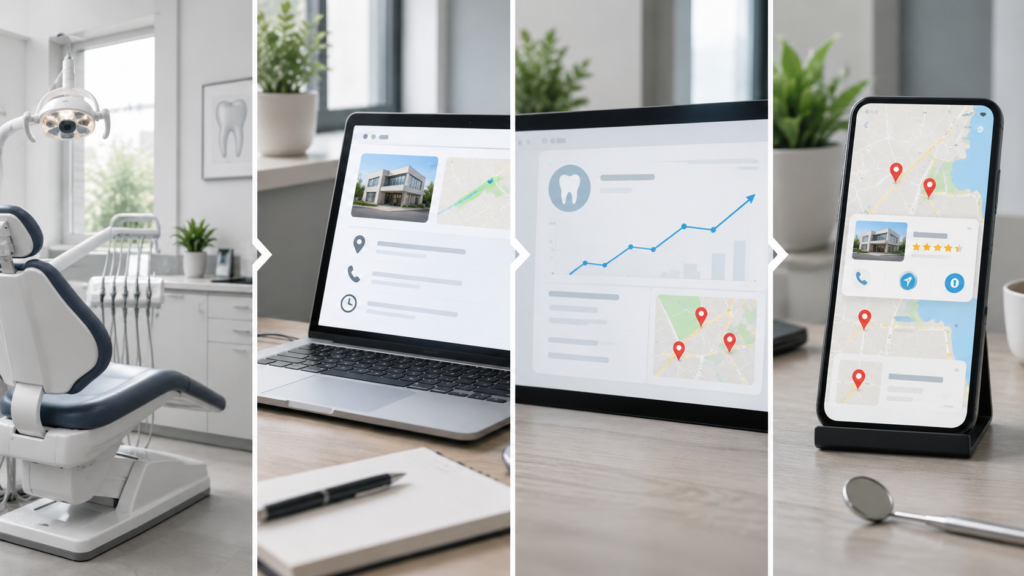
Local SEO Tools, Account Setup, and How to Optimize for the Local Pack
To rank higher in local search results and reach more customers on the first page of Google, dental practices need more than a claimed Google Business Profile — they need a systematic approach to every signal Google’s algorithm evaluates. The right tools make this process measurable. Google Business Profile itself is free and provides additional information about how patients find your listing — the number of searches, map views, phone calls, direction requests, and website visits generated by your profile each month.
Google Search Console, Your Account, and Tracking More Results Over Time
Google Search Console and your Google Business Profile account show which search queries bring users to your dental website, which pages appear in search results, and which local keywords are generating clicks versus impressions. For dental clinics, the most valuable data is the search query report filtered by queries containing your city or neighbourhood — this reveals which local keywords are generating website traffic and which are generating impressions without clicks (indicating a ranking position on page 2 or below). Optimise those pages with stronger local content and better meta tags to move them to the first page of search results.
Patients searching for dental services on mobile devices use Google Maps to find the nearest relevant dental clinic — they search by their location, browse local search results on the map view, and call directly from the listing. For dental clinics, Google Maps is a primary patient acquisition channel. Every optimisation to your profile directly affects what patients see when they search the map for a dentist in your area.
Videos added to your Google Business Profile — short clips of the clinic interior, team introductions, or patient experience walkthroughs — provide additional information to patients evaluating their options. Profiles with videos receive higher engagement than those with photos alone. For dental practices concerned about PHIPA compliance, ensure no patient-identifiable information appears in any video content. Staff introduction videos and clinic tour videos are both compliant and effective.
Schema markup — structured data added to your dental website — helps search engines understand your business information more accurately. A dental clinic marked up with LocalBusiness and Dentist schema communicates its name, address, phone, opening hours, services, and geographic service area directly to the Google algorithm, without requiring the search engine to infer these details from page content. Structured data does not guarantee Map Pack ranking, but it removes ambiguity — and in local SEO, ambiguity costs rankings.
Investing in local SEO generates compounding returns — unlike paid ads, those Map Pack positions do not stop producing patients when the budget runs out. Google’s local search algorithm — developed at the company’s headquarters in Mountain View, California and continuously updated to reflect real-world user behaviour — uses prominence signals — the overall online presence of a dental clinic across the web — to evaluate how well-known a local business is relative to its competitors. Prominence is built through link building from authoritative external sites, citation volume and consistency, review count and rating, and the frequency of mentions of the business name and address across the internet.
For dental practices, building prominence means earning links from the Ontario Dental Association, local health news sites, community organisations, and dental industry publications — not just directory listings. Each authoritative external link that confirms your business information and location strengthens your prominence signal and improves your local pack position.
For multi-location dental practices, each location needs its own distinct optimisation path — separate Google Business Profile, separate location page, separate citation profile, and separate review management. Dental groups that share a single website without location-specific pages, or that manage all locations under one Google Business Profile, suppress the Map Pack visibility of every individual location. The local algorithm needs to see each location as an independent local business with its own complete profile to rank it in the local pack for that location’s surrounding area.
Online Marketing, Digital Marketing, and Web Development — What Dental Clinics Can Handle Internally
Most dental clinics can handle their initial Google Business Profile setup, basic citation building, and review request automation internally. Online marketing tools for small businesses — including free Google tools like Google Business Profile, Google Search Console, and Google Analytics — give dental practices the right tools to monitor search results, track website traffic, and respond to patient reviews without external help. Web development for location pages and schema markup typically requires technical support, but the strategic work — keyword research, citation management, and Google Business Profile optimisation — is manageable with the steps in this guide.
Online visibility through the Google Map Pack is not a one-time setup. It requires regular maintenance: updating opening hours for holidays, adding photos on a regular basis, publishing posts, responding to reviews, and monitoring the search results page for competitors gaining ground. For a dental clinic seeing 30+ patients per week, doing this consistently while managing patient care becomes the point at which external digital marketing support pays for itself — typically within the first 60 to 90 days of professional management.
When DIY Stops Being Sensible
In the near future, AI-generated search answers will draw increasingly from Google Business Profile data — making Map Pack visibility a top priority. Local SEO for a single dental clinic in a low-competition Ontario market — a small town or suburban area with fewer than 10 competing dental clinics — is manageable with the steps in this guide and a consistent monthly time commitment. The work is mechanical: update the Google Business Profile weekly, request reviews after every appointment, fix citation inconsistencies, and add location-specific content to the dental website quarterly. For dental clinics in competitive urban markets — North York, downtown Toronto, Etobicoke, Scarborough — the picture is different.
Toronto has over 3,500 registered dental practices competing for Map Pack positions in a relatively small geographic area. The top three positions in any competitive local search query are held by clinics with complete citation profiles, 200+ reviews, active link building from local sources, and content strategies updated on a regular basis. Competing at this level requires more than a one-time profile completion — it requires ongoing management. At that point, local SEO for dentists provided by a specialist who works exclusively with dental practices in Ontario delivers more consistent results than a practice manager dividing attention between patient care and digital marketing.
Whether Google Ads or local SEO is the right investment for a dental clinic depends on how competitive the local market is and how quickly the practice needs to generate new patients. Map Pack ranking through local SEO takes three to six months to produce measurable results in competitive markets — Google Ads produces results within days. Most dental clinics in North York and the Greater Toronto Area need both, running in parallel, with the long-term local SEO investment reducing the cost per patient as organic visibility compounds.
What a North York Dental Marketing Professional Does Differently
Dentist Spark’s Map Pack ranking process for Ontario dental clinics begins with a full local SEO audit — reviewing the Google Business Profile completeness score, citation consistency across 50+ directories, on-page local SEO signals, review velocity, link building profile, and current Map Pack position for 10–15 target queries. This audit identifies the specific suppression factors holding the clinic out of the top three positions and ranks them by impact — so the highest-return work happens first.
Our citation management process corrects every NAP inconsistency across priority directories before building new citations. We submit to dental-specific directories, Ontario health directories, and local neighbourhood sites that carry geographic relevance for the clinic’s specific service area. Each citation is built with the identical business information and includes the dental website URL, business category, and a description optimised for local search intent.
We build location pages for each dental clinic location using a structured template that includes schema markup in Dentist and LocalBusiness format, neighbourhood-specific content, service information, and internal linking to individual service pages. Every location page is tested for mobile experience and Core Web Vitals before publication — a slow or broken location page sends a negative signal to the Google algorithm regardless of how accurate the business information is.
For dental clinics with multiple locations across Ontario, ranking multi-location dental practices requires a distinct strategy for each location — separate Google Business Profiles, separate location pages, separate citation profiles, and separate review management processes — while maintaining consistent brand signals across the group. Dentist Spark manages this as a coordinated system rather than independent campaigns, ensuring that each location’s local SEO signals reinforce rather than compete with the others.
Our monthly reporting shows Map Pack position changes for each target query, review volume and rating trend, citation count and consistency score, and the specific actions taken during the reporting period. Every metric is tied to a visible, verifiable ranking change — not to traffic proxies or engagement metrics that look active but do not translate to new patient bookings.

Frequently Asked Questions
How does the Google Map Pack and local search results work for small businesses using online marketing?
The Google Local Pack shows the top three local businesses for searches with local intent — queries like ‘dentist near me’ or ‘dental clinic north york.’ Google determines which three businesses appear using three primary signals: relevance (how well the business matches the search query), distance (how close the business is to the user’s location), and prominence (how well-known and trusted the business is online). The Local Pack appears above organic search results and receives the majority of clicks for local dental searches.
How long does it take to rank in the Google Local Pack in Ontario?
A dental clinic with a newly completed Google Business Profile, clean citation profile, and active review generation typically sees initial Map Pack visibility within four to eight weeks for low-competition local keywords. For competitive markets like North York or downtown Toronto, reaching a top-three position for high-volume dental searches takes three to six months of consistent local SEO effort. The Google algorithm updates local rankings continuously — positions shift as competitors add reviews, build citations, and improve their profiles.
What is the difference between Google Map Pack results and organic search engine results?
The Google Map Pack — also called the Google Local Pack or local 3-pack — shows three local business listings with ratings, addresses, phone numbers, and a map at the top of the search results page. Organic search results appear below the Map Pack and show website links based on traditional SEO signals like content quality, link building, and keyword relevance. The Map Pack is driven primarily by Google Business Profile signals, citation consistency, and reviews. Organic search results are driven primarily by on-page SEO, link building, and content authority.
Does a dental clinic need both local SEO and Google Ads for link building and keyword research in Ontario?
Local SEO and Google Ads target the same patients through different mechanisms. Local SEO builds the Map Pack and organic search results positions that produce free, compounding traffic over time. Google Ads produces immediate paid visibility at the top of the search engine results pages — above even the Map Pack. Whether Google Ads is worth it for small dental practices depends on budget and timeline. Most competitive Ontario dental markets require both: Google Ads for immediate new patient acquisition while local SEO compounds, and local SEO for long-term cost-per-patient reduction as organic and Map Pack traffic grows.
Every dental clinic Dentist Spark manages receives a monthly Map Pack position report showing rank changes for each target query, review volume and rating trend, citation consistency score, new backlinks acquired, and a summary of profile changes made during the reporting period. This data shows precisely whether the local SEO investment is translating into measurable improvements in search visibility — and which factors to address next to maintain or improve Map Pack position in the competitive Ontario dental market.
About Dentist Spark
Dentist Spark is a dental marketing agency based in North York, Ontario, working exclusively with dental clinics across the Greater Toronto Area and Ontario. We provide local SEO for dentists including full Google Business Profile optimisation, citation management, location page development, review strategy, link building, and monthly Map Pack position reporting. Every local SEO engagement is managed without long-term contracts — our results produce the retention. We work exclusively with dental practices, which means every strategy is built around the Ontario dental market, RCDSO compliance requirements, and the specific local search behaviour of dental patients.
Service Area
Dentist Spark serves dental clinics in North York, downtown Toronto, Etobicoke, Scarborough, Mississauga, Markham, Vaughan, Richmond Hill, Newmarket, and across Ontario. We manage local SEO for dental practices at every stage — from a newly opened single-location clinic building its first Google Business Profile to an established multi-location dental group managing Map Pack positions across eight Ontario municipalities. Our keyword research, citation management, and link building strategies are built specifically for the Ontario dental market and Canadian search behaviour.
Next Step
If your dental clinic is not appearing in the Google Map Pack for your target local keywords, local SEO for dentists from Dentist Spark starts with a free Map Pack audit — we identify exactly which signals are suppressing your visibility, show you where your nearest competitors are outranking you, and give you a clear priority list of what to fix first. No commitment required.