Most dental Google Ads campaigns that get clicks but produce no booked appointments fail for one of three reasons: the ads are targeting the wrong keywords and attracting people who were never going to book, the landing page does not give patients a clear next step, or conversion tracking is broken so the campaign cannot learn what is working. This guide covers seven specific causes and their fixes, written for Ontario dental practice owners and managers who have already launched Google Ads and are not seeing patient appointments as a result. If any of these issues is present in your account, fixing it typically produces measurable improvement within two to four weeks.
Key Takeaways
- ✓ Dental Google Ads can start generating patient inquiries within two to three weeks of launching — if the campaign is structured correctly from the start.
- ✓ The most common reason dental ads get clicks but no appointments is a mismatch between what the ad promises and what the landing page delivers.
- ✓ Dental cost-per-click typically ranges from C$4 to C$27+ depending on the service; without negative keywords and tight geographic targeting, budget drains quickly on clicks that never convert.
- ✓ 70% of dental searches occur on mobile devices — a landing page that loads slowly or is hard to navigate on a phone will lose the majority of ad traffic before a patient makes contact.
- ✓ Conversion tracking is not optional — without it, Google’s smart bidding algorithms cannot optimise toward the actions that actually produce booked appointments.
- ✓ Google Ads and dental SEO serve different time horizons: ads provide immediate visibility while SEO builds the long-term organic patient acquisition base that reduces cost per new patient over time.
Is It Your Google Ads or Your Wider Dental Marketing?

Before working through the seven fixes below, it is worth confirming that the problem is actually the Google Ads campaign and not something else in the practice’s marketing or operations.
Signs the problem is the Google Ads campaign itself:
- The campaign is generating clicks but zero or near-zero phone calls or form submissions
- The search terms report shows the ads are appearing for irrelevant searches
- The cost per click is high relative to the service being advertised
- Conversion tracking is not set up or is reporting zero conversions
Signs the problem is elsewhere:
- Calls and form submissions are coming in, but patients are not showing up or booking — this is a front-desk or booking process issue, not an ads problem
- Organic traffic and referrals are also declining — this may point to a broader dental marketing or reputation issue rather than Google Ads specifically
- The website has no online reviews or has a poor review profile — patients who click an ad and then check Google reviews may be leaving without contacting the practice
- The dental practice’s Google Business Profile is incomplete or inaccurate — this affects trust even for patients who found the practice through paid ads
If the problem is the landing page, the booking process, or the practice’s online reputation, fixing the Google Ads campaign structure will not resolve it. The fixes below are specific to the campaign itself.
Fix 1: Wrong Keywords Are Attracting the Wrong Clicks
The most common cause of dental ads that generate clicks but no appointments is keyword targeting that is too broad. When a campaign uses broad match keywords, Google interprets the intent loosely and can show the ads for searches that have nothing to do with booking a dental appointment.
A dental practice running broad match on “dentist” may find its ads appearing for searches like “dental assistant courses,” “how to become a dentist,” or “free dental care clinics.” These searches generate clicks but attract people who are not prospective patients — and every click costs money.
The fix: Switch from broad match to phrase match and exact match for high-intent dental keywords: “dentist near me,” “dental implants [city],” “teeth whitening [city],” “emergency dentist open now,” and “same day appointments.” Dental implant keywords average C$16 to C$34 per click in competitive Ontario markets; emergency dental keywords range from C$8 to C$20. Paying those rates for clicks from people searching for dental school admissions exhausts a monthly budget with nothing to show for it. (Source: WordStream Dental Industry Benchmarks, 2025, via Stub Group)
Fix 2: No Negative Keywords — or Too Few
Negative keywords tell Google which searches should never trigger the ads. Without a maintained negative keyword list, even a well-structured campaign leaks budget on irrelevant clicks.
Common categories of searches that dental Google Ads should exclude:
- Free dental care: “free dental,” “low-income dental,” “dental charity” — patients searching for free services are not the target audience for a private dental practice
- Education and careers: “dental assistant school,” “dental hygienist program,” “how to become a dentist”
- DIY searches: “how to fix a broken tooth at home,” “pull your own tooth”
- Competitor brand names: unless the campaign is specifically designed for competitive conquest
- Wrong geography: searches that include city names outside the practice’s service area
A mature dental Google Ads account should include several hundred negative keywords across these categories. Review the search terms report weekly during the first three months to catch new irrelevant searches. Agencies that work exclusively in the dental industry typically arrive with a pre-built negative list, which cuts wasted spend in the first weeks of a new campaign.
Fix 3: The Landing Page Does Not Convert
Google Ads send patients to a page. If that page does not give patients a clear, frictionless path to booking an appointment, the click is wasted regardless of how well the ad performed.
The most common landing page problem in dental Google Ads campaigns is sending all ad traffic to the practice’s homepage. Homepages are designed for general exploration — they present the full range of dental services, the team, the practice history, and a navigation menu. A patient who clicked an ad for “dental implants Mississauga” and lands on a general homepage has to search for the relevant information themselves, and most will not.
A converting dental landing page needs: a headline that matches the ad; a visible phone number and booking form above the fold; patient testimonials or Google reviews specific to the service; a load time under three seconds (Google recommends this, and 70% of dental searches occur on mobile devices); and a single clear call to action. If the campaign runs separate ad groups for dental implants, teeth whitening, and emergency dentistry, each should point to its own dedicated page.
Fix 4: Conversion Tracking Is Broken or Missing

This is the issue that makes every other fix harder: if the campaign is not tracking conversions, there is no way to know which keywords, ads, or landing pages are producing patient appointments and which are producing nothing.
Google’s smart bidding strategies — Target CPA, Maximise Conversions, Target ROAS — rely on conversion data to optimise the campaign. A campaign without conversion tracking cannot use these bidding strategies effectively and is essentially running blind.
Track: phone calls from the ad’s call extension; phone calls from the landing page (via call tracking software); online booking form submissions (as a Google Analytics conversion event passed to Google Ads); and appointment confirmations if the booking system allows it. Set up Google Analytics, link it to the Google Ads account, and import conversion goals into Ads. This enables cost-per-lead reporting — the most useful measure of campaign performance.
Fix 5: The Budget Is Too Low for the Market
Underfunding a dental Google Ads campaign is one of the most common causes of poor results, and it is often misread as an ads problem when it is actually a budget problem.
Google Ads operates on an auction system. When a campaign’s daily budget runs out — at 10 AM on a Tuesday in a competitive Toronto dental market — the ads stop showing. The practice misses all patient searches for the rest of the day, including the peak evening hours when many patients search on mobile devices after work.
Dental CPC typically ranges from C$4 to C$27 per click depending on the service and the local market. In competitive Ontario markets, a daily budget of C$30–C$50 produces very limited impressions. A starting budget of C$1,500–C$2,000 per month is commonly recommended for testing, with C$2,000–C$5,000 or more per month for established campaigns in competitive areas like the GTA, Mississauga, or Ottawa. (Source: Stub Group, 2025)
Signs the budget is too low:
- The campaign impression share is below 40–50%
- Average ad position is low (ads appearing at the bottom of search results pages)
- The daily budget runs out before noon on most days
The fix is not necessarily to spend more immediately — it is to narrow the campaign focus so the available budget concentrates on the highest-value, highest-intent search terms rather than spreading thinly across every dental keyword.
Fix 6: Poor Campaign Structure
A dental Google Ads account that runs a single campaign covering all dental services — implants, whitening, emergency dentistry, general dentistry, cosmetic treatments — in one ad group is almost always underperforming. This structure forces Google to match a wide range of keywords to a small set of ad copy, reducing ad relevance and quality scores, which in turn raises costs and lowers ad placement.
Better campaign structure: separate campaigns for each major service category (general dentistry, dental implants, cosmetic treatments, emergency dentist), each with its own budget; ad groups within each campaign organised by theme, with ad copy written to match the keywords in that group. This structure makes performance reporting clearer and allows budget to shift toward the services generating the strongest cost per lead.
Ad scheduling — running ads during office hours and extending to evening hours when mobile dental searches peak — ensures the budget is active when patients are most likely to call.
Fix 7: No Local or Geographic Targeting
Overly broad geographic targeting wastes ad spend on clicks from patients who will never travel to the practice. A dental practice in Brampton does not need to pay for clicks from patients in Barrie or Belleville.
Google Ads allows geographic targeting by radius around the practice’s physical location, by city, or by specific postal codes. For most dental clinics, a tight radius — typically five to fifteen kilometres depending on the local market density — concentrates ad spend on patients who are realistically within the service area.
Location extensions display the practice’s address alongside the ad and help patients immediately assess whether the clinic is convenient. They also improve click-through rates by adding local relevance to the ad.
Neglecting geographic targeting is one of the fastest ways to exhaust a dental ads budget without generating a single patient appointment from within the actual service area. Check the geographic performance report in Google Ads to see where clicks are actually coming from — in many unoptimised accounts, a meaningful share of spend is going to locations well outside the target area.
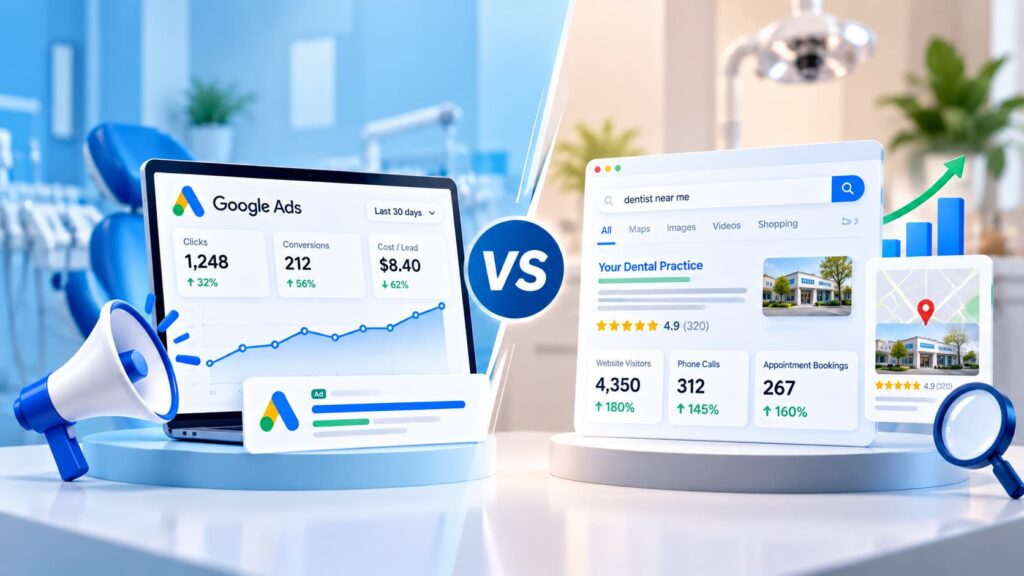
Dental Google Ads vs Dental SEO: Which to Fix First?
Google Ads provide immediate visibility and can generate patient inquiries within days. Dental SEO takes three to six months to show strong results but builds long-term organic traffic that does not stop when the budget runs out. A practice spending C$3,000–C$5,000 per month on Google Ads with no SEO is entirely dependent on paid search. Adding dental SEO alongside Google Ads builds the organic rankings that reduce long-term cost per new patient.
Google Local Service Ads: An Alternative Worth Considering
Google Local Service Ads (LSAs) charge per lead rather than per click — a phone call or message from a patient — and appear above standard paid ads with a “Google Guaranteed” badge. For dental clinics that have struggled to make standard Google Ads convert, LSAs are worth testing. The pay-per-lead model removes the risk of paying for clicks that never convert to patient contact.
Frequently Asked Questions
Why are my dental Google Ads getting clicks but no patient appointments?
The most common causes are a mismatch between the ad and the landing page, missing or broken conversion tracking, and keyword targeting that is too broad. If the ad promises a specific dental service but sends the patient to a general homepage, most will leave without contacting the practice. If conversion tracking is not set up, the campaign cannot learn which clicks are producing appointments and cannot optimise toward them. Fixing these two issues first typically produces the fastest improvement in campaign performance.
How much should a dental clinic spend on Google Ads in Ontario?
A starting budget of C$1,500–C$2,000 per month is a commonly cited minimum for testing dental Google Ads in a competitive Ontario market. Established campaigns in the GTA or other high-competition areas typically require C$2,000–C$5,000 or more per month to maintain consistent visibility and patient inquiry volume. For a full breakdown of dental marketing budgets by practice size and channel, see the dental marketing budget guide.
What are the best dental keywords for Google Ads?
High-intent keywords that consistently perform include location-specific terms (“dentist [city],” “dental implants [city]”), service-specific terms (“teeth whitening,” “emergency dentist open now,” “same day appointments”), and urgency terms (“tooth pain,” “broken tooth”). Phrase match and exact match types give the best control over which searches trigger the ads and keep spend concentrated on patients who are ready to book.
What is conversion tracking in dental Google Ads and why does it matter?
Conversion tracking records the actions that matter to the dental practice — phone calls, form submissions, online bookings — and attributes them to specific ads, keywords, and campaigns. Without conversion tracking, the Google Ads account cannot distinguish between a click that led to a booked appointment and a click that went nowhere. Google’s smart bidding strategies, which use machine learning to optimise campaign performance, require conversion data to function. A dental Google Ads campaign without conversion tracking is running without the information it needs to improve, and the practice has no way to calculate its actual cost per new patient.
How does campaign structure affect dental ads performance?
A well-structured dental Google Ads campaign separates different dental services into their own campaigns, each with dedicated ad groups, relevant ad copy, and a corresponding landing page. This structure improves ad relevance, raises quality scores, and typically reduces cost per click because Google rewards tightly themed ad groups with better placement at lower bid prices. It also makes performance reporting clearer — the practice can see exactly which dental services are generating appointments at what cost, and allocate budget accordingly.
What bidding strategies work best for dental Google Ads campaigns?
New campaigns with limited conversion data should start with manual CPC or Maximise Clicks until 30–50 monthly conversions have been recorded. Once that data exists, Target CPA or Maximise Conversions bidding can optimise toward booked appointments rather than just clicks. Smart bidding requires proper conversion tracking — without it, the algorithm optimises for proxy signals that may not reflect actual new patients.
Does dental SEO replace Google Ads for dental practices?
No — dental SEO and Google Ads serve different purposes and work best together. Google Ads provide immediate visibility and can generate patient inquiries within days, while dental SEO builds long-term organic search rankings that produce patient traffic without a cost per click. Most Ontario dental practices that achieve sustainable new patient growth run both channels: Google Ads for immediate volume and specific service promotions, dental SEO for the compounding organic patient acquisition base that reduces dependence on paid advertising over time.
About Dentist Spark
Dentist Spark is a dental marketing agency based in North York, Ontario, providing SEO, Google Ads, social media marketing, and website design exclusively for dental practices across Canada. Every engagement includes transparent monthly reporting on search rankings, website traffic, and new patient attribution — so the practice always knows what its marketing budget is producing.
Free marketing analysis: Dentist Spark offers a no-cost audit of your dental practice’s current marketing performance — an honest assessment of what is working, where budget is being wasted, and a clear recommendation for your practice size and local market.
Contact Dentist Spark:
- Phone: +1 866-753-1112
- Email: info@dentistspark.com
- Address: 61 Alness St, Unit 226-C, North York, ON M3J 2H2
- Hours: Monday–Saturday, 9:00 AM – 7:00 PM
- Website: dentistspark.com/