Opening a new dental practice in Ontario is one thing. Getting patients through the door in the first six months is another. Most new practice owners underestimate how competitive local dental marketing has become — and overestimate what brand awareness spending will do for them before they have established any local search presence.
The first six months of a dental practice’s marketing are the highest-stakes period. Cash flow is the primary pressure. New patient volume determines whether the practice reaches sustainability or runs deeper into debt while waiting for a patient base to materialize. The decisions made in this period — which channels to invest in, in what order, with what message — have a disproportionate impact on long-term practice growth.
This post lays out a practical, sequenced marketing strategy for new Ontario dental clinics: what to do first, what to invest in early versus later, and how to avoid the most expensive mistakes new practices make. For a full picture of how Dentist Spark supports practices at every stage, visit our dental marketing for new clinics page.
This is for dentists opening a new practice in Ontario and office managers responsible for getting early patient growth moving. It matters because the wrong marketing sequence wastes money the practice cannot afford to waste, and the right one builds compounding returns that lower patient acquisition costs over time.
Key Takeaways:
- The biggest first-year mistake is spending on brand awareness before capturing local search intent — patients ready to book today are worth more than general neighbourhood awareness
- Google Business Profile is the highest-ROI first marketing investment for a new practice, and it costs nothing to set up
- The Canadian Dental Care Plan is no longer a differentiator in the GTA — accepting it is table stakes; how you communicate around it is where the opportunity sits
- Google Ads can generate immediate patient inquiries while SEO builds; they serve different timeframes, not the same one
- A practice website that is not mobile-optimized and does not load in under three seconds will underperform regardless of how much marketing spend drives traffic to it
The First Six Months: What New Ontario Practices Get Wrong
The most expensive marketing mistake a new dental practice makes in Ontario is spending on high-funnel brand awareness — flyers, billboards, broad social media ads — before capturing the patients who are already trying to book a dentist appointment in the neighbourhood.
Brand awareness spending tries to make the entire community aware of a name. Local intent capture targets people who are actively searching for a dentist right now. For a new practice under cash flow pressure, the difference matters enormously: a person searching “new dentist accepting patients [neighbourhood]” is one click away from booking. A person who saw a flyer on their way to work is not.
The sequence that works for new practices:
- RCDSO compliance and regulatory setup before any marketing begins
- Local search foundation first (Google Business Profile, website, NAP consistency)
- Google Ads for immediate patient flow while SEO builds
- Local SEO content to build organic rankings over three to six months
- Broader visibility channels (social media, community presence) once the foundation is generating patients
Reversing this order — starting with awareness channels and building the local search foundation later — is where most new practices lose their early marketing budget.

Before Marketing Begins: RCDSO Registration, AODA, and CDCP Enrolment
RCDSO Compliance for a New Practice
The Royal College of Dental Surgeons of Ontario (RCDSO) registers individual dentists, not practices. For a new practice, the dentist must notify the College of the new practice address within 30 days. If the practice will operate under a name that differs from the dentist’s own name, that practice name requires College approval before it can be used in advertising.
RCDSO advertising rules govern what a new practice can say in its marketing from day one. Ontario dentists may not use testimonials, make claims they cannot substantiate, reference continuing education in a promotional context, or use comparative language (claiming to be “the best” or “number one”). These restrictions apply to everything — the practice website, Google Ads copy, social media posts, and the Google Business Profile description.
One rule that matters specifically for new practices advertising procedures: any ad that names a dental procedure must identify whether the treating dentist is a general dentist or a specialist in that area. A general dentist advertising oral surgery or cosmetic dentistry must make clear they are a general dentist. Failing to include that disclosure is an RCDSO advertising violation regardless of how experienced the dentist is.
Marketing materials that violate RCDSO advertising standards can result in a complaint to the College regardless of how new the practice is.
AODA Accessibility Requirements from the First Hire
Ontario’s Accessibility for Ontarians with Disabilities Act (AODA) creates obligations for dental practices that begin the moment the practice employs staff. Every practice with one or more employees must create accessibility policies and train staff on accessible customer service. Practices with 20 or more employees must file an accessibility compliance report by December 31, 2026. The website accessibility rule — WCAG 2.0 Level AA — applies once the practice reaches 50 or more employees.
That said, building a WCAG 2.0 Level AA compliant website from day one is advisable regardless of employee count. The standard covers colour contrast, text alternatives for images, keyboard navigation, and readable font sizes on mobile — all of which also improve usability for all patients. Retrofitting an inaccessible website later is significantly more expensive than getting it right at launch.
AODA compliance is not optional or deferred — obligations begin with the first employee. Marketing agencies working with Ontario dental practices should be familiar with the AODA requirements that apply at each staff threshold.
Accepting CDCP Patients
The Canadian Dental Care Plan (CDCP) is administered by Sun Life on behalf of the federal government. Oral health providers can sign up for the CDCP formally or treat CDCP patients claim by claim without signing up, under the same terms. Formal registration through the Sun Life provider portal may simplify billing administration for a high-volume practice, but it is not a prerequisite to accepting CDCP patients.
Marketing the practice as “CDCP accepted” is accurate once the dentist is eligible to bill under the plan — which requires a valid professional licence in good standing. Confirm that billing is working correctly before featuring CDCP acceptance prominently in advertising.
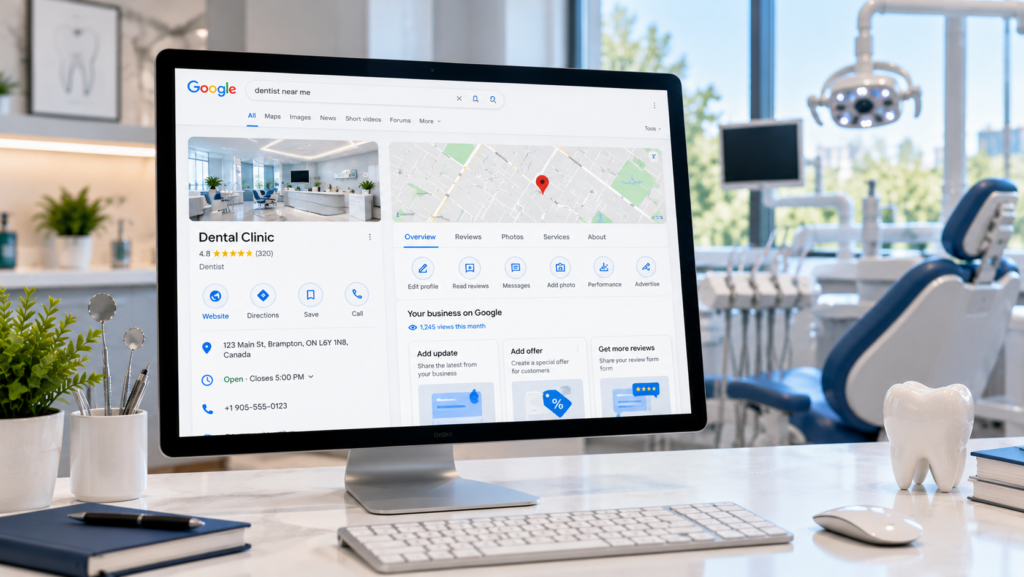
Step One: Claim and Build Your Google Business Profile
For a new dental practice in Ontario, the Google Business Profile (GBP) is the single highest-return first marketing investment. It is free to set up and directly determines whether the practice appears in Google Maps and the local pack when patients search for a dentist nearby.
A new practice that is not verified on the GBP is effectively invisible in local search. A practice that is verified but has an incomplete profile — missing hours, no photos, no service categories — will rank below established competitors with complete profiles.
A complete GBP for a new dental clinic includes:
- Full practice name, address, and phone number matching exactly what appears on the website and any directories
- Accurate hours including holiday hours and any Saturday availability
- Service categories set correctly — “General Dentist,” “Dental Clinic,” and any specialty services offered
- At least 10 original photos of the clinic interior, exterior, treatment rooms, and team
- A short practice description that includes the neighbourhood name and two or three primary services
- The practice website URL linking to the specific location page, not the homepage
For a practice accepting the Canadian Dental Care Plan, the services section and description should reference CDCP acceptance — this is a filtering criterion many patients use when searching for a new dentist, and having it in the GBP profile ensures it appears in search results.
After the GBP is set up and verified, the focus shifts to building reviews. New practices start with zero reviews, which puts them at a disadvantage against established clinics. The fastest legitimate way to close that gap is to ask every patient who comes in for the first few months to leave a Google review. Even 10 to 15 genuine reviews in the first month significantly improve local search ranking and conversion from the GBP listing. Google’s review policies prohibit selectively requesting reviews only from patients who had positive experiences — requests should go to all patients consistently.
Step Two: A Website That Converts, Not Just Exists
Many new practices launch with a basic website built quickly before opening. That website is often not optimized for local search, loads slowly, and does not convert the visitors it does receive into booked appointments.
A new practice website needs to do three things well: load fast, rank locally, and make it easy to book.
Speed and Mobile Performance
Over 70% of dental website traffic comes from mobile devices. A website that is not mobile-first will lose a significant portion of that traffic before the visitor reads a single word. Google also uses page speed as a ranking factor. A page that takes more than three seconds to load on a mobile connection will rank lower and convert worse than a faster competitor.
A new practice website should be tested against Google Page Speed Insights before launch. Images should be compressed, unnecessary scripts removed, and the most important content — clinic name, phone number, booking link — visible immediately on mobile without scrolling.
Local SEO Foundations
The website needs at least the following for local search:
- A title tag for the homepage that includes the city or neighbourhood and the type of practice (“Dental Clinic in North York | [Practice Name]”)
- A dedicated location page with local content, an embedded Google Map, and NAP information matching the GBP
- Individual service pages for the primary treatments offered — dental implants, teeth whitening, root canal, general dentistry, dental emergencies
- Schema markup (LocalBusiness/Dentist) to help Google understand the practice’s location and services
These are not optional additions to do later — they are the minimum viable structure for a website to generate any organic search traffic.
Online Booking
A new dental practice asking patients to book only by phone is losing appointments to competitors with online booking. Patients who find the practice at night, on weekends, or while at work want to book without calling. An online scheduling system integrated into the website and linked directly from the GBP listing removes that friction.
Step Three: Google Ads for Immediate Patient Flow
Local SEO takes time — typically three to six months before a new website generates meaningful organic traffic. During that period, Google Ads can deliver immediate patient inquiries while the organic foundation builds.
For a new Ontario dental practice, the highest-priority Google Ads campaigns are:
Emergency and urgent care: patients searching for an emergency dentist or same-day dental appointment are in immediate need and will travel. These searches convert at a high rate and generate new patients who often become long-term patients if the experience is positive.
New patient acquisition: keywords targeting patients who are actively looking for a new dentist accepting new patients in the local area. These searches indicate someone whose current dentist relationship has ended or who is new to the neighbourhood.
Specific treatments: dental implants, teeth whitening, root canal, cosmetic dentistry, and oral surgery campaigns targeted to the local area. These patients have specific treatment intent and are further along in their decision process.
Google Ads for a new practice should be set to Presence only location targeting (not “Presence or Interest”), with a tightly defined radius around the clinic. Budget should be concentrated on the highest-intent keywords rather than spread broadly across a large keyword list.
Conversion tracking must be set up to track phone calls and form submissions from day one. Without conversion tracking, there is no way to tell which campaigns are generating patients and which are only generating clicks.

The Canadian Dental Care Plan: Conversion Anchor, Not Brand Identity
With approximately 4.7 million Canadians enrolled in the CDCP for the 2026–2027 benefit period, the program represents a large pool of patients who now have access to dental coverage who did not before. For a new practice looking to build patient volume quickly, CDCP-eligible patients are a significant market segment.
However, in the GTA, accepting the CDCP is no longer a differentiator — the large majority of active oral health providers now participate in the plan. Stating “CDCP Accepted” draws in eligible patients, but it does not distinguish the practice from dozens of competitors.
The opportunity for a new Ontario practice is not simply to accept the CDCP but to make the experience of using it easier and clearer than competitors do. This means:
- Explaining on the website what the CDCP covers for general dentistry treatments, what frequency limits apply, and what patients can expect at a first visit as a CDCP patient
- Making CDCP eligibility verification part of the booking process — reducing the friction patients experience trying to understand if they qualify
- Training front desk staff to handle CDCP questions accurately, since eligible patients are often unfamiliar with the plan and benefit from clear, patient explanations
Eligibility for the CDCP requires a household income under $90,000 per year and no access to private dental insurance. Coverage is administered by Sun Life and needs to be renewed annually. For practices in neighbourhoods with higher proportions of CDCP-eligible residents, dedicating a page of the website to CDCP coverage — what it covers, how to use it, how to book — can capture search traffic from patients specifically looking for this information.
Communicating About Costs, Insurance, and Payment Plans
One of the most common reasons patients delay booking with a new dental practice is uncertainty about cost. Ontario does not have a universal publicly funded dental care program beyond the CDCP and programs like Ontario Works. Most dental care is paid out of pocket or through private dental insurance. For many patients, the first question before booking is not “is this clinic good?” but “can I afford this?”
New practices that address this uncertainty directly in their marketing and on their website convert more of the visitors and callers they already have.
Private Dental Insurance
The majority of patients with private dental insurance want to know whether the practice accepts their plan before they book. While most general dental practices can bill most major private insurers, patients do not assume this — they ask. Making it clear on the website and in Google Ads that the practice accepts major private dental insurance, and listing the insurers by name where possible, removes a barrier that otherwise results in patients calling competitors first.
The Ontario Dental Association publishes a suggested fee guide that most Ontario dental practices use as a reference. Patients covered by private insurance are typically reimbursed a percentage of the ODA fee guide rate, depending on their plan. For a new dental practice, communicating clearly about fee transparency and using standard fee guide rates can reduce billing surprises, one of the most common sources of patient dissatisfaction with new dental providers.

In-House Payment Plans
For patients without private dental insurance who are not eligible for the CDCP, the cost of dental treatment — particularly for restorative work like root canals, dental implants, or oral surgery — can be a significant barrier to booking. Many Ontario dental clinics offer in-house payment plans that allow patients to spread treatment costs over several months.
For a new dental practice, offering and clearly communicating payment plan availability can be a meaningful conversion factor for patients who are comparing options. This is particularly true for higher-value treatments where the upfront cost is a decision-making hurdle. A patient who needs a root canal but cannot pay in a single visit will often delay or seek a less expensive alternative — a practice that offers a payment plan removes that barrier directly.
Communicating payment plan availability should be part of the website content, the Google Business Profile services section, and the booking confirmation flow. It does not need to be the headline of a marketing campaign, but it should be easy to find for patients who are specifically looking for a provider they can afford.
Building Local Reputation Over Time
A new dental practice has no history and no reputation in the community. The marketing channels that build both — reviews, local search rankings, word of mouth — take time. The goal in the first year is to build systems that generate these assets automatically rather than relying on periodic effort.
Reviews: every patient appointment should trigger a review request — not only the ones that went particularly well. Automated follow-up systems — an email or SMS after each appointment — make review generation consistent without requiring staff to remember to ask. Under Google’s review policies, requests must not be selective (asking only patients who seemed happy), incentivized, or framed in a way that implies expected content. The RCDSO separately prohibits testimonials, so review content on the practice website should not be used in a testimonial format — the Google Business Profile, where reviews are independently posted, is the appropriate place for patient feedback to be visible.
Referral pathways: new patients who have a good experience are the highest-quality source of further new patients. Making it easy for them to refer family members — by giving them clear information about accepting new patients and what to tell someone who needs a dentist — creates a referral channel that grows with the practice.
Community presence: once the local search foundation is established, selective community involvement — local sponsorships, school programs, connections to community health organizations — builds visibility in the neighbourhood in a way that advertising cannot. For a new dental practice in areas with high dental anxiety rates, partnerships with mental health organizations or community health centres can create referral pathways that bring in patients who would not otherwise seek dental care.
Frequently Asked Questions
What marketing should a new dental practice prioritize in Ontario?
Google Business Profile setup and verification, followed by a mobile-optimized website with basic local SEO, followed by Google Ads for immediate patient flow. Brand awareness channels like social media and community advertising come after the local search foundation is established.
How does the Canadian Dental Care Plan affect marketing for a new Ontario dental clinic?
For a new dental practice, accepting the Canadian Dental Care Plan (CDCP) is an important step toward attracting eligible patients across the GTA. However, the real marketing opportunity goes beyond simply accepting the plan. A new dental practice should make it easy for CDCP-eligible patients to understand their coverage, explore available dental services, and book appointments. Creating a dedicated CDCP information page on the website and highlighting CDCP acceptance in Google Ads and the Google Business Profile can improve online visibility, attract patients actively searching for participating providers, and increase appointment bookings.
How long does dental SEO take to generate new patients for a new practice?
Organic search rankings for a new dental website typically take three to six months to develop meaningfully. Google Ads should run during this period to generate patient inquiries while SEO builds. After six to twelve months of consistent content, local link building, and GBP activity, organic traffic can become the primary patient acquisition channel.
Should a new dental practice run Google Ads?
Yes, for the first six to twelve months while organic rankings develop. Google Ads for emergency dentist searches, new patient acquisition keywords, and specific treatments can generate patient inquiries immediately after launch. Once organic rankings are established, the balance can shift toward SEO with Ads supporting specific services or seasonal campaigns.
What dental services should a new Ontario practice promote first?
For a new dental practice, promoting services that generate high patient volume and long-term value is essential for sustainable growth. Focus on general dentistry and routine dental care to attract a steady flow of patients, while highlighting dental implants and cosmetic dentistry to generate higher-value cases. Additionally, offering emergency dental services can help a new dental practice attract patients seeking immediate care, many of whom may become long-term patients if they receive a positive experience and quality treatment.
What is the Canadian Dental Care Plan and how does it affect new patients?
The Canadian Dental Care Plan (CDCP) is a federal government program administered by Sun Life that provides dental coverage to eligible Canadians with a household income under $90,000 per year who do not have access to private dental insurance. Oral health providers can bill CDCP claims without formal sign-up or register through the Sun Life provider portal for a more streamlined billing process. For a new dental practice in Ontario, accepting CDCP patients can help attract eligible individuals and families seeking affordable dental care. Clearly highlighting CDCP acceptance and coverage details on the practice’s website and Google Business Profile can improve online visibility, build patient trust, and help potential patients find and book appointments with the new dental practice.
About Dentist Spark
Dentist Spark is a dental marketing agency based in North York, ON, working exclusively with Canadian dental practices. We help new and established dental clinics in Ontario build patient acquisition systems through Google Ads, local SEO, Google Business Profile management, and practice website strategy.
If you are opening a new dental practice in Ontario and want to build your marketing foundation the right way, contact Dentist Spark for a consultation.
Website: dentistspark.com Email: info@dentistspark.com Phone: +1 866-753-1112