The best Google Ads keywords for dentists in 2026 are high-intent, location-specific search terms used by people actively searching for dental services — not generic phrases that generate traffic without producing actual patients. Effective dental Google Ads keywords combine service-specific terms, geographic modifiers, and intent signals that indicate a patient is ready to book, not just browsing.
This guide covers the highest-performing keyword groups for dental practices, how to structure them in a Google Ads campaign, what negative keywords to use, and how to match keywords to landing pages that convert prospective patients into new patient appointments.
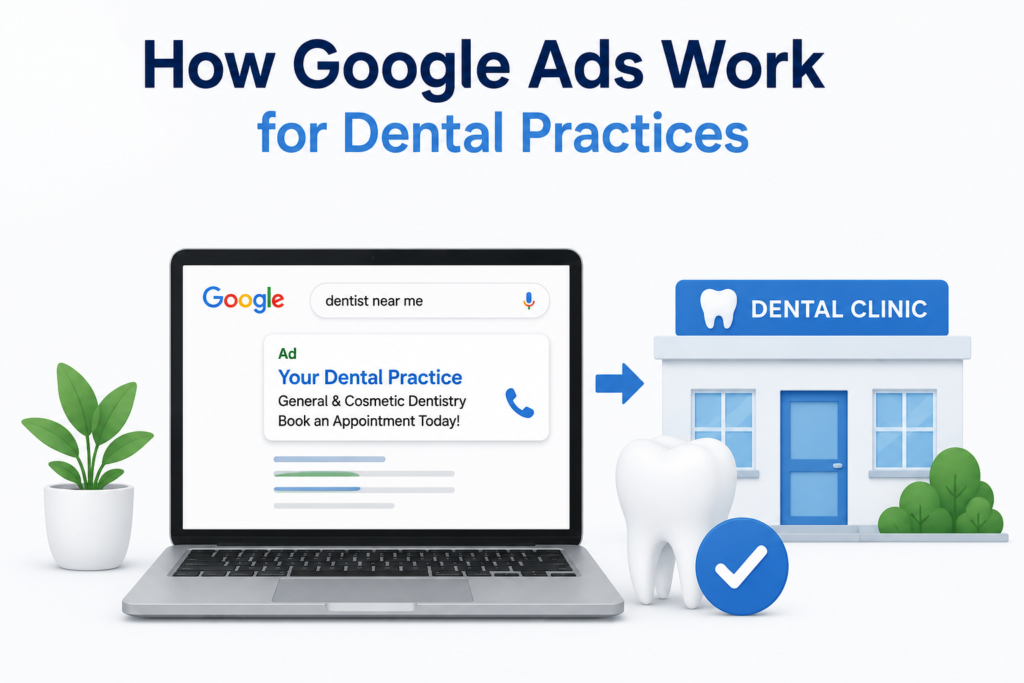
How Google Ads Work for Dental Practices
Google Ads lets dental practices appear at the top of the search results page for specific search terms at the exact moment a patient is looking for dental services. Unlike organic SEO which builds rankings over months, Google Ads provides immediate results — a new google ads campaign can generate phone calls and schedule online requests within hours of going live. Most dental searches happen on mobile devices, which account for over 70% of dental searches, making mobile-optimised ad copy and landing pages essential for campaign performance.
Google Ads work on a pay-per-click model — you pay only when someone clicks your dental ads. Ad quality and ad relevance determine your quality score, which directly affects both your ad position on the search results page and your cost per click. A high quality score means your dental google ads appear more prominently for less ad spend — making keyword selection and compelling ad copy the two most influential levers in any google ads strategy for dentists.
Google Ads can generate 35 to 40 high-quality leads daily for well-optimised dental practices. A new dental patient can be worth $700 to $1,500 in their first year — making a well-managed google ads campaign one of the highest-return marketing investments available to dental practices.
The Best Google Ads Keywords for Dentists in 2026
The following keyword groups represent the highest-performing dental keywords across Canadian dental practices, organised by service type, intent, and average cost per click. Service-specific and location-based keywords consistently outperform generic terms — they attract patients who are ready to book rather than those who are early in their research.
| Keyword Group | Example Keywords | Intent | Avg. CPC |
| Emergency | emergency dentist near me, dentist open now, same day appointments | Immediate need | $6 – $15 |
| Dental Implants | dental implants cost, dental implants near me, implant dentist | High value | $12 – $25 |
| General | dentist near me, family dentist [city], new patient dentist | Local search | $4 – $10 |
| Cosmetic | teeth whitening near me, cosmetic dentist [city], smile makeover | Elective service | $5 – $15 |
| Specialty | invisalign provider, sleep apnea dentist, pediatric dentist near me | Niche, high intent | $6 – $18 |
Emergency Dental Keywords
Emergency dentist keywords are among the highest-converting google ads keywords for dentists because they capture patients with an immediate need and no time to comparison shop. Terms like ’emergency dentist near me,’ ‘dentist open now,’ and ‘same day appointments’ attract patients at peak intent — they need care now, and the first credible practice they see typically wins the appointment. Emergency dental keywords cost $6 to $15 per click on average, with CPCs running 50 to 70% lower in smaller Canadian markets than in Toronto or Vancouver.
Dental Implants Keywords
Dental implant keywords attract high-value prospective patients considering a significant investment in their oral health. Terms like ‘dental implants cost,’ ‘dental implants near me,’ and ‘implant dentist [city]’ capture patients who are researching but leaning toward booking a consultation. Dental implant keywords average $12 to $25 per click — among the highest in the dental industry — but the patient lifetime value justifies the ad spend when campaigns are properly structured with dedicated landing pages and compelling ad copy specific to the procedure.
General Dentistry Keywords
General dentistry keywords — ‘dentist near me,’ ‘family dentist [city],’ ‘new patient dentist accepting patients’ — generate the highest search volume of any dental keyword group. Location-based keywords in this category typically attract users who are ready to book dental appointments and are searching for a practice convenient to their home or workplace. Adding geographic modifiers like neighbourhood names, suburbs, and postal code areas to general dentistry keywords improves local targeting and reduces irrelevant searches from outside your service area.
Cosmetic Dental Keywords
Cosmetic dental keywords target patients considering elective treatments — teeth whitening, veneers, smile makeovers, and cosmetic dentist consultations. These keywords attract a different patient psychology than emergency or general dentistry searches: cosmetic treatment patients are often comparison shopping and respond strongly to ad copy that emphasises before-and-after results, financing availability, and consultation offers. Long-tail keywords like ‘teeth whitening cost [city]’ or ‘cosmetic dentist accepting new patients’ exhibit lower competition and higher conversion rates than broad cosmetic search terms.
Specialty and Niche Keywords
Specialty keywords — ‘invisalign provider near me,’ ‘sleep apnea dentist,’ ‘pediatric dentist near me,’ ‘sedation dentist [city]’ — are niche keywords that attract highly specific, high-intent patients. These search terms typically generate lower search volume than general dentistry keywords but convert at significantly higher rates because they capture patients with a specific treatment in mind. Including niche keywords in separate ad groups with dedicated landing pages for each specialty ensures your dental ads are maximally relevant to each search query.
How to Structure a Google Ads Campaign for Dental Practices
Campaign setup is where most dental practices make their biggest Google Ads mistakes. Many dental practices lump all their dental keywords into one ad group with generic ad copy — which produces a low quality score, high cost per click, and poor click through rate. The STAG method (Single Theme Ad Groups) organises keywords into tightly focused groups: one ad group for emergency dentist, a separate one for dental implants, another for teeth whitening. Each ad group gets its own compelling ad copy and its own dedicated landing page, creating the relevance alignment that Google rewards with a higher quality score and lower ad spend.
Match Types: Exact, Phrase, and Broad
Using exact match and phrase match keyword types ensures relevant ad visibility without wasting budget on irrelevant searches. Exact match — [emergency dentist near me] — triggers your ad only for that precise search or close variants. Phrase match — “dental implants cost” — triggers for searches containing that phrase in order. Broad match gives Google the most latitude to match your ads to related searches, generating higher volume but lower precision. For most dental practices, a combination of exact and phrase match keywords provides the best balance of reach and relevance in a google ads campaign.
Negative Keywords: Your Most Underused Tool
Negative keywords prevent your dental ads from appearing for irrelevant searches — ‘dental assistant jobs,’ ‘free dental care,’ ‘dental school discount,’ ‘DIY teeth whitening.’ Without a robust negative keywords list, your google ads budget is consumed by clicks from people who will never become actual patients. Using negative keywords can reduce wasted ad spend by 30% or more, directly improving your campaign’s return on investment. Review your search terms report weekly when a campaign launches and monthly thereafter to continuously identify and exclude irrelevant searches.
Landing Pages: The Most Important Element After Keywords
Each major keyword group should direct patients to a dedicated landing page built specifically for that search intent. A patient clicking ’emergency dentist near me’ should land on a page about your emergency dentist services — not your homepage. Landing page quality is a direct component of Google’s quality score calculation, meaning a relevant, fast-loading landing page reduces your cost per click and improves your ad position simultaneously. Over 70% of dental searches occur on mobile devices, making mobile-optimised landing pages with click-to-call buttons and online booking integrations essential for converting ad clicks into new patient appointments.
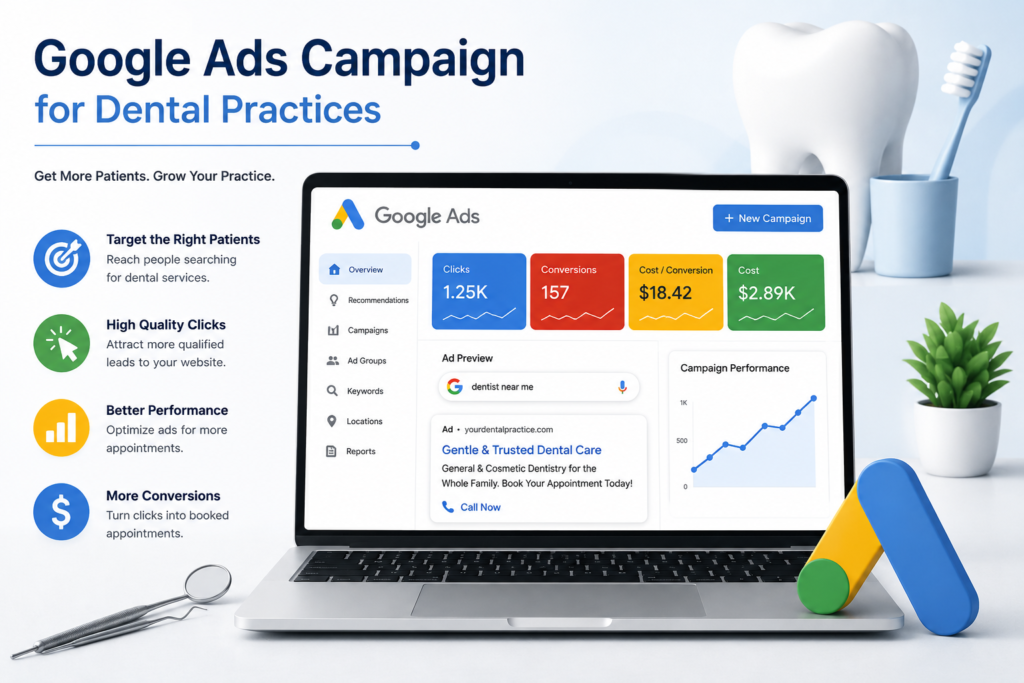
Google Ads Campaign Types for Dental Practices
Search Campaigns
Standard Google Ads search campaigns — text based ads appearing on the Google search results page — are the foundation of dental google ads strategy. Start with search campaigns before adding display campaigns or remarketing. They capture patients who are actively searching for specific dental services, producing the highest intent and the strongest conversion rates of any google adwords campaign type for dental practices.
Local Service Ads
Local service ads appear at the very top of the search results page above standard google ads, marked with a ‘Google Guaranteed’ badge. They are particularly effective for emergency dentist and general dentistry searches in local markets, generating phone calls directly from the search results without requiring a click to a landing page. Google ads offers local service ads as a separate campaign type with its own budget and bidding structure — most dental practices find them a strong complement to traditional search campaigns.
Performance Max Campaigns
Performance max campaigns give Google broad latitude to serve dental ads across search, display, YouTube, and Maps using automated bidding. They require more trust in Google’s algorithm and work best for dental practices with established google analytics conversion data. Most dental practices should build confidence in standard search campaigns before adding performance max campaigns to their google ads account — automated bidding performs best when fed significant historical conversion data.
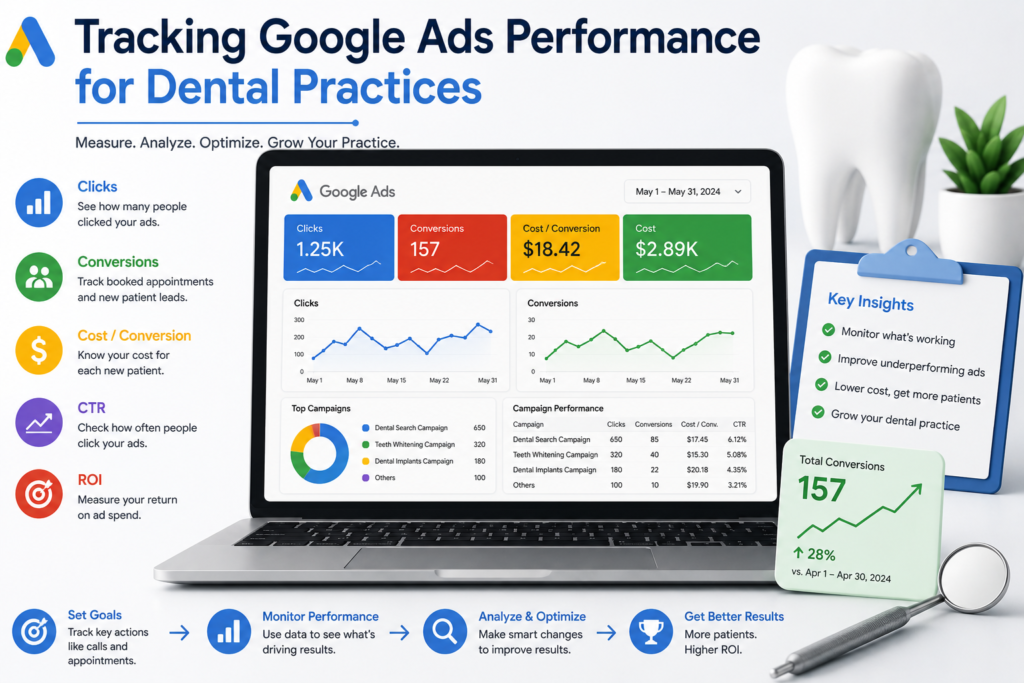
Tracking Google Ads Performance for Dental Practices
Ongoing optimization of any dental google ads campaign requires tracking the right metrics. Click through rate measures how compelling your ad copy is. Quality score reflects how relevant your keywords, ads, and landing pages are to each search query. Cost per new patient appointment — calculated from google analytics conversion tracking tied to actual booking completions — is the metric that determines whether your google ads budget is generating real return. Set up call tracking from day one to capture phone calls as conversions. Review campaign performance weekly in the first month, monthly thereafter, and adjust your bid strategy and keyword list based on what the data shows about which search terms are producing actual patients.
Why Dentist Spark for Expert Google Ads Management
Dentist Spark manages expert google ads campaigns exclusively for dental practices across Canada. We build campaign setup from keyword research through to landing page alignment, configure conversion tracking in google analytics from day one, and manage ongoing optimization to keep your dental google ads performing as your local market evolves. Our dental marketing agency approach connects google ads strategy with your broader dental marketing — so paid search and organic SEO work as a single, coordinated patient acquisition system.
Ready to Run Google Ads That Actually Book Dental Patients?
Book a free strategy session with Dentist Spark. We’ll review your current google ads account or build a new campaign structure from scratch — with keyword research, ad copy, landing pages, and conversion tracking built specifically for your practice and local market.
→ Book Your Free Strategy Session at DentistSpark
Frequently Asked Questions
What are the best Google Ads keywords for dentists in 2026?
The best Google Ads keywords for dentists in 2026 are high-intent, location-specific search terms: ’emergency dentist near me,’ ‘dental implants cost [city],’ ‘dentist near me accepting new patients,’ ‘teeth whitening [city],’ and specialty niche keywords like ‘invisalign provider near me.’ Effective dental keywords combine service specificity, geographic modifiers, and intent signals. Long-tail keywords typically exhibit lower competition and higher conversion rates than broad terms — making them especially valuable for practices with limited google ads budgets.
How does a Google Ads campaign work for dental practices?
A Google Ads campaign for dental practices shows text based ads at the top of the search results page when patients search for specific dental keywords. You pay per click, and your ad position is determined by your bid and quality score — a measure of how relevant your keywords, ad copy, and landing page are to the search query. Well-structured dental google ads campaigns targeting high-intent search terms generate immediate results, producing phone calls and new patient appointments from day one.
What is a good Google Ads budget for a dental practice?
Most dental practices should budget between $1,500 and $5,000 per month for Google Ads, depending on market competitiveness and the services being promoted. CPCs for dental keywords typically range from $3 to $20, with emergency and dental implant keywords at the higher end. In smaller Canadian markets, CPCs run 50 to 70% lower than major urban centres. Start with search campaigns targeting your highest-value services, track cost per new patient appointment through Google Analytics, and scale budget toward the keyword groups generating the strongest return.
How do I set up Google Ads campaign structure for dentists?
Structure your dental Google Ads campaign using the STAG method — one ad group per service type, each with its own tightly themed keywords, compelling ad copy, and dedicated landing page. Separate ad groups for emergency dentist, dental implants, teeth whitening, and general dentistry improve quality score and reduce cost per click by maximising relevance between search terms, ads, and landing pages. Use exact and phrase match keywords, build a robust negative keywords list, and configure call tracking and Google Analytics conversion tracking before the campaign goes live.
What landing page should dental Google Ads send patients to?
Each google ads campaign ad group should send patients to a dedicated landing page matching the search intent of that keyword group. A patient clicking ’emergency dentist near me’ should land on your emergency dentist page — not your homepage. Landing page quality directly affects your quality score, which influences both ad position and cost per click. Landing pages should load in under three seconds, be mobile-optimised for the 70%+ of dental searches that occur on mobile devices, and include a prominent click-to-call button and online booking option above the fold.
Conclusion
The best Google Ads keywords for dentists in 2026 are not found by guessing — they’re identified through structured keyword research, organised into tightly themed ad groups, matched to dedicated landing pages, and continuously refined using search term data and conversion tracking. Emergency dental keywords capture patients at peak need. Dental implant keywords attract high-value patients. General dentistry and location-based keywords build a steady flow of new patient appointments. Specialty keywords convert at high rates with lower competition.
The difference between dental google ads that waste budget and those that generate consistent new patient appointments is structure, keyword discipline, and ongoing optimization. Dentist Spark builds and manages google ads campaigns for Canadian dental practices that deliver measurable patient growth — not just clicks.