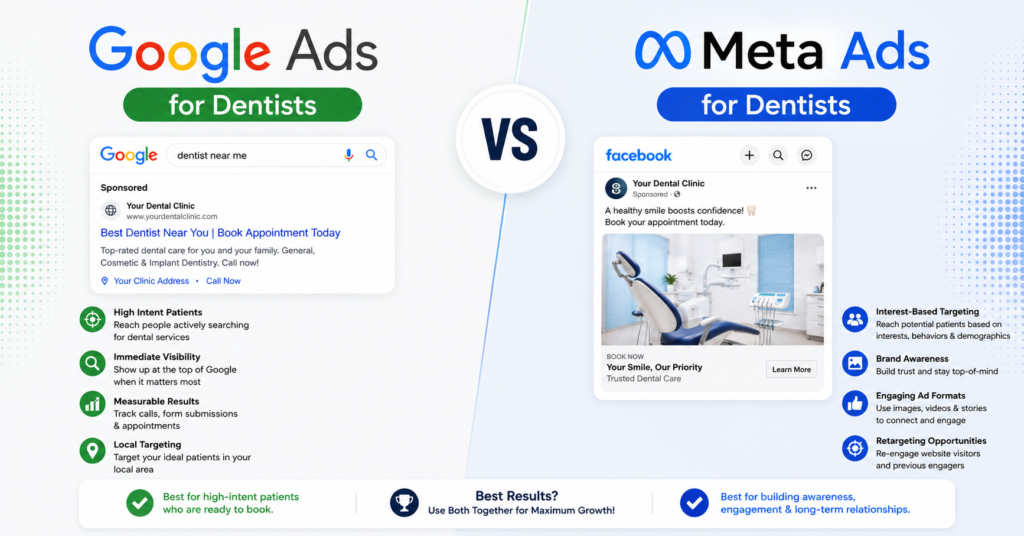
Google Ads for dentists vs Meta Ads for dentists comes down to one fundamental difference: intent. Google Ads captures patients who are actively searching for dental services at the exact moment they need care — emergency dentist, dental implants, same day appointments. Meta Ads reaches people who aren’t searching yet but can be targeted by demographics, location, and interests to build awareness of your dental clinic before they ever open Google. A hybrid ad approach commonly allocates up to 70% of the budget to Google Ads.
This guide explains how each platform works for dental practices, where each wins, where each falls short, and how to decide which deserves your ad spend — or whether running both is the right strategy for your dental office.
How Google Ads Work for Dental Practices
Dental Google Ads show text based search ads at the top of the search results page when patients search for specific dental keywords — ’emergency dentist near me,’ ‘dental implants cost,’ ‘cosmetic dentist [city],’ ‘teeth whitening same day appointments.’ This is demand capture: people actively searching for dental services with high intent, often ready to book at the exact moment they see your ad. Google ads work by matching your dental keywords to live search queries and displaying your ads to potential patients who are already in buying mode. 70% of dental searches occur on mobile devices.
Google ads campaigns for dentists generate immediate visibility and produce high quality leads with measurable conversion rates. With proper tracking — call tracking, conversion tracking through google analytics, and landing page optimization — dental google ads provide the clearest line of sight from ad spend to actual patients of any digital marketing channel. Most dental practices see google ads start generating phone calls and appointment bookings within two to three weeks of a well-structured campaign setup.
Google Local Service Ads
Google local service ads appear above standard search ads at the very top of the search results page, marked with a ‘Google Guaranteed’ badge. They operate on a pay-per-lead model rather than pay per click, generating phone calls directly from the search results page without requiring a landing page click. For emergency dentist and general dentistry searches within a defined service area, local service ads often deliver lower cost per new patient than standard google ads campaigns — making them a strong addition to any dental office’s paid advertising strategy.
Google Ads can generate 35 to 40 high-quality leads daily for well-optimised dental practices. A new dental patient is worth $700 to $1,500 in their first year — making demand-capture ads that reach people actively searching for dental services the highest-ROI paid channel for most dental clinics. Dental keywords cost between $3 and $20 per click. Emergency dental keywords typically cost $6-$15 per click. Most dental campaigns take 2-3 months to fully optimize. Dental implant keywords average $12 to $25 per click in 2026. Most dental practices should budget $1,500 to $5,000 per month.
How Meta Ads Work for Dental Practices
Meta ads campaigns run across Facebook and Instagram, targeting users based on demographics, interests, location, and online behaviour — not what they’re actively searching for. Instead of capturing existing demand, meta ads create demand by placing dental ads in front of people within your service area who fit the profile of your ideal patient but haven’t yet started searching for dental care. This makes meta ads fundamentally a brand awareness and top-of-funnel tool for dental practices, rather than a direct patient acquisition channel.
Meta ads perform best for dental services where visual results drive decisions — cosmetic dentist treatments, teeth whitening, smile transformations, and Invisalign. A before-and-after image or short video showing real patient results can prompt a prospective patient to consider a treatment they weren’t actively thinking about. Patient reviews and patient special offers embedded in meta ads campaigns build trust with undecided patients who encounter the dental clinic through their social feed rather than a search query.
Meta Ads typically have a lower cost-per-click but require a longer sales funnel to convert leads.
Meta Ads Campaign Types for Dentists
Meta ads offer multiple ad types for dental practices: image ads showcasing smile transformations, video ads explaining procedures or introducing the dental team, carousel ads displaying multiple dental services, and lead form ads that capture patient contact details without requiring a landing page visit. Lead form ads are particularly useful for generating leads for higher-consideration treatments like dental implants or cosmetic dentistry, where a patient may want to express interest before committing to a phone call.
Google Ads for Dentists vs Meta Ads: Side-by-Side Comparison
The table below summarises how each platform performs across the key metrics that matter for dental practices evaluating where to invest their ad spend.
| Google Ads for Dentists | Meta Ads for Dentists | |
| Patient intent | Actively searching, ready to book | Browsing, not yet searching |
| Best for | Emergency, implants, new patients | Brand awareness, cosmetic services |
| Ad format | Text based search ads | Image, video, carousel ads |
| Targeting method | Keyword + geographic targeting | Demographics, interests, behaviour |
| Time to results | 2–3 weeks with proper setup | 4–8 weeks to optimise audiences |
| Conversion tracking | Clicks, calls, bookings | Lead forms, website events |
| Ideal budget split | Primary channel for most practices | Supplement once Google is proven |
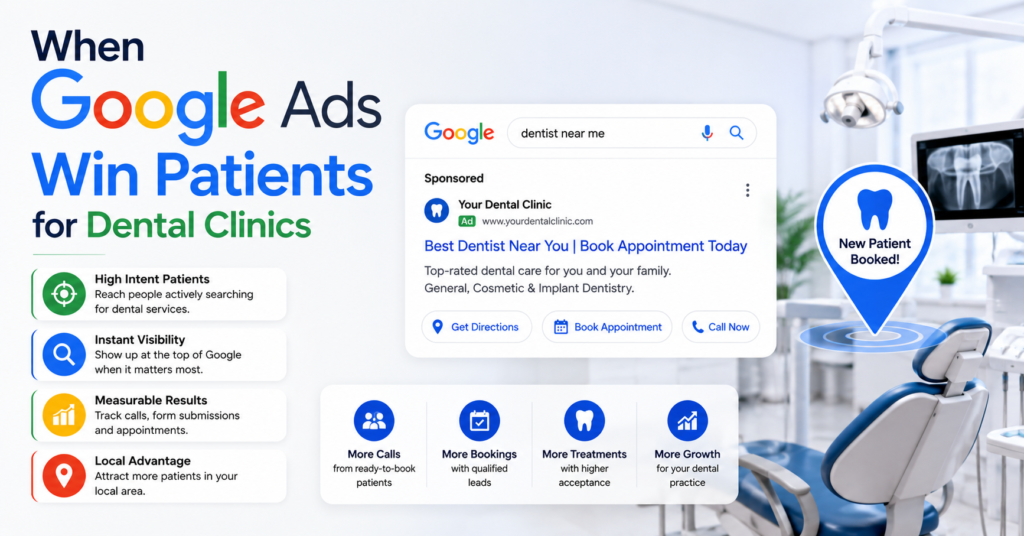
When Google Ads Win Patients for Dental Clinics
Google Ads for dentists win when the goal is capturing patients who are actively searching for dental services right now. Emergency dentist searches, dental implants consultations, new patients looking for a family dental office, and urgent care queries all convert at high rates through dental google ads because the patient has already identified their need — they’re just choosing which dental clinic to call. For most dental practices, google ads campaigns targeting these high intent search terms should be the primary paid channel before any ad spend is allocated elsewhere.
Google Ads also win on attribution clarity. Conversion tracking through google analytics shows exactly which dental keywords generated phone calls, which ads produced appointment bookings, and what the cost per new patient is by campaign. This precise targeting and measurement capability makes ongoing optimization evidence-based — you know what’s working because the data shows it directly, not through inference.
When Meta Ads Win Patients for Dental Clinics
Meta ads campaigns win for dental practices whose growth strategy includes building local brand awareness, promoting elective cosmetic treatments, or reaching patient demographics — younger adults, families in specific neighbourhoods — before they actively start searching. A dental clinic launching in a new service area, promoting a new cosmetic dentistry service, or running a specific patient special benefits more from meta ads’ demographic and interest targeting than from google ads’ keyword-based intent capture.
Meta ads also serve a remarketing function — showing dental ads to people who have previously visited your dental website but haven’t booked. These are warm potential patients who showed interest and then left. Retargeting them with patient reviews, before-and-after results, or a specific offer through meta ads campaigns can convert leads that google ads already generated but didn’t close on first contact.
Common Mistakes Dental Practices Make With Both Platforms
Common Mistakes With Google Ads Campaigns
• Running all dental services in one ad group — poor campaign structure suppresses quality score and inflates cost per click
• No negative keywords list — wasted spend on irrelevant searches (‘dental jobs,’ ‘free dental care’) that will never convert
• Sending all traffic to the homepage — landing page quality is a quality score factor; dedicated landing pages per service convert significantly better
• No conversion tracking configured — without proper tracking, there’s no way to measure which dental keywords are generating actual patients
• Underfunding the campaign — too little google ads budget produces too few impressions to compete for visible positions in a competitive local market
Common Mistakes With Meta Ads Campaigns
• Treating meta ads like google ads — meta audiences aren’t searching; ad copy that works for high intent search ads falls flat in a social feed
• No patient reviews or social proof in ads — dental ads without credibility signals struggle to build trust with cold audiences who’ve never heard of the dental office
• Expecting immediate booking results — meta ads build awareness first; most dental clinics see a longer lead time from meta ads impression to booked appointment than from google ads
• No lead tracking beyond impressions — reach and impressions are not patient outcomes; lead tracking and cost per appointment booking are the metrics that matter
Many dentists make the mistake of choosing between Google Ads and Meta Ads when the highest-ROI approach is a sequenced strategy: establish google ads campaigns first to generate immediate new patients and conversion data, then layer meta ads to build awareness and retarget warm leads — using the same google analytics data to inform audience targeting on both platforms.
Which Platform Wins Patients? The Verdict for Dental Practices
For immediate new patient acquisition, Google Ads wins. The intent signal from a patient actively searching for a dental clinic, emergency dentist, or dental implants consultation is the strongest buying signal in digital marketing — and capturing it through precise geographic targeting and dental keyword bidding generates real patients faster than any other paid channel. Most dental practices should establish proven google ads campaigns before allocating significant ad spend to meta ads.
For long-term dental marketing and brand building, both platforms working together win. Meta ads build the awareness and familiarity that makes your google ads more effective — a patient who has seen your dental office on Instagram and then encounters your ad on Google is more likely to click and book than one encountering you for the first time in search results. The platforms complement rather than compete when campaign structure, lead tracking, and ongoing optimization are managed as a unified dental marketing strategy.
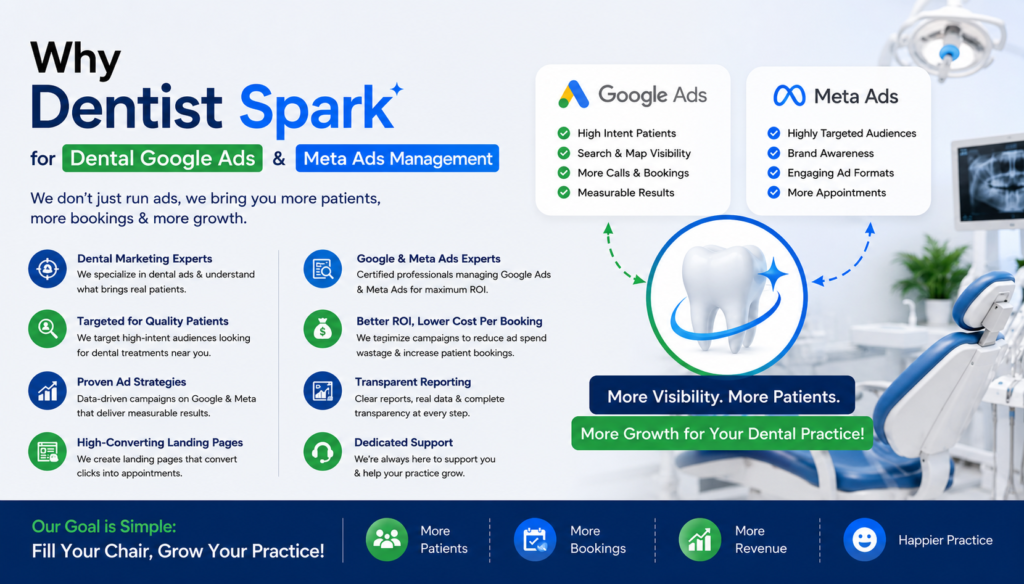
Why Dentist Spark for Dental Google Ads and Meta Ads Management
Dentist Spark manages both Google Ads and Meta Ads campaigns for dental practices across Canada — building campaign setup, configuring conversion tracking, optimising landing pages, and managing ongoing optimization as a single coordinated dental marketing system. We connect paid ad performance data with long term SEO strategy through google analytics so your dental office makes evidence-based decisions about where to allocate ad spend for maximum ROI and more patients booked per dollar invested.
Not Sure Whether Google Ads or Meta Ads Is Right for Your Dental Practice?
Book a free strategy session with Dentist Spark. We’ll assess your current dental marketing, your local competitive landscape, and your patient acquisition goals — then recommend the right channel mix and build the campaigns that generate actual patients for your dental clinic.
→ Book Your Free Strategy Session at DentistSpark
Frequently Asked Questions
What is the main difference between Google Ads and Meta Ads for dentists?
Google Ads for dentists captures patients who are actively searching for dental services at the exact moment they need care — high intent, ready to book. Meta Ads reaches patients who aren’t yet searching but can be targeted by demographics and location to build awareness of your dental clinic. Google Ads wins for immediate new patient acquisition. Meta Ads wins for brand building, cosmetic service promotion, and retargeting warm leads who have previously visited your dental website without booking.
How do Google Ads work to generate new patients for a dental practice?
Google Ads work by showing your dental office’s text based search ads at the top of the search results page when patients search for specific dental keywords — emergency dentist, dental implants, teeth whitening, cosmetic dentist. You pay per click, and your ad position is determined by your google ads budget, quality score, and landing page quality. With proper conversion tracking and campaign structure, dental google ads campaigns generate phone calls and new patient appointments within two to three weeks of launch.
Should a dental clinic run Google Ads or Meta Ads first?
Most dental clinics should establish google ads campaigns first. Google Ads generates immediate new patients from high intent searches and provides clear conversion data — cost per click, cost per phone call, cost per appointment booking — that proves the channel before additional budget is committed. Once google ads campaigns are generating consistent new patients and enough data has accumulated, meta ads campaigns can be layered on to build brand awareness and retarget warm leads, using the same conversion tracking infrastructure.
What are the most common mistakes dental practices make with Google Ads campaigns?
The most common mistakes with google ads campaigns for dental practices are: running all dental services in a single ad group with generic ad copy, no negative keywords list filtering wasted spend on irrelevant searches, sending all ad traffic to the homepage instead of dedicated landing pages, failing to configure conversion tracking so there’s no data on which keywords generate actual patients, and underfunding the google ads budget below the threshold needed to compete for visible positions in the local search results page.
How do Meta Ads help dental practices get more patients?
Meta Ads help dental practices get more patients by building brand awareness among local potential patients who aren’t yet searching — showing dental ads to people in your service area who fit your patient demographic before they have an immediate dental need. Meta ads campaigns are particularly effective for promoting cosmetic dentist services, teeth whitening, and dental implants through visual before-and-after content, and for retargeting people who have already visited the dental office website but haven’t converted to a booked appointment.
Conclusion
Google Ads for dentists vs Meta Ads for dentists is not a binary choice — it’s a sequencing decision. Google Ads wins on immediate patient acquisition because it captures people actively searching for dental services with high intent. Meta Ads wins on awareness and audience reach because it puts your dental clinic in front of potential patients before they start searching. Together, running both platforms with proper campaign structure, conversion tracking, and ongoing optimization produces more patients per dollar of ad spend than either channel operated in isolation.
Dentist Spark helps Canadian dental practices build and manage both channels as a coordinated dental marketing system — so every dollar of ad spend is working toward the same outcome: more patients, booked consistently.