Google AI Overviews have changed what it means to appear on the first page of search results — and for dental practices, that shift means the old rules of SEO (search engine optimization) alone are no longer enough. When a potential patient searches ‘best invisalign provider near me’ or ‘what do I do about a chipped tooth,’ Google now generates an AI-powered summary at the top of the search results page, pulling direct answers from websites it considers authoritative, well-structured, and trustworthy.
Getting your dental practice to appear in those AI-generated responses isn’t luck. It’s the result of a deliberate strategy that combines strong dental SEO, structured content, accurate business listings, and a newer discipline called Generative Engine Optimization — or GEO. This guide explains exactly how it works and what your clinic needs to do to show up where patients are increasingly looking.
What Are Google AI Overviews and Why Should Dental Practices Care?
Google AI Overviews are AI-generated summaries that appear above traditional search results for many informational and local queries. Instead of presenting a list of clickable links, Google synthesises information from multiple sources into a concise, structured answer — often with bullet points and key takeaways — that directly addresses the user’s query.
For dental professionals, this is a game changer. A patient searching for information online about dental implants, pain management, or how to find an invisalign provider used to have to click through multiple pages to get answers. Now Google provides those direct answers immediately. The practices whose content is cited in those summaries gain enormous visibility — and the ones who aren’t cited simply don’t exist in that moment.
This shift means that ranking on page one is no longer the finish line. You need to be the source Google’s AI trusts enough to quote. That requires a fundamentally different approach to how your dental practice creates and structures content online.
Google AI Overviews currently appear for a significant and growing share of health-related searches. For dental care queries, they are especially common — covering topics like treatment costs, procedure explanations, and how to find local providers.
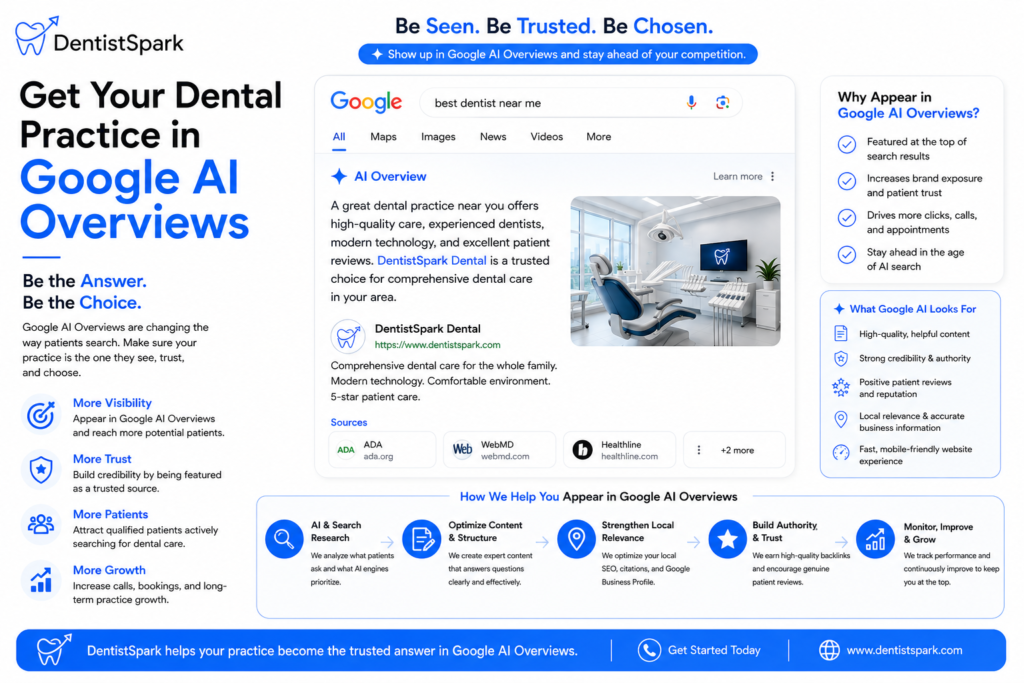
Understanding AI Search and How It Evaluates Dental Content
How AI Powered Search Differs From Traditional Search Engines
Traditional search engines match keyword queries to web pages and rank results based on relevance, authority, and a complex set of algorithmic signals. AI powered search goes further — it reads, comprehends, and synthesises content from multiple sources to generate a single, coherent answer in natural language.
Where traditional SEO focused heavily on keyword matching and link volume, AI driven search evaluates content quality, factual accuracy, contextual depth, and how well a page actually answers the user’s query. A dental office with a thin, keyword-stuffed service page will be passed over in favour of one whose content sounds natural, provides accurate information, and is structured in a way AI systems can parse and extract easily.
The practical implication for your dental practice is this: content written to satisfy a patient’s genuine question — clearly, accurately, and in plain language — will perform in AI mode far better than content written primarily to satisfy an algorithm.
What AI Tools and AI Assistants Look for in Dental Content
AI tools and personal AI assistants — whether Google’s AI Overviews, ChatGPT, Perplexity, or other AI assistants — evaluate dental content against several consistent criteria. They favour content that directly answers a specific patient question, uses natural language without forced keyword repetition, is supported by structured data and schema markup, comes from a source with demonstrable expertise and credibility, and is consistent with information found across other trusted sources.
For dental practices, this means every service page, FAQ section, and blog post needs to be built around answering real patient questions — not just ranking for search terms. A page that clearly explains what to expect during a dental implants procedure, written at an accessible reading level with proper structure, has a genuinely strong chance of being cited in AI-generated responses.
Dental GEO: The Strategy Behind Appearing in AI Overviews
What Is Dental GEO and How Does It Differ From Traditional SEO?
Dental GEO — Generative Engine Optimization for dental practices — is the practice of structuring your online content so that AI-powered search engines can find, understand, and confidently include your clinic in their generated responses. It sits alongside traditional SEO but targets a different output: not a ranked link in search results, but a cited source in an AI-generated answer.
Traditional SEO focuses on keyword optimization, quality backlinks, and website visibility in standard search engine results pages. 59% of Google searches now result in zero clicks. 93.8% of AI Overview citations are not from top 10 organic results. Dental GEO focuses on content clarity, structured data, factual depth, and the kind of authority signals that AI systems use when deciding which sources to quote. Both matter — but GEO is the emerging layer that determines whether your practice appears in the answer itself, above all the clickable links.
Think of it this way: a dental practice that ranks third in traditional search results might not appear in an AI Overview at all if its content isn’t structured to answer questions directly. Meanwhile, a clinic ranked fifth with exceptionally clear, structured content might be cited prominently in the AI summary. GEO changes what it means to win in search.
Generative Engine Optimization in Practice: What Needs to Change
Applying GEO principles to a dental office website isn’t about starting over — it’s about refining what exists and adding what’s missing. Most dental websites have service pages that describe treatments in general terms. GEO requires going deeper: answering the specific questions patients have about those treatments, addressing common concerns, providing key information about cost ranges and timelines, and doing all of this in content that reads as it sounds natural to a real patient.
Structured content is especially important. AI systems that generate overviews favour pages that use clear headings, short paragraphs, bulleted summaries of key takeaways, and FAQ sections with direct question-and-answer formatting. This structure makes it significantly easier for AI to extract and synthesise the most relevant information for a given user’s query.
Practical Steps to Appear in AI Overviews as a Dental Practice
1. Build Content That Directly Answers Patient Questions
Every page on your dental website should open with a direct, clear answer to the most likely question a patient has about that topic. A page about dental implants should immediately address what they are, who needs them, and what they cost — not begin with a paragraph about your practice’s history. AI-generated responses are built from content that gets to the point fast.
Map out the questions your patients ask most frequently — at the front desk, in consultations, in online reviews. These are the exact questions AI Overviews are built to answer. Bright Smiles Dental in Ontario, for example, saw a measurable increase in patient inquiries after restructuring their service pages around specific patient questions rather than generic procedure descriptions. The content didn’t change substantially — the structure and intent did.
2. Implement Schema Markup and Structured Data
Schema markup is code added to your dental website that tells search engines and AI systems exactly what your content means. For dental practices, this includes DentistSchema, LocalBusinessSchema, FAQSchema, and MedicalConditionSchema where relevant. Structured data gives AI powered search explicit, machine-readable signals about your services, location, hours, and expertise — reducing ambiguity and increasing the likelihood that Google includes your practice in AI-generated responses.
FAQSchema is particularly valuable. Schema markup helps improve chances of being cited in AI Overviews. When your FAQ content is marked up properly, Google can extract individual question-and-answer pairs directly and use them in AI Overviews. A well-structured FAQ section addressing questions like ‘How much do dental implants cost in Canada?’ or ‘What is the best invisalign provider in [city]?’ significantly improves your chances of appearing in AI summaries for those queries.

3. Optimise Your Google Business Profile for AI Mode
Google’s AI Overviews draw heavily from Google Maps and business listings data when generating local responses. A fully optimised Google Business Profile — with complete service descriptions, accurate hours, high-quality photos, your service area, and a strong volume of detailed patient reviews — strengthens the local signals that AI mode uses to recommend dental practices.
Patient reviews are especially influential. When a patient writes ‘Dr. Patel was the best invisalign provider I found in Mississauga — I had my chipped tooth repaired in the same visit,’ that review is rich with natural language signals Google uses to understand your practice’s specialisations, location, and patient experience. Encourage reviews that describe real treatment experiences in specific, natural terms.
4. Earn Quality Backlinks From Credible Sources
AI systems evaluate authority partly through the same signals traditional SEO does — quality backlinks from credible, relevant sources. Links from dental association websites, local health directories, Canadian news outlets, and community organisations tell AI-powered search that your dental practice is a recognised, trustworthy entity. This off-page authority is a key factor in whether Google chooses your content as a source for AI Overviews.
Focus on earning links from sources that patients and health professionals would recognise as credible. A mention in a local health publication, a link from the Ontario Dental Association, or a citation in a community wellness resource all carry meaningful weight with both traditional search engines and AI search systems.
5. Use Natural Language and Write for the Patient First
AI-generated responses are built from content that sounds natural to a human reader. Dental content that reads as naturally as a knowledgeable dentist explaining something to a patient — without forced keyword repetition, without jargon overload, and without filler — is far more likely to be extracted and cited than content optimised purely for keyword density.
Read your service pages aloud. If a sentence sounds awkward or unnatural, rewrite it. AI systems are increasingly sophisticated at distinguishing between content written to manipulate search results and content written to genuinely answer patient questions. The former is deprioritised; the latter is exactly what AI Overviews are built to surface.
How a Dental Marketing Company Helps You Stay Ahead in AI Search
The intersection of dental SEO, GEO, AEO, and AI powered search is technical and fast-moving. Google updates how AI Overviews work regularly. Schema markup requirements evolve. The content standards that earn AI citations today will be refined and raised over time. Most dental office owners don’t have the bandwidth to track these changes, interpret them, and apply them to their websites while running a busy clinical practice.
The practices that appear in AI Overviews consistently aren’t there by accident. They’ve invested in a content and technical strategy built specifically for the way AI powered search evaluates authority, relevance, and trustworthiness. That’s exactly the kind of dental marketing strategy Dentist Spark builds.
Dental practices that combine strong on-page SEO with GEO-optimised content and a fully built-out Google Business Profile are significantly more likely to appear in Google AI Overviews than those focused on traditional SEO alone.
Why Choose Dentist Spark for Your Dental Search Optimization Strategy
Most dental marketing agencies understand traditional SEO. Far fewer understand how generative AI has reshaped search behavior — and what that means for how patients find and choose a dental practice today.
At Dentist Spark, we build strategies that work across the full search experience — from traditional results with multiple links to AI-generated summaries that pull from a single trusted source. We know that a patient’s time spent evaluating a practice online is short, and that your content needs to earn their confidence quickly, regardless of which platform they’re using to search.
Our approach makes sense for dental practices at every stage of growth. Whether a patient finds you through a virtual assistant, a standard Google query, or an AI Overview, we ensure your online visibility is consistent, credible, and built to convert. That means more patient inquiries, not just better rankings.

Frequently Asked Questions
What are Google AI Overviews and how do they affect my dental practice?
Google AI Overviews are AI-generated summaries that appear at the top of the search results page for many health and local queries. Instead of showing a list of links, Google synthesises information from multiple authoritative web pages into a single, structured answer. For dental practices, this means a patient searching for dental care in your city may see an AI-generated response recommending providers — and if your content and business listings aren’t optimised for AI search, your clinic may not appear in that response at all, even if you rank well in traditional search results.
What is dental GEO and do I need it?
Dental GEO — Generative Engine Optimization — is the strategy of structuring your online presence so that AI-powered search engines include your dental practice in their generated responses. It’s distinct from traditional dental SEO, which focuses on ranking in clickable link results. As AI Overviews become more prominent in Google search, dental GEO is becoming an essential layer of any complete digital marketing strategy for dental practices. If your patients are using AI powered search to find dental care — and increasingly they are — you need a GEO strategy to stay visible.
How is AI search different from traditional search for a dental office?
Traditional search engines return a list of ranked links for a patient to click through. AI powered search generates a direct answer to the patient’s question, citing sources rather than simply listing them. For a dental office, this means the question is no longer just ‘do I rank on page one?’ but ‘does Google’s AI trust my content enough to cite it?’ The criteria are different: AI mode rewards content clarity, structured data, factual accuracy, and natural language far more than keyword density or link volume alone.
What dental SEO changes do I need to make to appear in AI Overviews?
To improve your chances of appearing in Google AI Overviews, your dental SEO strategy needs to incorporate several GEO-specific elements: content structured around direct patient questions, proper schema markup including FAQSchema and DentistSchema, a fully optimised Google Business Profile, quality backlinks from credible sources, and natural language writing that prioritises the patient’s information needs over keyword placement. These aren’t replacements for traditional dental SEO — they’re additions that address how AI powered search evaluates content differently from traditional search engines.
Can AI tools and AI assistants recommend my dental practice to patients?
Yes — and this is becoming increasingly important. AI tools like ChatGPT, Perplexity, and Google’s AI Overviews are being used by patients to find dental care, ask about treatment options, and compare providers. AI assistants recommend dental practices whose content is well-structured, factually accurate, and consistent across multiple online sources. If your dental website, Google Business Profile, and online reviews all present clear, consistent information about your services and location, AI assistants are significantly more likely to surface your practice when a local patient asks for a recommendation.
Conclusion
Appearing in Google AI Overviews isn’t reserved for the largest or longest-established dental practices. It’s earned through content quality, technical structure, and a genuine commitment to answering the questions your patients are already asking online. The dental practices that understand this shift — and act on it now — will hold a significant visibility advantage as AI powered search continues to grow.
Dental GEO, structured data, natural language content, and a fully optimised Google Business Profile aren’t separate tasks. They’re the interconnected components of a modern dental marketing strategy built for the way search actually works today. Getting this right means your practice shows up not just in traditional search results, but in the AI-generated answers that are increasingly where patient journeys begin.
Dentist Spark helps Canadian dental practices navigate this landscape with strategies that work across both traditional and AI driven search. If your clinic isn’t appearing where your patients are looking, that’s a gap worth closing — and closing soon.
Is Your Dental Practice Visible in Google AI Overviews?
Book a free audit with Dentist Spark. We’ll assess your current search visibility, identify where your dental SEO and GEO strategy have gaps, and show you exactly what it takes to start appearing in AI-generated search results — and converting that visibility into new patient bookings.