Key Takeaways
✓ Each location needs its own Google Business Profile, location page, and citation profile.
✓ Identical content across location pages signals duplication to Google — each page must be genuinely unique.
✓ NAP consistency across directories per location is foundational to local search visibility.
✓ Cloud-based technology and standardised protocols enable consistent care and coordinated SEO management.
✓ Toronto’s competitive dental market requires neighbourhood-level keyword targeting per location.
Multi location dental practices face a unique challenge in local search. Each dental office competes independently in its own local market. The key strategies that drive visibility treat each location as its own local business — with its own Google Business Profile, its own location page, and its own citation profile.
This guide covers how to build and manage local SEO across multiple locations — from technical structure to content and operations.
Why Multi-Location Dental Practices Face Unique SEO Challenges
A single dental clinic competes in one local market. Multi-location dental practices compete in several simultaneously. Each location has its own competitors, its own patient population, and its own search behaviour.
The most damaging SEO mistake for multi-location practices is publishing identical content across location pages — changing only the city name. When Google encounters pages with near-identical content, it may choose to index only one, reducing the practice’s total local search footprint. Each location needs genuinely unique content: specific to that office’s team, its neighbourhood, and the patients it serves. Growth without proper content systems reduces the number of location pages that earn independent rankings.
Key Strategy 1: A Separate Google Business Profile Per Location
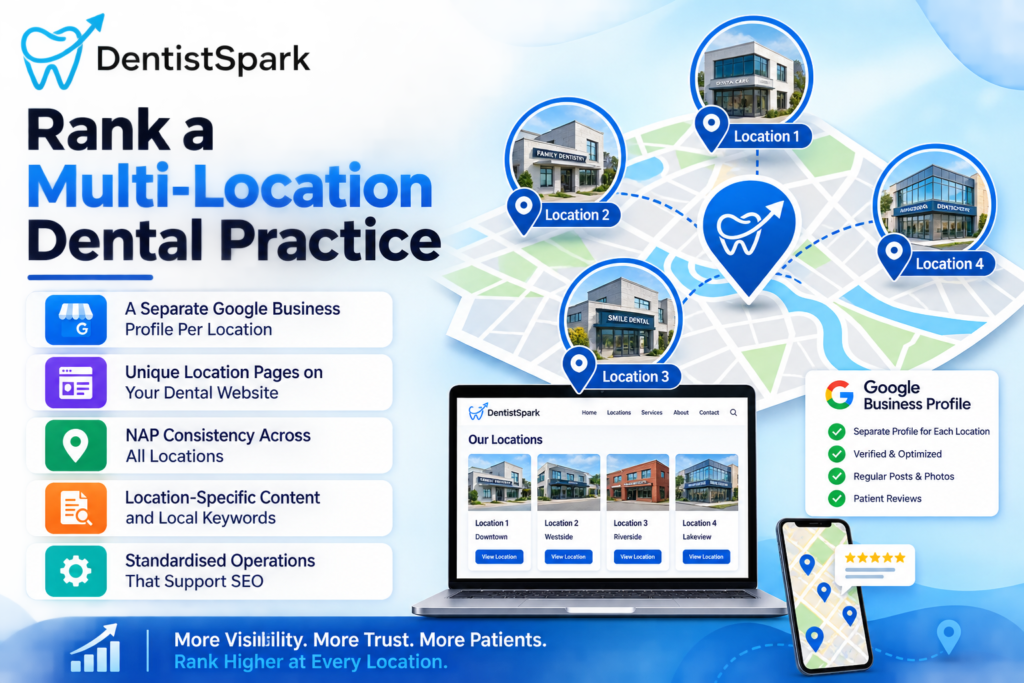
Each dental office must have its own verified Google Business Profile. A single group profile doesn’t allow Google to serve the nearest location to local searchers. Each profile needs accurate hours, dental services listed individually, and photos of that location’s team and space. Flexible hours are essential given Toronto’s traffic and busy schedules.
The Map Pack receives approximately 42% of patient clicks for local dental searches. Each location must earn its own Map Pack position. That requires its own profile, its own reviews, and its own consistent management. Respond to all reviews on each profile — a cohesive team approach to review management produces the consistent review velocity that Google rewards.
Ontario Clinics: Testimonials and RCDSO Compliance
If your dental offices are in Ontario, note that the RCDSO prohibits posting patient testimonials on clinic websites and social media operated by the practice. Use Google star ratings and review counts as social proof on your location pages instead of embedded patient testimonials. See our guide to dental advertising rules in Canada for the full compliance picture.
Key Strategy 2: Unique Location Pages on Your Dental Website
Every location needs a dedicated page on the group’s dental website — not a directory listing. Each location page should include the complete NAP information, a description of dental services offered at that office, team bios specific to that location, and neighbourhood-specific content.
For a Toronto dental clinic operating across multiple neighbourhoods, this means a page for ‘Dentist in Leslieville,’ a separate page for ‘Dentist in North York,’ and so on. These pages compete for neighbourhood-level searches where competition is lower and patient intent is high.
Seamless record sharing and cloud-based technology streamline operations for multi-location dental practices. The same infrastructure that enables consistent patient care — shared patient records, standardised protocols, coordinated scheduling — also supports more efficient, coordinated SEO management across locations.
Key Strategy 3: NAP Consistency Across All Locations
NAP — name, address, phone number — must be consistent and accurate across every directory for every location, including Google, Yelp, RateMDs, Yellow Pages, the Canadian Dental Association directory, and provincial dental college listings.
Conduct a citation audit for each location when setting up multi-location SEO. Correct inconsistencies before building new citations. Centralising citation management — using one system to monitor and update all locations — reduces administrative burden and prevents the NAP drift that occurs when locations update contact details without coordinating across directories.
Key Strategy 4: Location-Specific Content and Local Keywords
Each location page needs content that reflects the unique characteristics of its local area — neighbourhood references, local landmarks, transit directions, and the dental services most relevant to that patient population.
Optimising for localised keywords — ‘pediatric dentistry Scarborough,’ ’emergency dental North York,’ ‘toronto dentist Yorkville’ — allows each location to compete for the searches most relevant to its patient base without cannibalising the group’s other locations. Expert team members at each location can contribute to location-specific content through team bios and clinical commentary.
Key Strategy 5: Standardised Operations That Support SEO
Operational consistency directly affects local search rankings. Standardising patient care protocols across all dental offices ensures consistent service quality regardless of which location a patient visits. Consistent quality drives consistent reviews. Consistent reviews drive consistent rankings.
Cloud-based technology streamlines scheduling and communication across multiple locations. Regular training ensures consistent quality of care. A cohesive team that applies the same patient care standards produces the consistent online reputation that multi-location practices need to rank well in multiple local markets simultaneously.
Managing Reviews Across Multiple Dental Offices
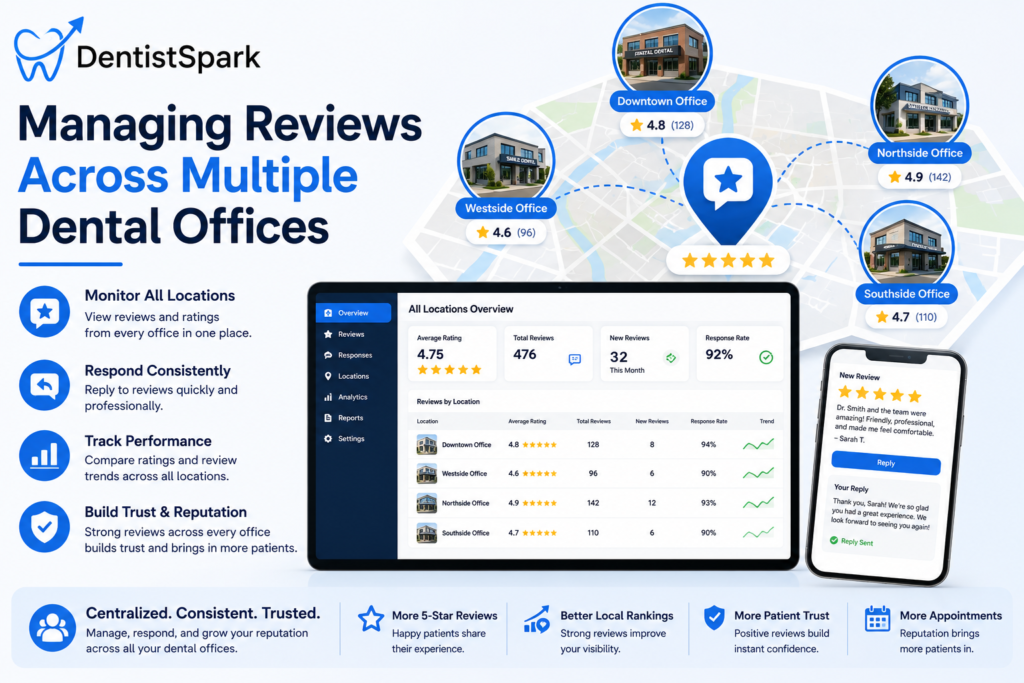
Each location needs its own review generation process — asking patients for Google reviews after appointments, monitoring incoming reviews daily, and responding to every review within 24 to 48 hours.
Building relationships with staff members at each location to champion review generation ensures the process runs without centralised management having to chase each location individually. Each dental office should maintain a steady cadence of new reviews — recency matters as much as volume in local search rankings.
Why Dentist Spark for Multi-Location Dental Practice SEO
Dentist Spark works exclusively with dental practices across Canada. We build multi-location SEO strategies that treat each dental office as a distinct local market while maintaining group-level brand consistency and authority signals.
Our expert team manages Google Business Profile optimisation, location page development, citation management, and review strategy across multiple locations — coordinated as a single system rather than disconnected campaigns. For Toronto dental clinics and Canadian dental groups expanding to new patients across multiple locations, we build the SEO infrastructure that makes each location rank where it needs to.
Managing Multiple Dental Locations and Struggling to Rank?
Book a free strategy session with Dentist Spark. We’ll audit each of your dental offices, identify the SEO gaps holding specific locations back, and build a coordinated multi-location strategy that generates new patients across all of them.
→ Book Your Free Strategy Session at DentistSpark.com
Frequently Asked Questions
How do multi-location dental practices rank in local search?
Each dental office needs its own Google Business Profile, unique location page, and citation profile across local directories. Shared group-level strategy — consistent authority signals, standardised protocols, coordinated review management — amplifies each location’s individual local signals. The combination of location-specific and group-level SEO is what drives rankings across multiple dental offices simultaneously.
What is the biggest SEO mistake for multi-location dental practices?
Publishing identical content across multiple location pages with only the city name changed. When Google encounters near-identical pages, it may choose to index only one — reducing the group’s total local search footprint. Each location page needs genuinely unique content specific to that office’s team, dental services, neighbourhood, and patient community. A page for a dental clinic in Leslieville and one in North York should read as completely different pages.
Does each dental office need its own Google Business Profile?
Yes. Each dental office in a multi location practice must have its own verified Google Business Profile. A single group profile doesn’t allow Google to serve the nearest location to local patients. Each profile needs accurate hours, location-specific dental services, photos of that clinic’s team and space, and its own consistent stream of patient reviews.
How should a multi-location dental practice manage patient reviews?
Each location needs its own review generation process. Staff at each dental office should request Google reviews after appointments and respond to all reviews within 24 to 48 hours. Centralising review monitoring using one dashboard allows the group to identify reputation issues at any location before they affect search rankings or new patient acquisition.
What are the key strategies for ranking a dental practice with multiple locations in Toronto?
Toronto’s competitive dental market requires neighbourhood-level keyword targeting for each location. Key strategies include a verified Google Business Profile per office, unique location pages targeting neighbourhood-specific search terms, NAP consistency across directories, location-specific patient reviews, and dental services content tailored to each neighbourhood’s patient demographics. Flexible hours at each Toronto location also improve Map Pack visibility for time-sensitive searches.
Conclusion
Ranking a multi-location dental practice requires treating each dental office as its own local business — with its own Google Business Profile, unique content, citation profile, and review management process. The group-level strategy provides the authority signals and brand consistency that amplifies each location’s individual signals.
Dentist Spark builds and manages those systems for Canadian dental groups. If your multi location practice isn’t ranking where it should across all locations, a coordinated SEO strategy is where the change needs to start.