Introduction
Nearly 73% of U.S. adults report some degree of dental fear, according to a 2025 JADA study. Patients arrive at a dental landing page carrying questions about their oral health — and their hesitation. If the landing page doesn’t address that hesitation before asking for a booking, they leave. Most dental landing pages list dental services, feature a clinic photo, and close with a contact form. What they don’t do is answer the five questions every prospective patient silently asks. This guide helps website visotrs identify each objection and the specific landing page design element that resolves it.
Key Takeaways
✓ Most dental landing pages describe services well — but patients leave because their hesitation wasn’t addressed.
✓ The five objections that kill dental conversions: pain, cost, trust, booking clarity, and relevance.
✓ Nearly 73% of adults fear the dentist — a good landing page addresses anxiety before asking for a booking.
✓ Ontario dental clinics: RCDSO prohibits patient testimonials on clinic websites — use Google ratings as social proof instead.
✓ Each objection maps to a specific landing page design element — matching element to objection is what converts.
Objection 1: Is This Going to Hurt? — Landing Page Design for Anxious Patients
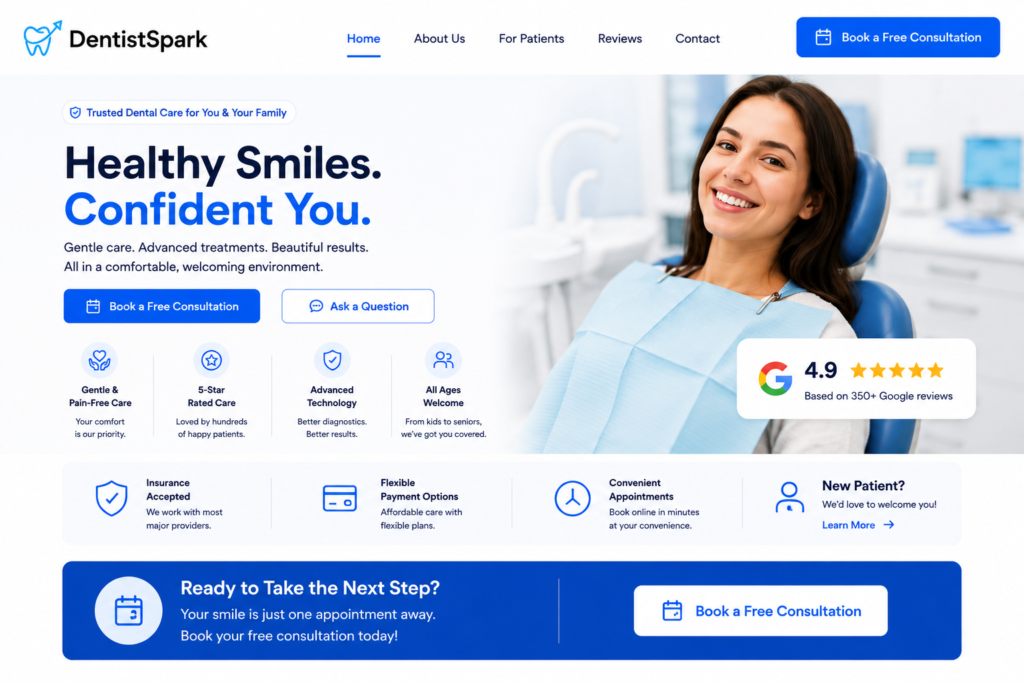
Pain is the primary reason patients avoid dental care. A good landing page leads with reassurance — in the headline or subheading, visible without scrolling. ‘We see nervous patients every day. We go at your pace.’ This signals the hesitation has been anticipated.
For sedation dentistry and dental surgery landing pages, lead with the outcome the patient wants: ‘Have the dental work you’ve been avoiding — without the anxiety.’ Include sedation options clearly. Use real team photos rather than stock photos — approachable faces reduce anxiety before a word is read.
• Above-the-fold reassurance — address anxiety before describing the dental service
• Sedation options clearly listed — what each level involves and how patients typically feel
• Real team photos not stock photos — actual faces of the dentists and staff patients will meet.
Objection 2: Can I Afford This? — Call to Action and Fee Framing
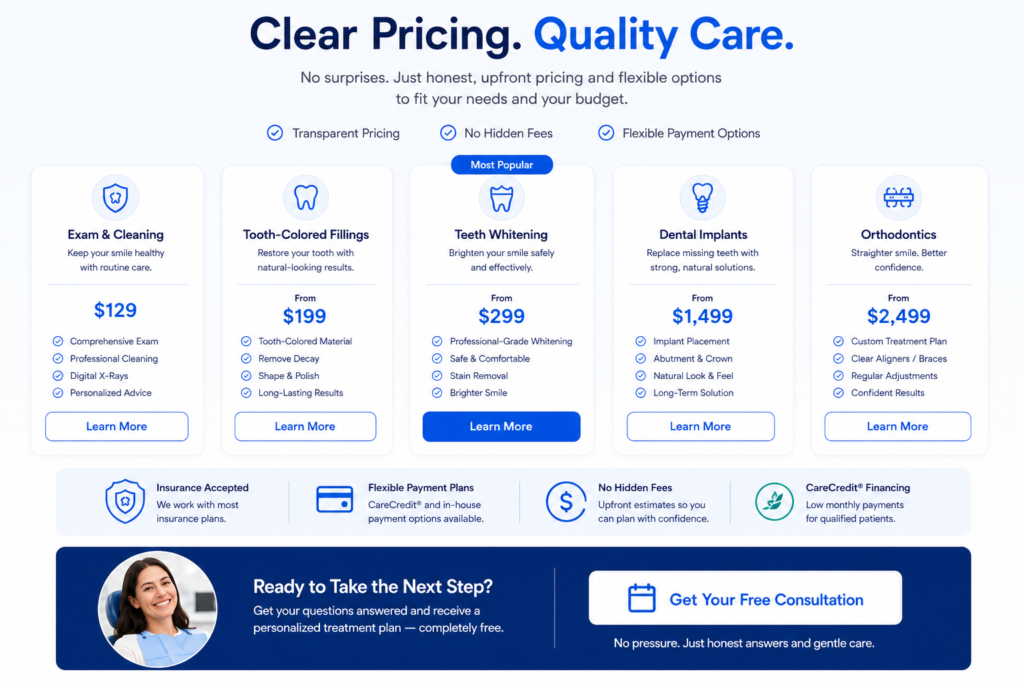
Cost anxiety is the second most common reason patients delay dental bookings. When a dental landing page makes no mention of fees, insurance, or payment options, patients fill that silence with worst-case assumptions. A good landing page addresses cost near the call to action.
For Ontario dental clinics: the RCDSO requires that advertised fees reflect the actual maximum cost of the service. Any fee or range mentioned on a dental landing page must be complete and accurate. See our full guide to dental advertising rules in Canada for the complete compliance picture.
• Insurance acceptance statement — name the major plans you accept, near the call to action
• Payment plan information — even one sentence reduces financial hesitation
• Free consultation offer — frames the first step as zero-commitment for new patients
Objection 3: Do I Trust This Practice? — Social Proof on a Good Landing Page
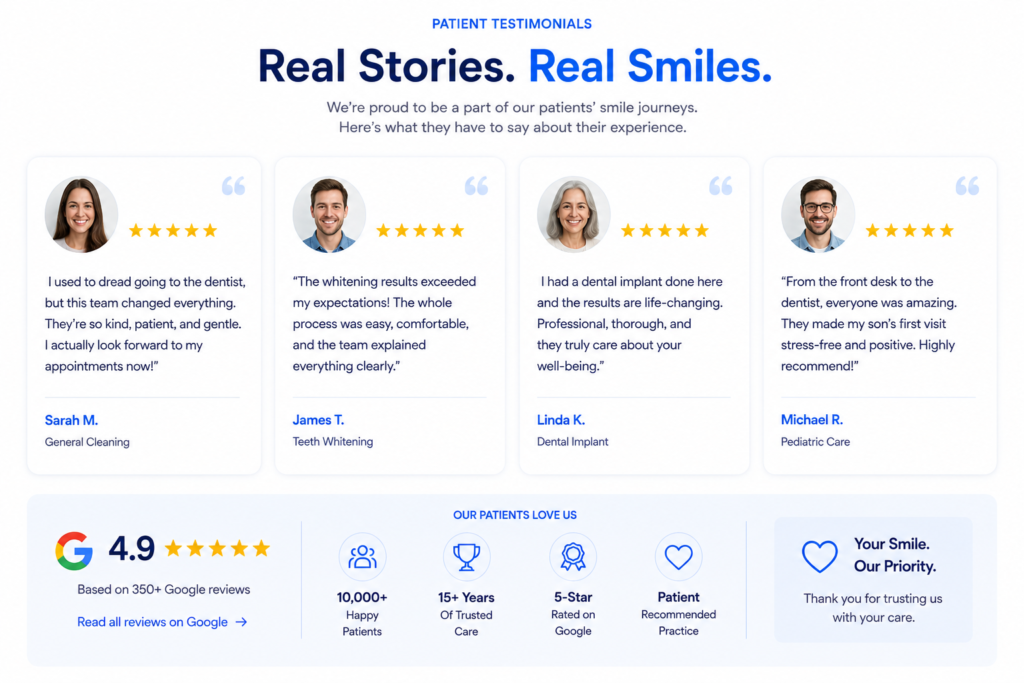
A patient who doesn’t recognise your dental clinic has no baseline trust. Your dental landing page must build it quickly. Good landing page design places trust signals in the first visible section. Your Google star rating with review count — displayed prominently — is more persuasive than any marketing copy.
Ontario Clinics — RCDSO Compliance on Testimonials
The RCDSO prohibits posting patient testimonials on clinic websites and social media operated by the practice. Display your Google star rating, review count, and a link to your Google Business Profile instead. This approach builds trust compliantly for Ontario dental clinics.
• Google star rating and review count — prominently displayed, linked to your Google Business Profile
• Professional credentials and registrations — dental college registration, specialist designations
• Real clinic photos — not stock photos; actual images of the space patients will visit
Objection 4: How Do I Actually Book? — Call to Action and Form Design
77% of patients prefer providers that offer online scheduling, yet most dental landing pages bury their contact form below the fold. A good landing page design places the call to action and booking form above the fold — visible without scrolling on desktop and mobile. More elements below the fold serve returning visitors; new patients need the call to action immediately.
Ask for the minimum in the form: name, phone number, preferred time. Every additional field reduces completion rates. A click-to-call button for mobile visitors captures patients ready to act immediately without filling out a form.
• Above-the-fold call to action — visible without scrolling on all devices
• Click-to-call button — large, tappable, visible on mobile
• Response time expectation — ‘we’ll call you back within one business hour’
Objection 5: Is This Right for My Situation? — Dental Service-Specific Landing Pages
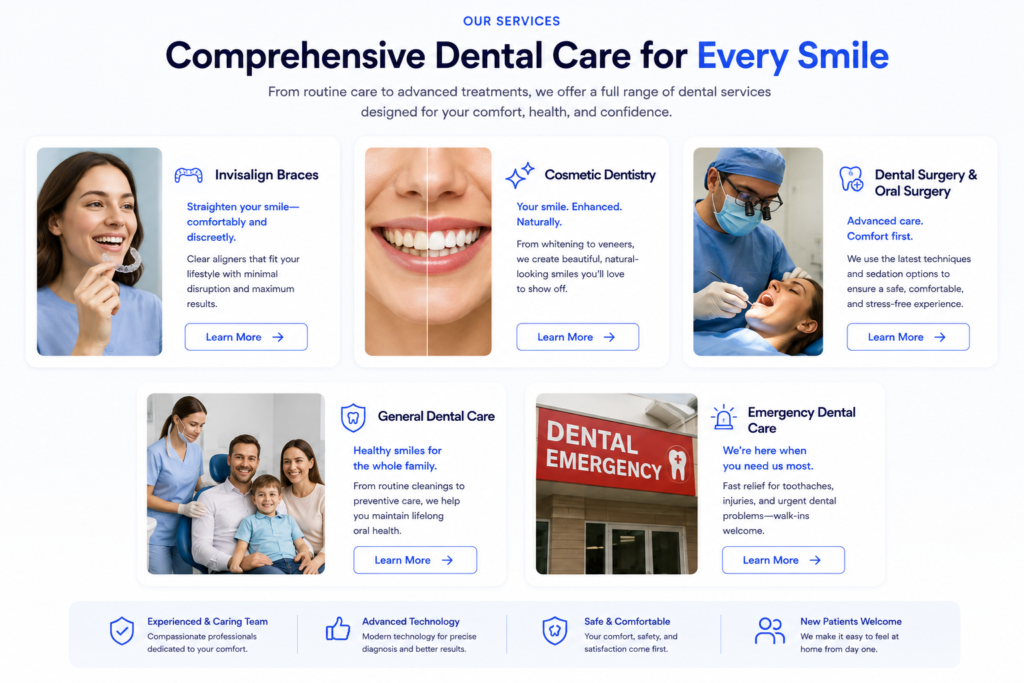
A patient searching for ‘Invisalign braces for adults’ is a different patient from one searching ‘cosmetic dentistry Toronto.’ Both might land on the same generic page — and the generic page answers neither precisely. A good landing page has one job, serves one type of patient, and promotes one dental service.
Each dental service needs its own dedicated page. For Invisalign braces, address comfort, visibility, and cost. For dental surgery, address pain management and sedation. For dental implants, address permanence and candidacy. Specificity is what converts.
• Invisalign braces — addresses adult hesitation about visibility and comfort
• Cosmetic dentistry — leads with outcomes and before/after results
• Dental surgery and oral surgery — addresses pain management and sedation upfront
• General dental care — focuses on new patients, cleanings, and family services
• Emergency dental — focuses on same-day availability and immediate pain relief
Landing Page Design: Templates, Builders, and What to Avoid
Good landing page design doesn’t require coding from scratch. Landing page templates designed for dental clinics let you build landing pages quickly. A free landing page builder gives smaller dental offices access to professional landing page design without large upfront costs. There are many tool options — from drag-and-drop builders to fully custom development. For practices new to landing pages, a template is the fastest way to launch. Customize it with brand assets, real photos, and service-specific content.
Toronto dental practices, for example, often highlight neighbourhood-specific dental services — ideas that give potential customers an immediate sense of relevance. The benefits of template-based landing pages are speed and structure. The most common mistake: adding more elements than necessary. A good landing page removes anything that doesn’t resolve one of the five patient objections above.
Why Dentist Spark for Dental Landing Page Design
Dentist Spark builds dental landing pages for Canadian dental clinics structured around patient psychology and RCDSO compliance. We map the specific objections relevant to each dental service and build the landing page design elements that resolve them.
For practices driving paid traffic to landing pages that aren’t converting new patients, the problem is almost always an unanswered objection. Our landing page audits identify which objection is driving abandonment and rebuild the page to address it.
Is Your Dental Landing Page Leaving Patient Objections Unanswered?
Book a free landing page audit with Dentist Spark. We’ll review your current pages, identify which patient objections are driving abandonment, and show you the specific landing page design fixes that recover those lost bookings.
→ Book Your Free Audit at DentistSpark.com
Frequently Asked Questions
What makes a good landing page for a dental clinic to attract new patients and book dental services?
A good landing page addresses the five patient objections before asking for a booking: pain and anxiety, cost and insurance, trust and credibility, how to book, and whether the service matches their situation. Good landing page design places the call to action above the fold, uses real photos rather than stock photos, and keeps the booking form to minimum required fields. Each dental service needs its own dedicated landing page.
Which landing page design elements and more elements convert dental patients most effectively?
The elements that most directly convert dental patients are: an above-the-fold call to action with a simple booking form, a visible Google star rating and review count, a headline addressing the patient’s specific concern, transparent fee framing near the call to action, and real photos of the dental team and clinic. A focused landing page that resolves the five core objections consistently outperforms one with more elements but less clarity.
Can Ontario dental clinics use patient testimonials on landing pages?
The RCDSO prohibits Ontario dental clinics from posting patient testimonials on clinic websites and social media operated by the practice. Use your Google star rating and review count with a link to your Google Business Profile instead. This approach delivers the same social proof compliantly. See our guide to dental advertising rules in Canada for the full picture.
Do dental practices need separate landing pages for Invisalign braces and cosmetic dentistry?
Yes. A landing page for Invisalign braces serves a different patient with different objections than a cosmetic dentistry landing page. Invisalign patients want to understand comfort, visibility, and how the process compares to traditional braces. Cosmetic dentistry patients want to see outcomes and understand which treatments suit them. Separate landing pages allow each service’s specific objections to be addressed precisely and improve Google Ads quality scores.
Should I use landing page templates, a free landing page builder, or custom landing page design?
A free landing page builder gives smaller dental clinics a functional starting point without high development costs. Most offer landing page templates customisable with brand assets and real photos. The limitation is design flexibility and integration with practice management systems. For high-traffic paid campaigns targeting dental services like implants or dental surgery, a professionally designed landing page built around patient objections typically delivers stronger new patient conversion rates.
Conclusion
A dental landing page that doesn’t convert isn’t failing because patients don’t want dental care. It’s failing because the landing page design didn’t answer the question stopping them from booking. Every unanswered objection is a patient who left.
Build the five landing page design elements that resolve each objection — pain, cost, trust, booking clarity, and relevance — and the page stops describing your dental services and starts converting new patients consistently.