Dental SEO and dental PPC are both strategies for getting your practice in front of patients on search engines — but they work differently, cost differently, and deliver results on completely different timelines. Understanding the distinction is one of the most important decisions a dental practice owner can make when building a digital marketing budget.
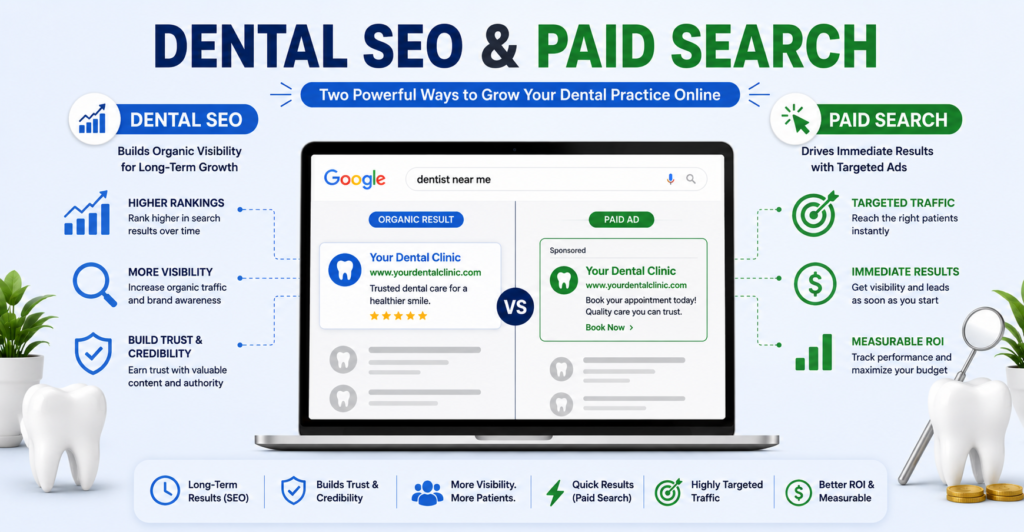
SEO — search engine optimization — earns your practice visibility in organic search results through content, technical website improvements, and authority signals built over time. PPC — pay per click — purchases visibility through paid ads that appear at the top of the search engine results page immediately. Both have a legitimate role in a dental marketing strategy. The question is knowing which one to prioritise, when, and why.
What Is Dental SEO and How Does It Work?
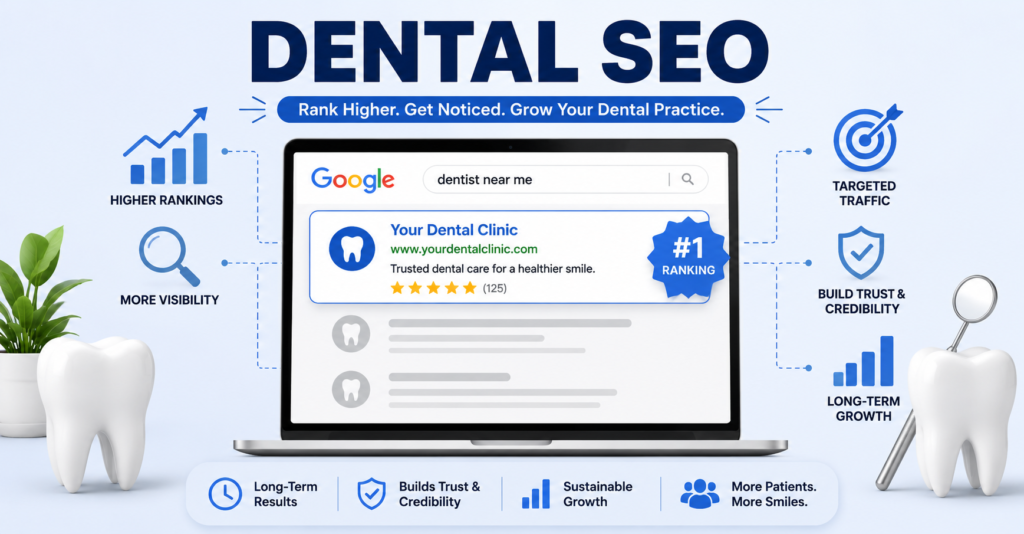
Dental SEO is the long-term strategy of improving where your dental practice appears in organic search results — the unpaid listings that appear below any paid ads on a search engine results page. It involves keyword research to understand what your patients are searching for, on-page optimisation of your dental website, technical improvements that help search engines crawl and index your content, and off-page signals like backlinks and Google Business Profile authority.
The goal of dental SEO is to make your practice the most relevant and trustworthy result for the searches your target patients are running — ‘family dentist in Kelowna,’ ‘dental implants cost Vancouver,’ ’emergency dentist open Sunday Calgary.’ These are high-intent searches from patients who are ready to book, and organic rankings capture that demand without paying for each click.
Because SEO builds authority gradually, the results compound over time. A dental practice that invests consistently in search engine optimization for 12 to 18 months typically generates a growing stream of organic traffic and new patient inquiries that continues to deliver return long after the initial investment.
Organic search consistently delivers one of the lowest long-term costs per new patient acquisition for dental practices — but it requires patience and consistent investment before those results become significant.
Core Components of Dental SEO
• Keyword research to identify the search queries your local patients use most
• On-page optimisation of page titles, headings, content, and internal linking structure
• Technical SEO including site speed, mobile performance, and structured data
• Content creation — service pages, blog posts, and FAQs that answer patient questions
• Google Business Profile optimisation for local search visibility and Google Maps rankings
• Link building to build domain authority through credible external references
• Google Analytics tracking to measure organic traffic, rankings, and patient conversions
What Is Dental PPC and How Does Pay Per Click PPC Work?
PPC advertising — pay per click — is a form of paid search advertising where your dental practice pays each time a patient clicks one of your ads. In dental marketing, this almost always means Google Ads, though Bing Ads and social media ads on platforms like Facebook and Instagram also fall under the broader PPC umbrella.
With Google Ads, you create campaigns targeting specific search queries — ‘dentist near me,’ ‘teeth whitening Toronto,’ ‘Invisalign consultation.’ When a patient runs one of those searches, your ads appear at the top of the search results page, above organic results, marked as sponsored. You pay a cost per click (CPC) each time someone clicks through to your landing page.
Unlike dental SEO, PPC advertising delivers immediate visibility. The moment your Google Ads account is active and your ppc campaigns are live, your practice can appear at the top of search results for your target keywords. That speed makes PPC valuable for new practices, for filling short-term appointment gaps, and for promoting specific high-value procedures quickly.
How Google Ads Determines Where Your Ads Appear
Google doesn’t simply award the top ad position to the advertiser with the highest maximum CPC bid. Instead, it calculates an ad rank based on your bid, your quality score, and the expected impact of your ad format. Quality score reflects how relevant your ad copy is to the search query, how well your landing pages match user intent, and your historical user engagement data.
This means a dental practice with a modest ad spend but highly relevant, well-structured campaigns can outrank a competitor spending significantly more but running generic ads to poorly optimised landing pages. Good ppc advertising is as much about relevance and structure as it is about budget.
Key Elements of a Well-Structured Dental PPC Campaign
• Ad groups organised tightly around specific services — one ad group per procedure rather than one campaign for everything
• Relevant keywords matched carefully to patient search queries with appropriate match types
• Negative keywords to prevent wasted spend on irrelevant searches that won’t convert to appointments
• Compelling ad copy that addresses the patient’s need directly and includes a clear call to action
• Optimised landing pages that match the ad’s promise and make booking frictionless
• A clear bidding strategy aligned with your advertising cost targets and patient acquisition goals
• Conversion tracking connected to your Google Analytics account to measure actual bookings, not just clicks
Dental SEO vs PPC: A Direct Comparison
Cost Structure and Budget Implications
Dental SEO requires upfront investment in content, technical improvements, and ongoing optimisation — but the traffic it generates doesn’t cost per click. Once your practice earns strong search rankings, those positions generate patient inquiries without ongoing per-visit costs. The investment is in building authority, not buying each visitor.
PPC advertising works the opposite way. You pay for every click, every time. In competitive dental markets, cost per click for high-value search terms — ‘dental implants,’ ‘cosmetic dentist,’ ’emergency dentist’ — can range from $5 to $30 or more per click. A monthly ad spend of $1,500 to $5,000 is typical for dental practices running meaningful paid search campaigns in mid-to-large Canadian cities. When the budget stops, the visibility stops immediately.
Timeline to Results
PPC delivers results from day one. Set up your Google Ads account, build your campaigns, go live, and your practice can appear at the top of search results within hours. This immediacy is genuinely valuable for specific scenarios — a new practice with no organic presence, a promotional push for a new service, or covering a period when SEO rankings are being rebuilt after a website migration.
Dental SEO takes longer — typically three to six months before rankings begin to move meaningfully, and six to eighteen months to achieve competitive top-three positions for high-volume local search terms. The trade-off is that those rankings, once earned, are durable. They don’t disappear when you reduce your monthly investment the way paid ads do.
Long-Term Value and Sustainability
The compounding nature of SEO is its defining advantage over paid ads. Content created today continues to rank and attract patients months and years later. Authority built through consistent link building accumulates over time. A dental practice that invests seriously in search engine optimization for two to three years builds a search presence that is genuinely difficult for new competitors to replicate quickly.
PPC has no such compounding effect. Every dollar of ad spend delivers return only while it’s being spent. A competitor who outbids you tomorrow captures the position you held today. This doesn’t make PPC less valuable — it makes it strategically different, better suited to short-term objectives than to building long-term search visibility.
Search Visibility and Brand Awareness
PPC ads appear above organic results and can dominate the top of the search results page — but many experienced searchers scroll past paid ads deliberately, with studies suggesting that organic results earn significantly higher click-through rates for most non-transactional queries. Appearing in both paid and organic positions simultaneously — through a combined SEO and PPC strategy — maximises your total share of the search results page and reinforces brand visibility with patients who see your practice twice on one search.
The Role of Keywords in Dental SEO vs Paid Search
Keyword Research for Dental SEO
Effective keyword research for dental SEO maps the full range of search queries your patients use across every stage of their journey — from early research (‘how much does a crown cost’) to ready-to-book queries (‘dentist accepting new patients Burnaby’). Long tail keywords — specific, multi-word phrases with lower search volume but higher conversion intent — are particularly valuable in dental SEO because they’re less competitive and attract patients who are closer to booking.
The best keywords for SEO are those with sustainable monthly search volume, meaningful local intent, and realistic ranking potential given your current domain authority. A thorough keyword list for a dental practice typically includes dozens of terms across general dentistry, specific procedures, local area variations, and informational queries — each mapped to a specific page or content piece on your website.
Keyword Strategy for Paid Search Ads
PPC keyword strategy is more immediate and more granular. You’re building a keyword list that captures high-intent search queries and organising them into tightly themed ad groups — one ad group for dental implants queries, a separate one for teeth whitening, another for emergency dentist searches. This structure allows your ad copy to be highly specific to each search query, which improves quality score and reduces cost per click.
Negative keywords are equally important in paid search. Without them, your ads can appear for irrelevant search queries — ‘dental assistant jobs,’ ‘free dental care,’ ‘DIY teeth whitening’ — generating clicks that cost money but never convert to patient bookings. Careful negative keyword management is one of the most impactful ways to reduce wasted spend in a dental Google Ads account.
Landing Pages: Why They Matter More in PPC Than SEO
In dental SEO, traffic from organic search typically lands on your main service pages — well-optimised pages that also serve as information resources for patients and crawling tools for search engines. They serve dual purposes.
In paid search advertising, dedicated landing pages are essential. A patient who clicks a paid search ad for ‘dental implants consultation Toronto’ should land on a page focused entirely on that offer — with a clear headline matching the ad, a concise explanation of what’s included, patient testimonials, and a prominent booking form. No distracting navigation. No competing calls to action.
The alignment between your paid ads and their destination URL is a direct quality score factor in Google Ads. Better-matched landing pages produce higher quality scores, which reduces your cost per click and improves your ad rank. Dental practices that send all their paid search traffic to a generic homepage leave significant conversion potential — and money — on the table.
When to Use Dental SEO, When to Use PPC, and When to Use Both
Prioritise Dental SEO When
• You’re building long-term, sustainable patient acquisition that doesn’t depend on ongoing ad spend
• You want to rank for a wide range of search queries across all your services and locations
• Your practice is established and you have a 12 to 18 month horizon for results
• You want to build brand visibility and authority that compounds over time
Prioritise Paid Ads When
• You’re a new practice with no organic search presence and need patients immediately
• You’re promoting a specific high-margin service — dental implants, Invisalign, cosmetic procedures
• You need to fill appointment gaps quickly during a slow period
• You’re entering a new service area and want immediate visibility while SEO builds
Use Both When
The most effective dental marketing strategy for most established practices combines both channels. SEO builds the durable long-term foundation. PPC fills the gaps, accelerates growth during key periods, and captures high-intent patients for specific procedures. Running both simultaneously means your practice appears multiple times on one search — in paid positions and organic results — reinforcing trust and maximising your total share of patient attention.
Google Analytics data from your PPC campaigns can also directly inform your SEO strategy. The search queries driving the most clicks and conversions in paid search reveal exactly which organic keywords are worth prioritising in your content and on-page optimisation work. The two channels, managed well, make each other more effective.
Dental practices that run coordinated SEO and PPC strategies consistently outperform those relying on one channel alone — both in total patient acquisition volume and in cost efficiency over 12 to 24 months.
Other Forms of Dental Online Advertising Worth Knowing
Google Ads and Bing Ads represent the core of dental search engine advertising — but they’re not the only forms of paid advertising available to dental practices. As patient search behavior continues to evolve across multiple search platforms and social media platforms, a broader understanding of the online advertising landscape helps practice owners make smarter budget decisions.
Social Ads on Facebook and Instagram
Social ads on platforms like Facebook and Instagram operate differently from paid search. Rather than targeting patients based on what they’re actively searching for, social ads target audiences based on demographics, interests, location, and online behavior. For dental practices, this makes social ads effective for building awareness among prospective patients who aren’t actively searching yet — particularly for elective procedures like cosmetic dentistry, Invisalign, and teeth whitening where a compelling visual can prompt interest before the patient has even considered the treatment.
Social ads work best when paired with strong video content or high-quality imagery that communicates your practice’s environment, team, and patient experience. A short video walkthrough of your clinic or a before-and-after treatment result resonates on social platforms in a way that text ads alone cannot achieve.
Video Ads on YouTube and Beyond
Video ads — primarily through YouTube, which is owned by Google — give dental practices access to a large, engaged audience at a relatively low cost per view compared to search advertising. Video content builds familiarity and trust in a way that no text-based format can fully replicate. A 30-second video explaining what to expect at a first appointment, or introducing your dental team, can meaningfully reduce patient anxiety and increase the likelihood of a booking when that patient later encounters your practice in Google Search.
YouTube video ads can be targeted by location, age, interests, and even specific search behavior on the platform — making them a practical option for practices looking to build brand visibility in their local market beyond traditional search results.
Display Ads and Remarketing
Display ads appear across the Google Display Network — millions of websites, apps, and online platforms — using the display URL and visual creative to keep your dental practice in front of patients who have previously visited your website but haven’t yet booked. This form of online advertising, often called remarketing, is particularly useful for dental practices promoting higher-consideration treatments like dental implants or orthodontics, where patients typically research across multiple URLs and sessions before making a decision.
Amazon Ads are less relevant for dental services directly, but the broader principle they represent — ads based on demonstrated intent signals — is increasingly applied across search platforms. Staying up to date on how intent-based advertising evolves across these platforms is part of what separates reactive dental marketing from a truly proactive strategy.
Which Online Advertising Channels Are Right for Your Practice?
Not every dental practice needs to be active across every online advertising channel. For most, Google Ads remains the highest-priority paid channel because it captures patients at the exact moment they’re searching for dental care. Social ads and video ads layer on top of that foundation — building awareness and familiarity that makes your Google Search ads more effective when patients encounter them.
The right mix depends on your budget, your target patient demographic, and the procedures you’re prioritising. A practice focused on growing its cosmetic dentistry caseload will benefit from a different channel balance than one primarily focused on general family dentistry. Getting that mix right — and keeping it up to date as search behavior shifts — is where an experienced dental marketing partner adds the most value.
Why Choose Dentist Spark for Dental SEO and PPC Advertising
Dentist Spark works exclusively with dental practices across Canada. We understand the competitive dynamics of dental search engine marketing in every major Canadian market — from high-competition urban centres like Toronto and Vancouver to growing mid-sized cities where local practices have a genuine opportunity to dominate local search results with the right strategy.
We don’t offer generic digital marketing packages. Every engagement starts with a thorough keyword research analysis of your specific local market, a review of your current search rankings and paid search performance, and a clear recommendation on whether SEO, PPC, or a combination of both is the right investment for your practice at this stage of growth.
Whether you need a complete search engine optimization strategy, a Google Ads account built and managed from scratch, or an integrated approach that coordinates both channels, Dentist Spark delivers strategies measured against one outcome: more patients booked, more consistently.
Frequently Asked Questions
What is the main difference between dental SEO and paid search ads?
Dental SEO earns visibility in organic search results through content quality, technical website improvements, and authority signals built over time — you don’t pay per click for that traffic. Paid search ads purchase immediate visibility at the top of the search engine results page through a cost per click model — your practice appears instantly but only while your ad spend is active. SEO delivers compounding long-term value; paid ads deliver immediate, controllable, short-term visibility. Most dental practices benefit from both, used strategically.
How much does Google Ads cost for a dental practice?
Google Ads costs for dental practices vary significantly by market, competition, and the procedures being advertised. In major Canadian cities, cost per click for competitive dental search terms typically ranges from $5 to $30 or more. A monthly ad spend of $1,500 to $5,000 is common for practices running meaningful paid search campaigns. High-value procedures like dental implants and Invisalign tend to have higher advertising costs but also higher returns per converted patient. The key metric isn’t ad spend — it’s cost per booked appointment, which depends heavily on the quality of your campaigns and landing pages.
How long does dental SEO take to show results?
Most dental practices begin to see measurable improvements in search rankings and organic traffic within three to six months of implementing a consistent SEO strategy. Competitive positions for high-volume search terms in major markets typically take six to eighteen months to achieve. The timeline depends on your starting domain authority, the competitiveness of your local market, and how comprehensively your SEO strategy is executed. Unlike paid ads, the results earned through SEO continue to deliver return well after the foundational work is complete.
What are the best keywords for dental PPC campaigns?
The best keywords for dental PPC campaigns are high-intent local search terms that capture patients who are close to booking — ‘dentist near me,’ ’emergency dentist open now,’ ‘dental implants consultation [city],’ ‘Invisalign provider [city].’ Long tail keywords — more specific phrases with lower search volume but higher conversion intent — often deliver better cost efficiency in paid search because they attract more qualified patients and face less competition. A thorough keyword research process, combined with careful negative keyword management to eliminate wasted spend, is essential for strong PPC performance.
Do I need separate landing pages for my dental Google Ads?
Yes — dedicated landing pages for paid search ads consistently outperform generic website pages in conversion rate. A patient who clicks an ad for ‘same day dental implants consultation’ should land on a page focused entirely on that offer, not your homepage. Landing pages built specifically for paid ads remove distractions, match the patient’s specific search intent, and make booking as easy as possible. This alignment also improves your quality score in Google Ads, which directly reduces your cost per click and improves your ad rank.
Conclusion
Dental SEO and dental PPC aren’t competing strategies — they’re complementary tools that serve different purposes in a comprehensive dental marketing plan. SEO builds the durable, compounding foundation of organic search visibility that generates patient inquiries over the long term. PPC provides the immediate, controllable visibility needed to fill appointment books now, promote specific services, and capture patients at the exact moment they’re searching.
Understanding the difference allows dental practice owners to make smarter budget decisions — investing in the right channel at the right time rather than defaulting to one approach and wondering why growth plateaus. The practices that grow most consistently in competitive markets are almost always the ones running both channels in a coordinated, data-informed way.
Dentist Spark helps Canadian dental practices build and manage both — with strategies grounded in real local market data, genuine search engine marketing expertise, and a clear focus on the outcome that matters most: more patients, booked consistently.
Not Sure Whether Your Practice Needs SEO, PPC, or Both?
Book a free strategy session with Dentist Spark. We’ll review your current search visibility, analyse your local competitive landscape, and give you a clear, honest recommendation on where to invest your dental marketing budget for the strongest return.